
Weekly Torah Studies for 2025/26 (5786).
On the road to Emmaus, Yeshua met with two of His disciples and, beginning at Moses and all the Prophets, He expounded to them in all the Scriptures the things concerning Himself. (Luke 24:27). For our Torah studies this year, therefore, week by week we will seek to discover how all of Torah prepared the way for the coming Messiah.
25th July 2026 (11 Av)
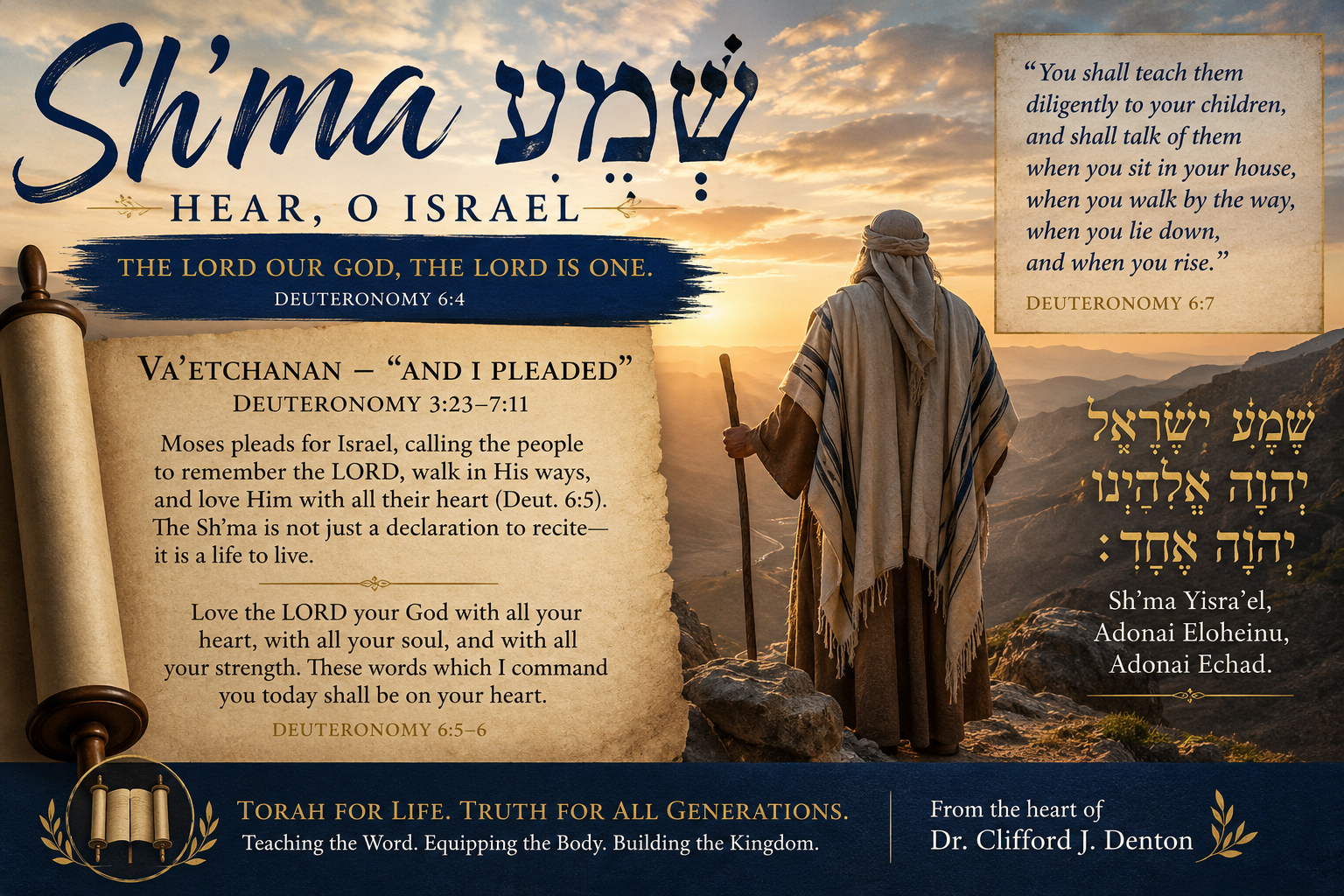
Va’etchanan (and I pleaded): Deuteronomy 3:23-7:11
It was a wonderful thing that Israel heard from Moses, recorded at the end of this week’s portion:
… you are a holy people to the Lord your God; the Lord your God has chosen you to be a people for Himself, a special treasure above all the peoples on the face of the earth. (Deuteronomy 7:6)
Who would not want to hear this and do their utmost for the God who so loved them? Oh that it was as easy as that!
It was clear that God’s love for Israel was not because of their own merit, but because of His covenant faithfulness:
The Lord did not set His love on you nor choose you because you were more in number than any other people, for you were the least of all peoples; but because the Lord loves you, and because He would keep the oath which He swore to your fathers, the Lord has brought you out with a mighty hand, and redeemed you from the house of bondage, from the hand of Pharaoh king of Egypt. (Deuteronomy 7:7-8)
The wonderful promise of God’s favour on His chosen people carries with it a warning - there are conditions which must be remembered. In particular, they must not follow false gods like other nations who are to be displaced and utterly destroyed to make room for them in the Land of Canaan. They will soon see a victory against these seven nations, but remember also a warning that they too can come under God’s judgement. The condition for God’s continued favour is obedience in keeping all that God has commanded them:
Therefore know that the Lord your God, He is God, the faithful God who keeps covenant and mercy for a thousand generations with those who love Him and keep His commandments; and He repays those who hate Him to their face, to destroy them. He will not be slack with him who hates Him; He will repay him to his face. Therefore you shall keep the commandment, the statutes, and the judgments which I command you today, to observe them. (Deuteronomy 7:9-11)
These passages from Moses’ teaching are to be remembered for all generations. It is why Moses repeated, at this time, the requirements of God for His people, founded on the Ten Commandments that were given so fearfully and memorably from Mount Horeb.
God promised so much to His chosen people, but within the expectation that they must not be tempted into following false gods and thereby also depart from His ways. The warning must be passed on and heeded by every generation:
For the Lord your God is a consuming fire, a jealous God. When you beget children and grandchildren and have grown old in the land, and act corruptly and make a carved image in the form of anything, and do evil in the sight of the Lord your God to provoke Him to anger, I call heaven and earth to witness against you this day, that you will soon utterly perish from the land which you cross over the Jordan to possess; you will not prolong your days in it, but will be utterly destroyed. And the Lord will scatter you among the peoples, and you will be left few in number among the nations where the Lord will drive you. And there you will serve gods, the work of men’s hands, wood and stone, which neither see nor hear nor eat nor smell. (Deuteronomy 4:24-28)
God will never forget the covenant He made with Abraham, and will provide a way back to Himself. Nevertheless, these words of warning are for all time.
The wonderful status of being the chosen people of God bears conditions and consequences.
In our portion this week is also the Shema, the foundational statement of faith for Israel, along with the command to teach every generation the way to walk with God (Halakhah):
Hear, O Israel: The Lord our God, the Lord is one! You shall love the Lord your God with all your heart, with all your soul, and with all your strength.
And these words which I command you today shall be in your heart. You shall teach them diligently to your children, and shall talk of them when you sit in your house, when you walk by the way, when you lie down, and when you rise up. You shall bind them as a sign on your hand, and they shall be as frontlets between your eyes. You shall write them on the doorposts of your house and on your gates. (Deuteronomy 6:4-9)
These direct quotations from Moses’ words are among the most important instructions God has ever given to His people, and Moses must have spoken deeply from the heart of a pastor to reiterate them to Israel at this time.
Soon Moses’ life would end and Israel would cross the Jordan. From then on, through every generation they must remember what they have been taught. This is why Torah is foundational to all the teaching of the Bible. Torah itself must then be interpreted into Halakhah, the way to walk to please God, for every generation.
Israel has indeed taken this command seriously, built families who teach their children and developed a rabbinic system that sought to interpret Torah to each generation. All this, and yet still there have hundreds of years of exile from the Promised Land, just as Moses warned. These are matters to be understood and for deep lessons to be learned.
God’s requirements for Israel and all who have joined them from the Gentile world, through faith in the God of Israel, still go on from generation to generation. They are called to be the holy people whose journey began with Moses, out of Egypt and with Joshua into the Promised Land.
The continuity of God’s covenant purposes continued seamlessly at the time of Yeshua HaMashiach and on into the era of the New Covenant. Each generation still needs to appropriately interpret Torah in their day, following God’s requirement at the time of Moses.
Yeshua did not change God’s requirements for Israel, but enabled them. He came to rightly interpret Torah. This was typified in His teaching on the Sermon on the Mount (Matthew 5-7) and it was the reason for such clear statements as:
Do not think that I came to destroy the Torah or the Prophets. I did not come to destroy but to fulfil. (Matthew 5:17)
Therefore whoever hears these sayings of Mine, and does them, I will liken him to a wise man who built his house on the rock. (Matthew 7:24)
In the manner of the Rabbis of His day, He gathered disciples, teaching them how to interpret Torah into a walk with God. Furthermore, His teaching was confirmed by wonderful miracles of deliverance and healing.
It was unfortunate, but also expected, that He was opposed by other Rabbis, as they sensed His usurping their position of authority. After all, in their own mind they were doing exactly what Moses commanded, to interpret Torah into Halakhah for the people. Yet, they did not realise that they were bringing control through their strict requirements, codified as they were into diverse systems of rabbinic Judaism. Yeshua, justifiably, was uncompromising in His warning about this as recorded, for example, as a series of woes in Matthew 23:
…..But woe to you, scribes and Pharisees, hypocrites! For you shut up the kingdom of heaven against men; for you neither go in yourselves, nor do you allow those who are entering to go in….
Such warnings were in accordance with Moses’ commands that Israel must live rightly by Torah or suffer consequences. Such consequences were already part of Israel’s history in the scattering of ten tribes following the invasion of the Assyrians and then the Babylonian captivity of Judah in 586 BCE. Yeshua followed the manner of warning the leaders of Israel that the earlier Prophets had brought, and was opposed in just the same manner.
Yet, there was something profoundly more special in the leaders of Israel’s opposition of Yeshua than in the case of any earlier Prophet. Their antagonism to the One who came to lead the way to the right interpretation of Torah led to the crucifixion of Yeshua, but this unknowingly was the means by which Yeshua sacrificed His life as the perfect Lamb of God to take away the sins of the world (Isaiah 53, John 1).
Yeshua followed Moses’ exhortations to Israel to rightly interpret Torah to each new generation and then became the sin offering for all who would accept His sacrifice by faith. He was both the perfect teacher and the One who covered the transgressions of those who could not perfectly keep the commandments of God given through Moses.
A new era began with Yeshua’s life and sacrificial death but in complete continuity of what God taught through Moses. The requirement of the people of God to be a Holy People continues today in the new framework of faith and obedience opened up by Yeshua. This is why the Apostles of Yeshua were to establish the new community of faith through right interpretation of Torah in light of Yeshua HaMashiach. This is enabled by the power of the Holy Spirit, whilst living through faith in Yeshua’s sacrifice that through grace we need not be under the curse of the law (Galatians 3:13). It is why pastors and teachers, in the light of the New Covenant, still have the commission that goes back to Moses to rightly interpret the teaching of God and to fulfil what was first stated by Moses, and then confirmed through Peter:
… you are a holy people to the Lord your God; the Lord your God has chosen you to be a people for Himself, a special treasure above all the peoples on the face of the earth. (Deuteronomy 7:6)
…..you are a chosen generation, a royal priesthood, a holy nation, His own special people, that you may proclaim the praises of Him who called you out of darkness into His marvellous light. (1 Peter 2:9)
Dr Clifford Denton
Founder and Director
Tishrei Bible School
