
Devarim (words), Deuteronomy 1:1-3:22
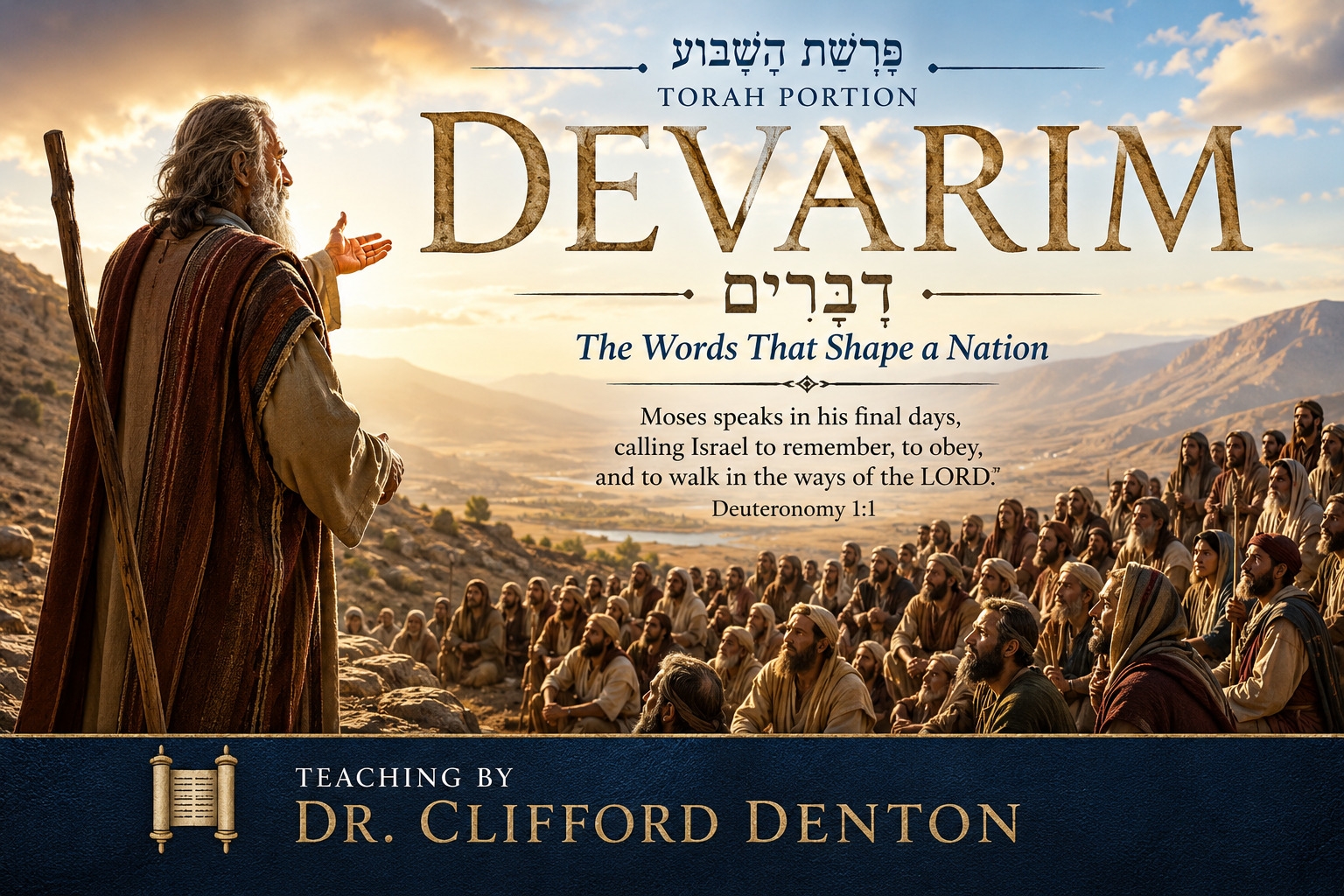
Weekly Torah Studies for 2025/26 (5786).
On the road to Emmaus, Yeshua met with two of His disciples and, beginning at Moses and all the Prophets, He expounded to them in all the Scriptures the things concerning Himself. (Luke 24:27). For our Torah studies this year, therefore, week by week we will seek to discover how all of Torah prepared the way for the coming Messiah.
18th July 2026 (4 Av)
Devarim (words), Deuteronomy 1:1-3:22
Almighty God ordained a period of thousands of years to complete the work of redemption since the banishment of Adam and Eve from the Garden of Eden. He has ordained only tens of years for the life of each human being. As Moses himself said:
The days of our lives are seventy years;
And if by reason of strength they are eighty years,
Yet their boast is only labour and sorrow;
For it is soon cut off, and we fly away. (Psalm 90:10-11)
Everyone completes their life’s work and the next generation takes their own responsibility, sometimes in continuity of ours. This has been so for thousands of years. In particular, the covenant purposes of God go forward from generation to generation.
Just as Moses prepared his people for his departure from this world, so did Yeshua, Moses in his imperfection, Yeshua in His perfection.
Our final Torah portions for this year, records Moses’ last words to Israel prior to his death. His lifespan was 120 years, but like everyone else his life came to an end.
It is good to reflect on the lives of those who went before, as well as our own life. It is how well we live that matters, and how we pass on our life’s contribution to the next generation.
Moses was a shepherd to his people within the prophetic ministry appointed by God. He was credited with being the humblest man on earth (Numbers 12:3). We have read the account of his lifelong journey, especially through the forty years since leading Israel out of Egypt. He had the great privilege of speaking with God face to face, as a man speaks to his friend (Exodus 33:11). He was patient with Israel and cared for them greatly as witnessed in his great intercession on their behalf after they had made the golden calf:
Moses said to the people, “You have committed a great sin. So now I will go up to the Lord; perhaps I can make atonement for your sin.” Then Moses returned to the Lord and said, “Oh, these people have committed a great sin, and have made for themselves a god of gold! Yet now, if You will forgive their sin—but if not, I pray, blot me out of Your book which You have written.” (Exodus 32:30-32)
Yet even this great man showed his anger for one moment in time, and did not give God honour, by striking a rock in the Wilderness of Zin twice in frustration:
Then the Lord spoke to Moses and Aaron, “Because you did not believe Me, to hallow Me in the eyes of the children of Israel, therefore you shall not bring this assembly into the land which I have given them.” (Numbers 20:12)
So here we are on the edge of the river Jordan. Here, Moses began his final pastoral message to Israel by recalling their journey from Egypt. The generation of the men of war who came out of Israel had died because of their lack of faith, when they were in the Wilderness of Paran. They were prohibited from entering Canaan. It was the next generation’s turn to take their responsibility as the covenant people of God. Their fathers died because of unbelief, but now it was their turn to be prepared for the next step.
They were already trained for battle. The experience of this generation in defeating Kings Sihon and Og, was sufficient experience for them to conquer Canaan:
And I commanded Joshua at that time, saying, ‘Your eyes have seen all that the Lord your God has done to these two kings; so will the Lord do to all the kingdoms through which you pass. You must not fear them, for the Lord your God Himself fights for you.’ (Deuteronomy 3:21-22)
Then followed Moses’ final words to this generation of the Children of Israel which we will study week by week, prior to Moses handing over authority to Joshua and dying on Mount Nebo. We will have the opportunity to reflect on the great ministry of Moses, tinged though it is with sadness concerning his error in striking the rock at the waters of Meribah.
Every generation of human beings comes and goes, passing on teaching and responsibilities, both small and great, to the next generation. It is so for us, as it always was throughout the thousands of years of history. The entire Bible brings us examples of the generations that have gone before us. The covenant purposes of God are fulfilled through God’s people. We can study many great lives and consider, even in Moses’ life, an inevitable imperfection in all humanity.
Adam and Eve displayed such imperfections in their fall from close fellowship with God. Even Noah, a great saviour of mankind through his obedience in building the Ark, was involved in an unfortunate incident when he was drunk, bringing a curse on Ham’s son Canaan (Genesis 9:24-25). Abraham is our great father of faith, but he was not without error. The birth of Ishmael and the consequences to world history are evidence of human weakness. Nevertheless, he grew in faith sufficiently to take his son to Mount Moriah as a sacrifice that was a foreshadowing of the Messiah’s sacrifice. So it goes on from generation to generation. Isaac did not discern God’s purposes through Jacob clearly enough to prevent enmity between Jacob and Esau. Jacob mismanaged his family sufficiently that Joseph was sold by his brothers to slavery in Egypt.
Jacob (Israel) summarised his life to Pharaoh as:
The days of the years of my pilgrimage are one hundred and thirty years; few and evil have been the days of the years of my life, and they have not attained to the days of the years of the life of my fathers in the days of their pilgrimage. (Genesis 47:9)
From generation to generation, human weakness and failure can be accounted to every person, despite their desire to fulfil God’s purpose in their life. This must be put alongside their testimony of faith which characterises, in a complementary way, those with covenant responsibility.
The Epistle to the Hebrews, Chapter 11, contains a wonderful account of the lives of the multitude of God’s people who lived by faith and so pleased God, despite their human frailty. The number is so great that the writer states in summary:
And what more shall I say? For the time would fail me to tell of Gideon and Barak and Samson and Jephthah, also of David and Samuel and the prophets: who through faith subdued kingdoms, worked righteousness, obtained promises, stopped the mouths of lions, quenched the violence of fire, escaped the edge of the sword, out of weakness were made strong, became valiant in battle, turned to flight the armies of the aliens…..(Hebrews 11:32-34)
Alongside these lives of faith could be written a parallel account of the weaknesses of each of these people. The Bible is full of the stories of one generation after another seeking to obey God’s covenant purposes yet falling short, even as Moses did. We learn that it was the faith they had, which earned them the acclamation of God. In highlighting human weakness, therefore, we are not seeking to display them as failures, only to show that there is a great reality that needed a remedy - possibly shown in its most profound form by the way even Moses was prohibited from leading Israel across the Jordan.
The balanced message is that God still has a plan of redemption that finally removes the stain of all the errors of all those who live by faith, despite human weakness.
This leads us to the need for the perfection of One appointed by God to be the means of such redemption – to Yeshua HaMashiach. Alongside every human life is the strength of Messiah to redeem mankind from the consequences of personal failure.
Yeshua was identified by Paul as this Redeemer:
Moreover, brethren, I do not want you to be unaware that all our fathers were under the cloud, all passed through the sea, all were baptized into Moses in the cloud and in the sea, all ate the same spiritual food, and all drank the same spiritual drink. For they drank of that spiritual Rock that followed them, and that Rock was Christ. But with most of them God was not well pleased, for their bodies were scattered in the wilderness. (1 Corinthians 10:1-5)
In the mystery of God’s redemptive plan His Son, not yet made manifest as the Man, Yeshua, was the unseen presence throughout all the stages of covenant history. He was with Abraham on Mount Moriah, and with Moses and the Children of Israel in the wilderness in anticipation of the great day of redemption that was ahead. Moses, the shepherd of God’s people, imperfect though he was, points to Him, the perfect shepherd of His people. All other human beings had weaknesses, which the Bible does not hide within the call to be victorious through faith. The object of their faith was ultimately brought to focus through the sacrificial death of Yeshua. Others were imperfect, but He came as the perfect leader of His people, bringing redemption from the Fall that no-one else could bring.
We can study His life in parallel with Moses, and this is the deepest meaning of our Torah studies. It is no surprise, therefore, that, just as Moses prepared Israel for their future in Canaan, so Yeshua prepared His disciples for when He would leave them following His sacrificial death on the Cross. The Gospels give us glimpses of how He spent His last days preparing His disciples, just as Moses prepared the Children of Israel. John chapters 15-17 could be a place to start our study of Yeshua’s concluding teaching, prior to His sacrificial death as the fulfilment of the perfect sacrifice for all who live by faith. But there is far more to Yeshua’s pastoral discourse with His disciples than even those magnificent passages in John’s Gospel. Nevertheless they are worth quoting briefly here by way of illustration:
But now I go away to Him who sent Me, and none of you asks Me, ‘Where are You going?’ But because I have said these things to you, sorrow has filled your heart. Nevertheless I tell you the truth. It is to your advantage that I go away; for if I do not go away, the Helper will not come to you; but if I depart, I will send Him to you. And when He has come, He will convict the world of sin, and of righteousness, and of judgment: of sin, because they do not believe in Me; of righteousness, because I go to My Father and you see Me no more; of judgment, because the ruler of this world is judged. I still have many things to say to you, but you cannot bear them now. However, when He, the Spirit of truth, has come, He will guide you into all truth; for He will not speak on His own authority, but whatever He hears He will speak; and He will tell you things to come. He will glorify Me, for He will take of what is Mine and declare it to you. All things that the Father has are Mine. Therefore I said that He will take of Mine and declare it to you. A little while, and you will not see Me; and again a little while, and you will see Me, because I go to the Father. (John 16:5-16)
Moses was to die. Before he died he would pass on the leadership of Israel to Joshua to complete the journey into the Promised Land, which became the earthly Kingdom of Israel. Yeshua raised the concept of the Kingdom to the higher place of His ruling from the right hand of the Father in Heaven. He will return one day to bring His people with Him into the fulness of the Kingdom. Meanwhile we, the generations that succeed one another with covenant responsibility as years go by, are left in the care of the Holy Spirit.
Moses prepared the Children of Israel for the battles that would arise in Canaan. Yeshua prepared His people for the ongoing Kingdom battles here on earth, now seen more clearly as spiritual battles (Ephesians 6). There has been no-one who could complete his covenant ministry like Yeshua. Nevertheless, like Moses and all others who are called to God’s covenant purposes, we are to be conscious of our part in God’s purposes as life still goes on from generation to generation. This is why we have the New Covenant teaching as well as the Old Covenant teaching.
How well are we doing? If Moses could make an error as serious as it was, let us take our own call and commission the more seriously, in fulfilling our purpose before God and preparing the next generation. Regarding some of the lessons with which we can begin, we can return to Paul’s first letter to the Corinthians, where he refers to the time of Moses:
Now these things became our examples, to the intent that we should not lust after evil things as they also lusted. And do not become idolaters as were some of them. As it is written, “The people sat down to eat and drink, and rose up to play.” Nor let us commit sexual immorality, as some of them did, and in one day twenty-three thousand fell; nor let us tempt Christ, as some of them also tempted, and were destroyed by serpents; nor complain, as some of them also complained, and were destroyed by the destroyer. Now all these things happened to them as examples, and they were written for our admonition, upon whom the ends of the ages have come. (1 Corinthians 10:6-11)
Above all, let us live by faith in the One so much greater than Moses, who came to complete the redemption from the Fall of all mankind which began with Adam and his wife Eve. Let us seek to prepare the next generation as faultlessly as we are able, but above all to live by faith in our Messiah and His perfect sacrifice for our human weakness. This is the same as the faith of Abraham, Isaac, Jacob, the twelve sons of Jacob and Moses himself, which was ultimately realised in the sacrificial death of Yeshua HaMashiach.
Dr Clifford Denton
Founder and Director
Tishrei Bible School
