
Ekev: Deuteronomy 7:12-11:25
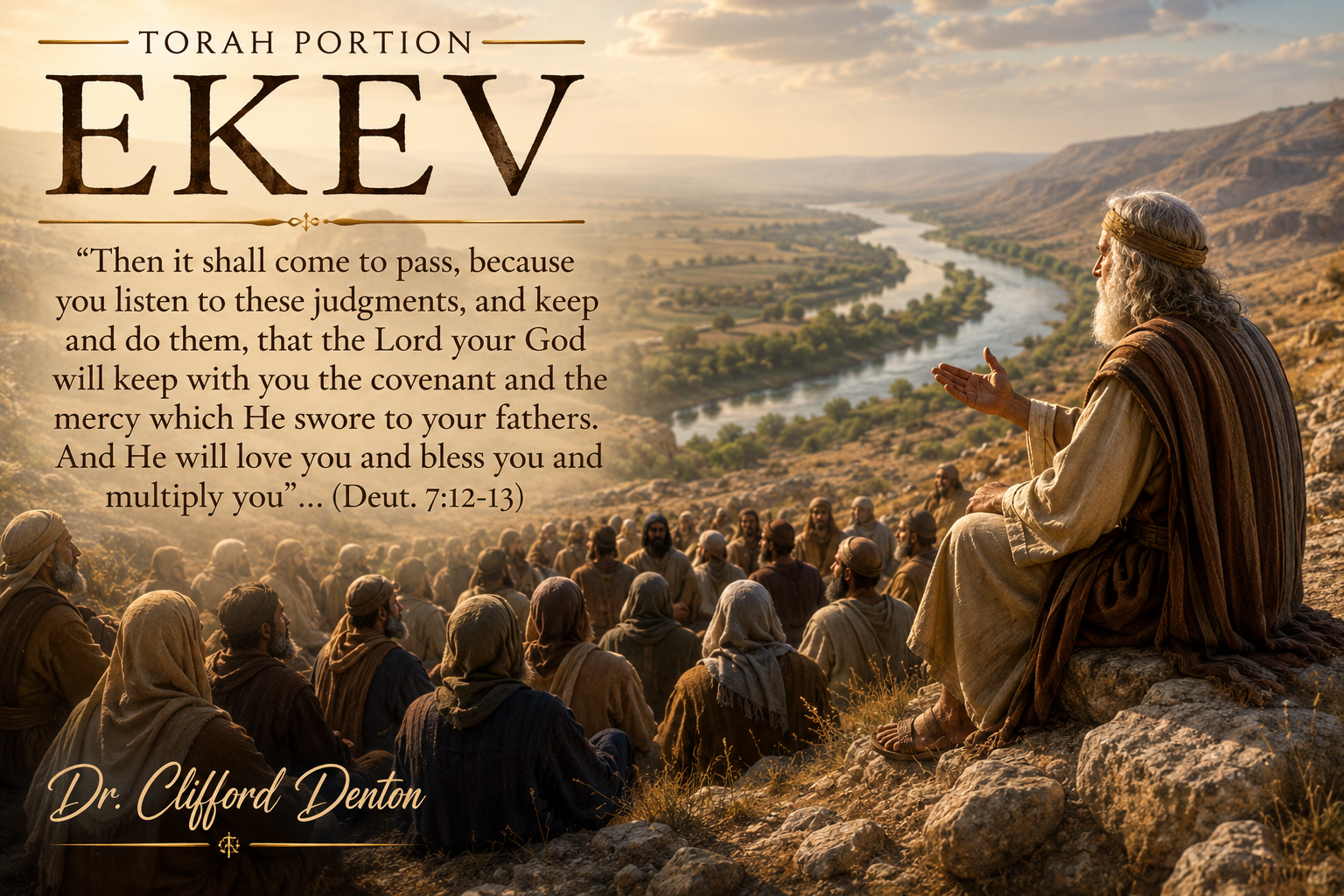
Weekly Torah Studies for 2025/26 ( 5786).
On the road to Emmaus, Yeshua met with two of His disciples and, beginning at Moses and all the Prophets, He expounded to them in all the Scriptures the things concerning Himself. (Luke 24:27). For our Torah studies this year, therefore, week by week we will seek to discover how all of Torah prepared the way for the coming Messiah.
1st August 2026 (18 Av)
Ekev (as a result): Deuteronomy 7:12-11:25
Moses ensured that the Children of Israel remembered all that happened in the forty year journey from Egypt to Canaan. There are many profound issues to consider. God dealt with the Egyptians in a way that no other nation has witnessed. He also disciplined His people in ways that are unique among all nations – the discipline of a Father to His children. Such discipline is remembered to this day. What other nation has seen the ground swallow up a group of people as it did with Dathan and Abiram, their households and all they possessed?
In the midst of all this strong discourse from Moses, there is a small but powerful word that can be skimmed over too lightly. The word is love, and it appears six times in our study this week. Moses refers to God’s love for Israel, Israel’s call to love God and also their neighbour.
The Hebrew root of the word love is ahav (אהב). This is not a word that can be understood fully from the dictionary. Ahav, whether in terms of the Old Covenant or the New Covenant, is Hebraic and is understood through action. It is the essence of Torah, but can be lost to view in the many other details. If we link two verses in our study this week we will begin to open up the right doors of understanding:
Then it shall come to pass, because you listen to these judgments, and keep and do them, that the Lord your God will keep with you the covenant and the mercy which He swore to your fathers. And He will love you and bless you and multiply you … (Deuteronomy:7:12-13)
Therefore you shall love the Lord your God, and keep His charge, His statutes, His judgments, and His commandments always. (Deuteronomy: 11:1)
God’s love for Israel will be expressed and defined through action, according to the blessings that He promised: blessings on the children who would be born, the produce of their land, their animals, their health and protection from their enemies. God can influence the weather, take care of produce from the land, and keep away enemies and diseases. The God of Creation is willing be active within the created order. Such love is conditional, however, requiring the right response, or it will be withdrawn. The necessary response is to fulfil all the requirements of God’s statutes, judgements and commandments. Fulfilling all this is defined as the love of God’s people for their heavenly Father – love defined by action. As God’s people are active in their love for God, so He is active in His love for them.
Time and again, however, in our reading of Torah, we discover the consequences of the Children of Israel not showing this active love for God. We will come to this more fully in later chapters and thereby have a doorway to understanding thousands of years of the history of Israel – times when God loved His people in positive blessing and times when such love was withdrawn, with all the consequences of history.
But, for now, let us stay with the subject of God’s love, especially as it was later revealed through Yeshua HaMashiach. When the word love appears in the New Testament, it comes from the same root meaning as in the Tanakh (Old Testament) – whatever language is used for translation of the Scriptures, including Greek and English, the root meaning comes from ahav, across all Scripture.
Consider the actions of Yeshua throughout His entire earthly ministry. There is nowhere where we find hard-heartedness in Him. Always He brought a compelling message about the love of the Father manifest in Him. John 3:16 is the central example of this:
For God so loved the world that He gave His only begotten Son, that whoever believes in Him should not perish but have everlasting life.
The condition for God’s love was being newly emphasised as belief in Yeshua, rather than fulfilling, in one’s own strength, the requirements of God’s statutes, judgements and commandments. There is a reason for this, because God does not change. We must come to that.
The only robust words of criticism and warning from Yeshua were given to the interpreters of Torah from the various rabbinic schools. This too, nevertheless, was out of love because Yeshua desired that the people of Israel be rightly taught and Torah be rightly interpreted for the sake of both the teacher and those taught.
Apart from this, the account of Yeshua’s ministry is one of a fresh and compelling demonstration of the love of God. It can be compared directly with that of Moses, who spoke on God’s behalf about God’s love, but there is a difference. As the Apostle Paul realised:
God was in Christ reconciling the world to Himself, not imputing their trespasses to them… (2 Corinthians 5:19)
God Himself came in the form of a Man, Father and Son in complete unity. When Philip asked Yeshua to show him the Father, Yeshua replied unambiguously:
Don’t you know me, Philip, even after I have been among you such a long time? Anyone who has seen me has seen the Father. How can you say, ‘Show us the Father’? Don’t you believe that I am in the Father, and that the Father is in me? The words I say to you I do not speak on my own authority. Rather, it is the Father, living in me, who is doing his work. Believe me when I say that I am in the Father and the Father is in me; or at least believe on the evidence of the works themselves. (John 14:9-11)
An era of history began through Moses when God required that His love, outworked in blessings for His people, required their response in fulfilling all the statutes, judgements and commandments. That era taught all the world that fallen mankind cannot respond sufficiently to gain the love of God through their own efforts.
Central, however, to God’s fatherly loving purposes was a way of covering transgression through sacrifice, so that at the right time the sacrifice could be complete when a new era began through the life and ministry of His Son. God so loved the world……
Love then, is still in action. It became the action of self-sacrifice that took Yeshua to the Cross. As He Himself said:
Greater love has no one than this, than to lay down one’s life for his friends. (John 15:13)
Yeshua defined the greatest aspect of His love to those who believe, as becoming the sin sacrifice for all time, freeing us from the curse for inevitable transgression of God’s statutes, judgements and commandments to remain in the love of the Father.
Love still has conditions, and is to be active and not passive, and we can discover the balance of our loving response to God through His Son by studying the Gospel accounts in full. Much understanding is interwoven in the special record of what Yeshua said in John Chapter 15:
As the Father loved Me, I also have loved you; abide in My love. If you keep My commandments, you will abide in My love, just as I have kept My Father’s commandments and abide in His love. (John 15:9-10)
This is My commandment, that you love one another as I have loved you. (John 15:12)
There is profound harmony between God’s teaching through Moses and His teaching through Yeshua. God’s people are still to be Torah observant, but through right interpretation. The promise of being able to live according to right interpretation was foreseen by Jeremiah. He announced the New Covenant, which we now know was dependent on the sacrifice of Yeshua. The giving of the Holy Spirit as the perfect and personal interpreter of Torah is the means of fulfilling all for which Moses earnestly pleaded in his final discourse with the Children of Israel:
Behold, the days are coming, says the Lord, when I will make a new covenant with the house of Israel and with the house of Judah - not according to the covenant that I made with their fathers in the day that I took them by the hand to lead them out of the land of Egypt, My covenant which they broke, though I was a husband to them, says the Lord. But this is the covenant that I will make with the house of Israel after those days, says the Lord: I will put My law in their minds, and write it on their hearts; and I will be their God, and they shall be My people. No more shall every man teach his neighbour, and every man his brother, saying, ‘Know the Lord,’ for they all shall know Me, from the least of them to the greatest of them, says the Lord. For I will forgive their iniquity, and their sin I will remember no more. (Jeremiah 31:31-34)
It is necessary for us all to find both the conditions for and the means of receiving God’s love, now fully and finally through faith in Yeshua.
What Yeshua said of Abraham would also be true of Moses:
Your father Abraham rejoiced to see My day, and he saw it and was glad. (John 8:56)
Dr Clifford Denton
Founder and Director
Tishrei Bible School
