
Re’eh (see!): Deuteronomy 11:26-16:17
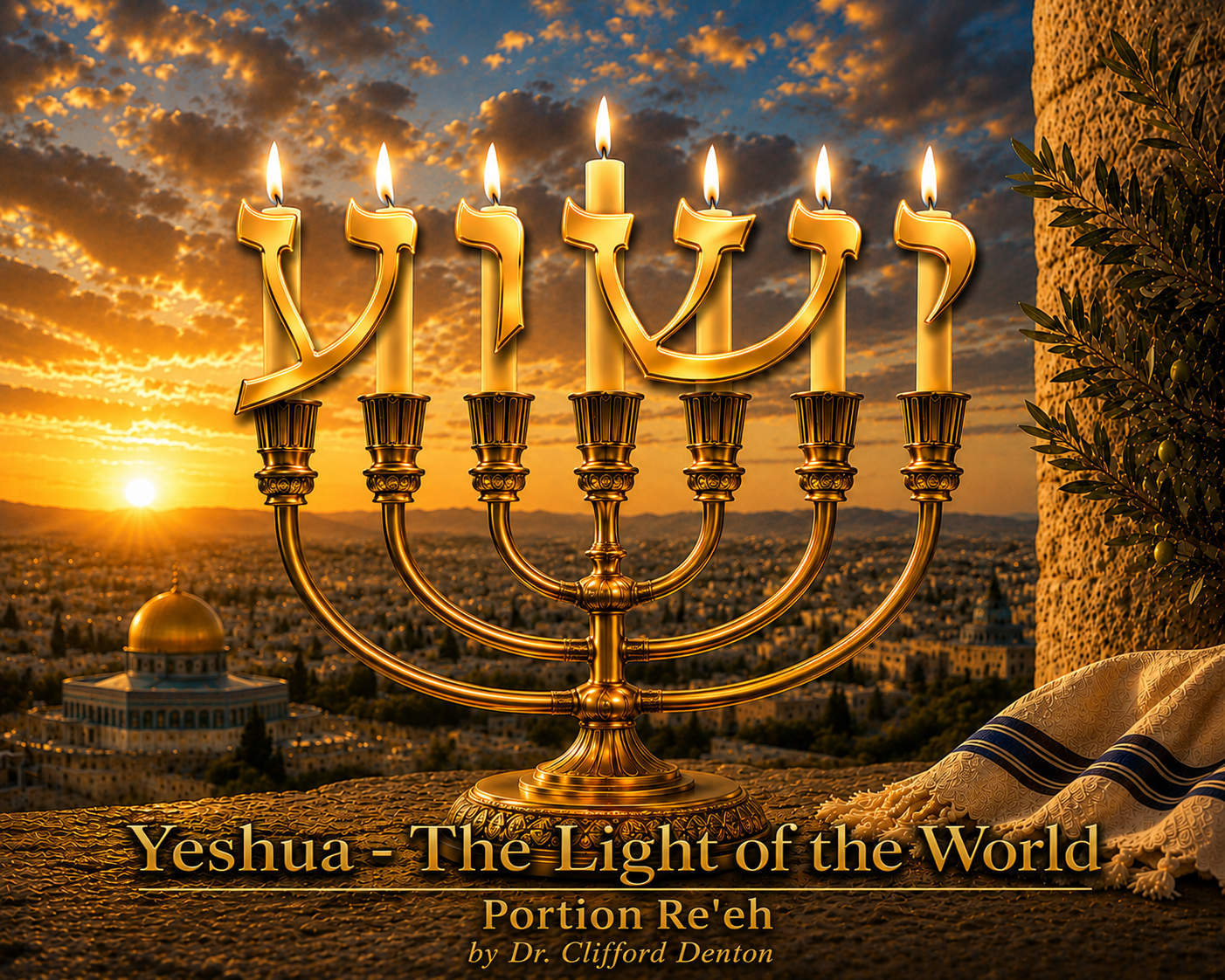
Weekly Torah Studies for 2025/26 ( 5786).
On the road to Emmaus, Yeshua met with two of His disciples and, beginning at Moses and all the Prophets, He expounded to them in all the Scriptures the things concerning Himself. (Luke 24:27). For our Torah studies this year, therefore, week by week we will seek to discover how all of Torah prepared the way for the coming Messiah.
8th August 2026 (25 Av)
Re’eh (see!): Deuteronomy 11:26-16:17
Do we sometimes study the fine detail of Torah and Halakhah so closely that we miss the bigger picture? As Yeshua said, with characteristic hyperbole, we can “strain out a gnat but swallow a camel” (Matthew 23:24)
Torah is the teaching of God and Halakhah is how our life’s walk is founded on this teaching. Surely God has His eyes of blessing on those who seek to live according to all that Moses taught on His behalf, carefully interpreting every statute, judgement and commandment into an appropriate way of life. Yet the bigger picture – the overall result for the nation of Israel and all other nations – is of paramount importance.
Israel was about to cross the Jordan to establish a nation that in every way was a witness to the God of Abraham, Isaac and Jacob. They were to be a prophetic presence among all nations, a light to the Gentiles, as the manifestation of the teaching of God in the world:
I, the Lord, have called You in righteousness, and will hold Your hand; I will keep You and give You as a covenant to the people, as a light to the Gentiles. (Isaiah 42:6)
God’s presence among His people was to be understood by the way they lived. His presence would be in the Temple just as it had been in the Tabernacle, but also in daily life. Our portion this week includes the command for the land to be cleansed of all idolatry and of the presence of foreign gods (Deuteronomy 12:29-32). Foreign gods and idols were to be replaced by a central place for the people to gather before the God of Israel, to stand before Him, honour Him and bring prescribed offerings (Deuteronomy 12:11-12). The sanctity of life was to be respected even in the way animals were eaten after draining their blood (Deuteronomy 12:23). Care must be taken to ensure a clarity and purity of the Word of God, with the removal of those who prophesied falsely (Deuteronomy 13). In matters of both life and death there was to be dignity (Deuteronomy 14:1-2). There was to be purity in what was eaten (Deuteronomy 14:3-21), also how tithing was administered and how the Levites were cared for (Deuteronomy 14:22-29). There was to be no profiteering regarding how loans were made and debts repaid (Deuteronomy 15: 1-6), how the poor were looked after (Deuteronomy 15:7-11), how servants were treated, hired and released (Deuteronomy 15:12-18) and how animals were managed (Deuteronomy 15:19-23). Each year was to be a regular and prescribed cycle of the Feasts of the Lord, defined by Him in clear detail and purpose (Deuteronomy 16).
From these passages and others, we understand that God has an ordered way in which His people must live. There is much detail, covering every aspect of life, but out of this detail should emerge an overall picture defined by two over-riding principles: in all things the nation of Israel should be seen by all surrounding nations as loving God with all their heart, soul and strength (Deuteronomy 6:5) and their neighbours as themselves (Leviticus 19:18).
All of this seems achievable. If every teaching of Moses is interpreted correctly then surely the sum total would be a nation visible to the world attracting them to the God of Israel as a moth to a shining light. Yet even Moses, the pure prophetic mouthpiece of God, knew that he had failed on at least one occasion, when his human-ness broke through when he struck the rock twice in anger. Likewise, the entire history of Israel has also revealed human weakness, despite an overall desire to live up to the calling of the Chosen People. The light to the world that should be the overall result of teaching from God through Moses has not shone as brightly as it should.
At a time when Israel recognised its failure, Psalm 80 was written as a prayer for restoration. In it, is a picture of God’s purpose for the nation, likened to a fruitful vine:
You have brought a vine out of Egypt;
You have cast out the nations, and planted it.
You prepared room for it,
And caused it to take deep root,
And it filled the land.
The hills were covered with its shadow,
And the mighty cedars with its boughs.
She sent out her boughs to the Sea,
And her branches to the River. (Psalm 80:8-11)
This beautiful metaphor was God’s overall intent for His people, a visible result to all around of the outworking of the detail of the Torah. Yet, we can come back to Psalm 80 time and again and recognise that generation after generation somehow does not attain the overall result intended, as something goes wrong for each of us in our interpretation of Torah into Halakhah.
It is the same for all nations, not just Israel. The Bible has been available across the entire world for hundreds of years. From time to time one or other nation takes hold of its truth, works it into its laws and into its ways of life, yet look at the overall result and you will not find any nation shining forth as a strong and lasting light from God – sometimes a strong but temporary glimmer, sometimes rays of hope, but always an eventual falling away.
This is where we must consider the wonder of God’s presence in Yeshua HaMashiach. If we take a moment to pause and consider the call on Israel as a whole, to fully live by the teaching of God through Moses, reaching out beyond what was achieved to what was intended, we realise that there are depths that were never plumbed to obtain the fulness of God’s desire. For Yeshua to be what He claimed to be – and He was and is truly what He claimed – all of the fulness of the Torah must have been realised in Him.
Look at it another way. Israel was given the Torah, first on tablets of stone, then through the mouth of a man, Moses, to take into their human lives. Just as all Creation is a manifestation of the spoken Word of God, so is Torah, but Torah filtered through our humanity is unfortunately tainted in its outworking. Torah, an expression of the life of God, could only be perfected outwardly if received inwardly as the manifestation of God Himself into man. God chose the Man Yeshua for this purpose. This is why John could say that Yeshua is the Word made flesh (John 1:14), God in man. Only in this way could Israel, as a whole, ever have succeeded to shine a light all around. Theirs was a hard lesson to find this out, and their lesson is also our lesson.
The magnificence of God, at the climax of His redemptive purposes, was to ensure that both the detail of Torah and His overall purpose were fulfilled through His Son. Torah includes a sacrifice for sin and forgiveness of sin through faith. This too was within the ministry of Yeshua. Taking all the purposes of the Kingdom of God into His own wonderful life:
It was said of Him, Out of Israel I called my son. (Matthew 1:15, compare Psalm 80:8)
He said of Himself, I am the true vine. (John 15:1, compare Psalm 80:8)
And I am the light of the world. (John 8:12, compare Isaiah 42:6)
In one sense, it is not that Israel failed to be that light, but that Israel bore a Son (Isaiah 9:6) to be their King and redeem them from their otherwise failure. The Kingdom of God is the final realisation of the Kingdom of Israel for which Moses prepared his people on the East side of the Jordan. Now, the Children of Israel and every other person who is called can enter into God’s light-giving purposes in Yeshua, the true vine.
The Light of God in Yeshua will be shared with everyone who asks in faith, so that they become citizens of the Kingdom of Heaven prepared by God. The standard set by God cannot be attained in the flesh alone but now can be realised by the life of God by His Spirit:
So I say to you, ask, and it will be given to you; seek, and you will find; knock, and it will be opened to you. For everyone who asks receives, and he who seeks finds, and to him who knocks it will be opened. If a son asks for bread from any father among you, will he give him a stone? Or if he asks for a fish, will he give him a serpent instead of a fish? Or if he asks for an egg, will he offer him a scorpion? If you then, being evil, know how to give good gifts to your children, how much more will your heavenly Father give the Holy Spirit to those who ask Him! (Luke 11:9-13)
Only in this way can we fulfil the earnest overall desire of Moses for his people, outworked through the Torah of God, reiterated by Yeshua as now possible through the indwelling of the Spirit of God – our measure of that same Word that became flesh in Him - thereby fulfilling the call which God foresaw through Moses:
Let your light so shine before men, that they may see your good works, and glorify your Father which is in heaven. (Matthew 5:16)
Dr Clifford Denton
Founder and Director
Tishrei Bible School
