
Chukat (statute of), Numbers 19:1-22:1
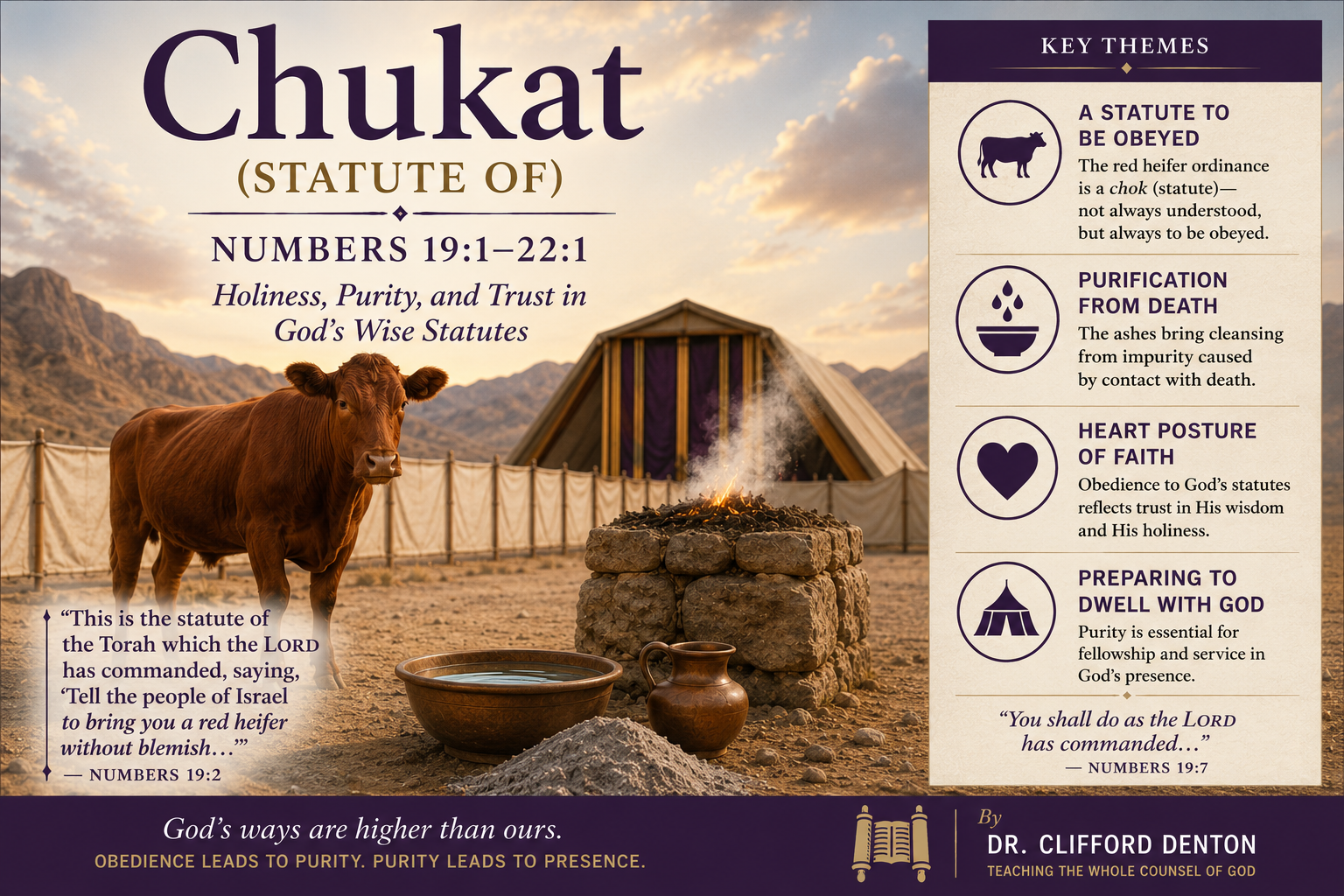
Weekly Torah Studies for 2025/26 (5786).
On the road to Emmaus, Yeshua met with two of His disciples and, beginning at Moses and all the Prophets, He expounded to them in all the Scriptures the things concerning Himself. (Luke 24:27). For our Torah studies this year, therefore, week by week we will seek to discover how all of Torah prepared the way for the coming Messiah.
20th June 2026 (5 Tammuz)
Chukat (statute of), Numbers 19:1-22:1
“What must I do in this situation, my teacher (Rabbi)?”, is the ongoing question of anyone who seeks to abide by the teaching of God (Torah). There is no teacher like Almighty God who set out principles, through Moses, for every part of life. These principles can be interpreted, with mature insight, for every generation. While God’s teaching is for every moment, it also spans history. In around 6,000 years God’s overarching plan has been the recovery of mankind from the banishment from Eden of our forefather Adam, to the restoration of mankind into the eternal Kingdom through faith in God and His Son Yeshua HaMashiach.
Thus, when we read any Torah portion, we have lessons for the here and now, but also lessons for God’s eternal purposes. The former is for immediate application and the latter is part of a very long and gradually developing purpose. We must hold both in balance. We must not look so much to our personal needs for today as to forget to hold our heads high in faith for that more wonderful greater fulfilment of God’s purposes. Neither should we be so full of our future heavenly calling as to forget to live a life worthy of that calling each day of our life.
The Bible has many examples of people who responded to God for His purposes in their day, not realising how their relatively simple motivations and obedience was part of God’s greater eternal purposes. Take, for example, Hannah’s grief when she could not bear a child (1 Samuel 1). In human thinking at that time, it was shameful for a wife not to bear offspring for her husband. Yet, God led her to a vow, when He granted her a child, that she would dedicate the child to His service. So, out of an immediate human need was born Samuel, one of the greatest Prophets of all time, used by God to restore Israel back to God. Nevertheless, even Samuel, in going about his earthly ministry could not foresee enough of the greater picture to understand that God would eventually anoint a King for Israel, David, who would be a shadow of the coming Messiah.
Samuel mourned because Israel wanted a king like the other nations (1 Samuel 8), and God’s response to him did not open even his eyes to a step in history that would have eternal consequences:
And the Lord said to Samuel, “Heed the voice of the people in all that they say to you; for they have not rejected you, but they have rejected Me, that I should not reign over them.” (1 Samuel 8:7)
Granted that Israel first received the weak King Saul, bringing its own lesson that their motive was wrong to want a king like the other nations. Nevertheless, God’s plan of redemption was proceeding all the time. In hindsight we can perceive it but, at the time, the daily journey of the people of Israel was not always easy or clear concerning God’s long term purposes.
Whilst Samuel took His part, another plan of God was quietly proceeding which would converge at the right time with God’s purpose through Samuel. With hindsight, we know how it turned out when Naomi, her husband and two sons went to Moab at a time when food was short in Bethlehem (Ruth 1). The immediate needs of this good woman were perhaps all she knew as she lost both her husband and her two sons and then returned to Bethlehem some ten or so years after she left, with her daughter-in-law Ruth, and with the sad testimony:
Do not call me Naomi; call me Mara, for the Almighty has dealt very bitterly with me. I went out full, and the Lord has brought me home again empty. Why do you call me Naomi, since the Lord has testified against me, and the Almighty has afflicted me? (Ruth 1:20-21)
She had no idea that long after she, Boaz and Ruth had died, her great-great grandson would be the same David who, having a heart after God’s own heart (1 Samuel 13:14), would be anointed by Samuel as King (1 Samuel 16):
Now this is the genealogy of Perez: Perez begot Hezron; Hezron begot Ram, and Ram begot Amminadab; Amminadab begot Nahshon, and Nahshon begot Salmon; Salmon begot Boaz, and Boaz begot Obed; Obed begot Jesse, and Jesse begot David. (Ruth 4:18-22)
So it is that throughout the history of Israel, through sometimes a difficult journey, the teaching of God has a long-term interpretation, which is embedded in the lives of His people, whether they perceived it or not.
Perhaps the best example of one who could understand that God’s immediate purposes also had eternal meaning, is Abraham. It took him a long time to reach this place of faith, but he was a willing learner. He was commended by God for his willingness to deepen his walk of faith through the experiences of life - which were often difficult. His obediently taking his son Isaac as a sacrifice to Mount Moriah (Genesis 22) proved that he had reached the required depth of faith, and where he could perceive the higher purposes of God beyond the immediate daily walk:
By faith Abraham obeyed when he was called to go out to the place which he would receive as an inheritance. And he went out, not knowing where he was going. By faith he dwelt in the land of promise as in a foreign country, dwelling in tents with Isaac and Jacob, the heirs with him of the same promise; for he waited for the city which has foundations, whose builder and maker is God…..
By faith Abraham, when he was tested, offered up Isaac, and he who had received the promises offered up his only begotten son, of whom it was said, “In Isaac your seed shall be called,” concluding that God was able to raise him up, even from the dead, from which he also received him in a figurative sense. (Hebrews 11:8-19)
Our Torah portion this week, therefore, should be read with these things in mind. Israel was on a journey through the wilderness. Time and again there was difficulty, and once more we find the people complaining both for lack of water and concerning the diet of daily manna (Numbers 20, 21:5):
And the people spoke against God and against Moses: “Why have you brought us up out of Egypt to die in the wilderness? For there is no food and no water, and our soul loathes this worthless bread.”
Yet, like their forefather Abraham, they were learning to live a life of faith and obedience.
The rules for purification in Numbers 19 are ongoing evidence of God’s requirement for both external and internal purity. Their emphasis was to be on life and not death. To be in contact even with a dead relative required cleansing, for which there was provision of the ashes of the Red Heifer. This was also the time when both Miriam and Aaron died.
Even the difficulties that they had in finding a route to journey through Edom, Moab and the lands of the Canaanites and Amorites had eternal purposes for the judgment of the nations. For example, God eventually built up a case for judgment against Edom, which is spoken of by the Prophets in later days (Obadiah 1:1-4, Isaiah 34:5-6, Jeremiah 14:17-18 and Ezekiel 25:12-14):
Thus says the Lord God: “Because of what Edom did against the house of Judah by taking vengeance, and has greatly offended by avenging itself on them,” therefore thus says the Lord God: “I will also stretch out My hand against Edom, cut off man and beast from it, and make it desolate from Teman; Dedan shall fall by the sword. I will lay My vengeance on Edom by the hand of My people Israel, that they may do in Edom according to My anger and according to My fury; and they shall know My vengeance,” (Ezekiel 25:12-14)
Whilst Israel and Judah have many times come under the discipline of God, nevertheless, they are His chosen people to bring a prophetic message to the world. To come against the nation with wrong motive is to misunderstand God’s eternal purposes and come under God’s judgment. As Jeremiah said of Israel in contrast with other nations, typified by Babylon:
The Portion of Jacob is not like them,
For He is the Maker of all things;
And Israel is the tribe of His inheritance.
The Lord of hosts is His name.
You are My battle-ax and weapons of war:
For with you I will break the nation in pieces;
With you I will destroy kingdoms. (Jeremiah 51:19-20)
Despite the hard journey of Israel in the wilderness, God was preparing for Himself a people within a long-term vision for the purification and redemption of the world.
Most importantly, our Portion this week has some deep-rooted meaning for God’s eternal purposes through Yeshua.
The entry into Canaan, the immediate goal of the Children of Israel, was not to be God’s final destination for His covenant people. Abraham’s example of seeing beyond the immediate to the Eternal Kingdom, though not completely clear as to how and where, should be the perspective of all God’s people.
Aaron, the first High Priest would not even enter the Promised Land, and neither would Moses. They were God’s choice for leading Israel from the Kingdom of Egypt through difficult times, but their not even being granted to be leaders into Canaan bears much importance. The error at Meribah was sufficient to show that an even greater leader would one day be needed. In hindsight, it was inevitable that the limitations of even Moses’ humanity would make him inadequate for the absolute fulfilment of God’s eternal purpose of redeeming mankind from its banishment from Eden.
Yet, the pattern was established in all things, which is why Torah is at the foundation of all God’s teaching, not just for Israel, but for the entire world. The pattern of the Priesthood and of God’s speaking through human beings, exemplified by the great Prophet Moses was for all time.
While Aaron and Moses were shown to fail, there would be one whom Moses foresaw (Deuteronomy 18:15-19) who would come to lead God’s people in later times. All this points to Yeshua the Messiah. We see it so clearly in hindsight, weighing all of Torah, the Prophets and the Writings against the New Testament. Once the veil goes from one’s eyes, one sees it logically and also through eyes of faith.
Even the Red Heifer for purification pointed to Him. The Writer to the Hebrews understood this. What he wrote should be cross-referenced with Numbers 19:
We have an altar from which those who serve the tabernacle have no right to eat. For the bodies of those animals, whose blood is brought into the sanctuary by the high priest for sin, are burned outside the camp. Therefore Jesus also, that He might sanctify the people with His own blood, suffered outside the gate. Therefore let us go forth to Him, outside the camp, bearing His reproach. For here we have no continuing city, but we seek the one to come. Therefore by Him let us continually offer the sacrifice of praise to God, that is, the fruit of our lips, giving thanks to His name. But do not forget to do good and to share, for with such sacrifices God is well pleased. (Hebrews13:10-16)
For if the blood of bulls and goats and the ashes of a heifer, sprinkling the unclean, sanctifies for the purifying of the flesh, how much more shall the blood of Christ, who through the eternal Spirit offered Himself without spot to God, cleanse your conscience from dead works to serve the living God? (Hebrews 9:13-14)
Life and death is still the issue. The sprinkling with the water of purification containing the ashes of the red heifer are symbolic of purification by the Holy Spirit and they also bear witness to the life of the Holy Spirit as opposed to the dead works of the natural man.
We have yet another symbol of profound implication in our portion, the Bronze Serpent of Numbers 21. Here the physical conflict with fiery serpents who bite and thus bring physical damage to the body which needs healing, points back to a prophecy in Genesis which speaks of One who would come. Yeshua is the One who was foreseen soon after Creation. The fiery serpents become a symbol of the attacks of the spiritual powers of darkness led by satan himself, likened to a serpent:
So the Lord God said to the serpent:
“Because you have done this,
You are cursed more than all cattle,
And more than every beast of the field;
On your belly you shall go,
And you shall eat dust
All the days of your life.
And I will put enmity
Between you and the woman,
And between your seed and her Seed;
He shall bruise your head,
And you shall bruise His heel.” (Genesis 3:14-15)
And as Moses lifted up the serpent in the wilderness, even so must the Son of Man be lifted up, that whoever believes in Him should not perish but have eternal life. For God so loved the world that He gave His only begotten Son, that whoever believes in Him should not perish but have everlasting life. For God did not send His Son into the world to condemn the world, but that the world through Him might be saved. (John 3:14-17)
This quote from John 3 is taken from Yeshua’s conversation with Nicodemus, one of the teachers from among the Pharisees,. When Yeshua talked with him, He foresaw His own sacrificial death on the Cross, as the fulfilment of the snake on the bronze pole. Those who look on His death on the Cross in faith will be saved from their sins.
The Apostle Paul was able to understand how, just as the image on the bronze pole was of a fiery serpent so Yeshua allowed Himself to embody the sins that were the result of satan’s temptations to us (like the bites of a fiery serpent):
For He made Him who knew no sin to be sin for us, that we might become the righteousness of God in Him.(2 Corinthians 5:21)
All these deep matters have a beginning in the teaching from our Portion this week.
To take these matters on board personally requires us to seek purity in our transient daily lives just as was so often said by God to His people:
Be holy, for I am holy. (1 Peter 1:16)
We must seek to make the most of every day concerning our earthly responsibilities but, as through all covenant history, realise perhaps with limited understanding that God is always moving forward to complete His covenant purposes, even using our contribution in ways that can multiply in fruitfulness for His purposes. We should always have our minds on the present purposes of God with our heads held high regarding His future fulfilment:
Therefore, my beloved brethren, be steadfast, immovable, always abounding in the work of the Lord, knowing that your labour is not in vain in the Lord. (1 Corinthians 15:58)
And there will be signs in the sun, in the moon, and in the stars; and on the earth distress of nations, with perplexity, the sea and the waves roaring; men’s hearts failing them from fear and the expectation of those things which are coming on the earth, for the powers of the heavens will be shaken. Then they will see the Son of Man coming in a cloud with power and great glory. Now when these things begin to happen, look up and lift up your heads, because your redemption draws near. (Luke 21:25-28)
Dr Clifford Denton
Founder and Director
Tishrei Bible School
