
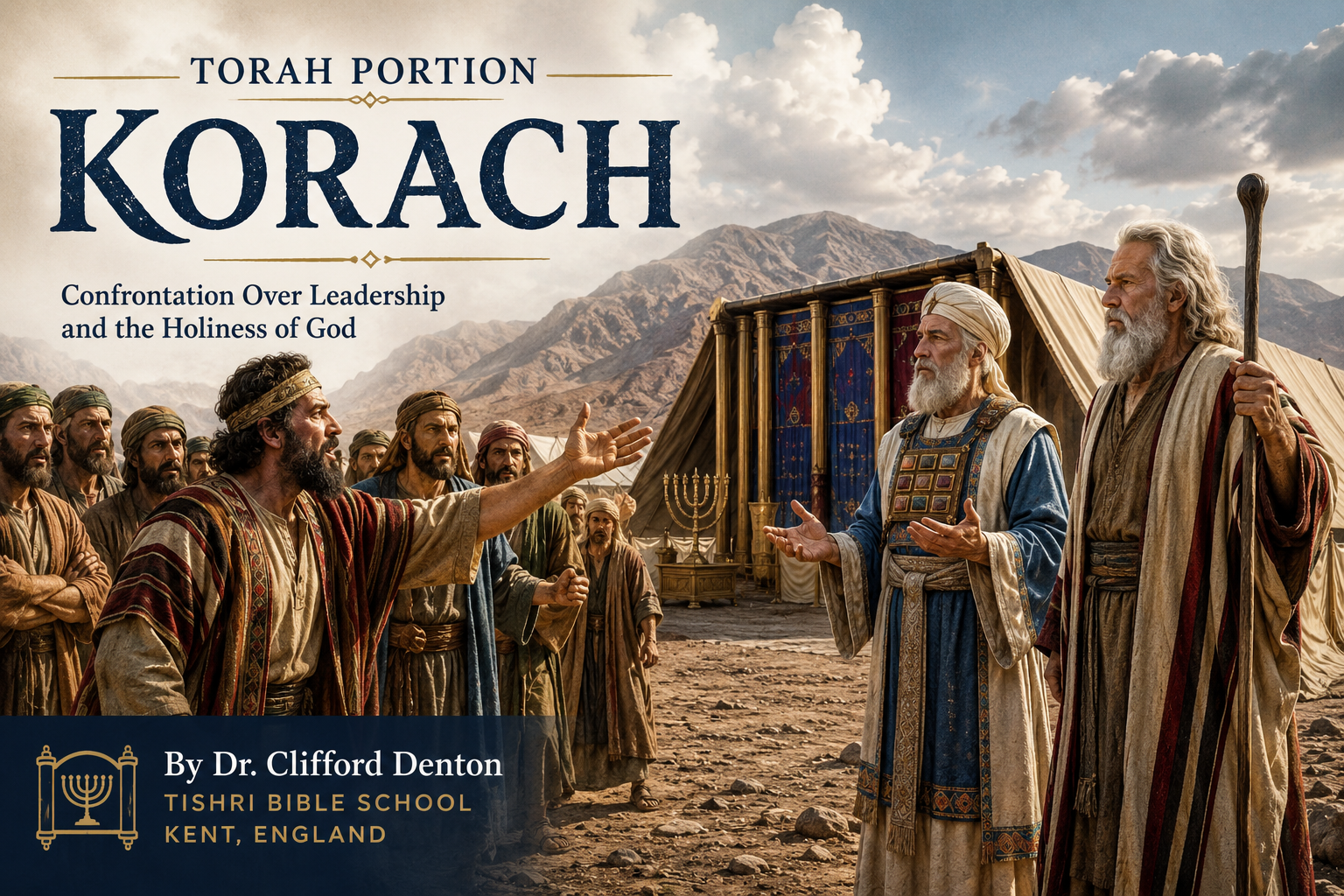
Weekly Torah Studies for 2025/26 (5786).
On the road to Emmaus, Yeshua met with two of His disciples and, beginning at Moses and all the Prophets, He expounded to them in all the Scriptures the things concerning Himself. (Luke 24:27). For our Torah studies this year, therefore, week by week we will seek to discover how all of Torah prepared the way for the coming Messiah.
13th June 2026 (28 Sivan)
Korach (Korah), Numbers 16:1-18:32
How important it is to both read the Torah portion in context and also to understand the relevance of its teaching for every generation.
God’s instructions to Moses were intended to bring order to the community among whom He would dwell. After the account of the rebellion in this week’s reading, we have a clear review of the order of service of the Tabernacle, both how the Levites should minister and how they should be provided for from the offerings made to the Lord. Even in the eating of their share of the meat and grain brought to the altar, there was to be utmost reverence. To Aaron and his sons, the Lord said:
Here, I Myself have also given you charge of My heave offerings, all the holy gifts of the children of Israel; I have given them as a portion to you and your sons, as an ordinance forever. This shall be yours of the most holy things reserved from the fire: every offering of theirs, every grain offering and every sin offering and every trespass offering which they render to Me, shall be most holy for you and your sons. In a most holy place you shall eat it; every male shall eat it. It shall be holy to you. (Numbers 18:8-10)
To the Levites, the Lord said:
When you take from the children of Israel the tithes which I have given you from them as your inheritance, then you shall offer up a heave offering of it to the Lord, a tenth of the tithe…..
…. When you have lifted up the best of it, then the rest shall be accounted to the Levites as the produce of the threshing floor and as the produce of the winepress. You may eat it in any place, you and your households, for it is your reward for your work in the tabernacle of meeting. (Numbers 18:26-31)
This might remind us of the order of our own lives, where provision comes in a different way. The Apostle Paul, in reviewing the Lord’s provision, both spiritual and physical, in 1 Corinthians 10, ended with the admonition:
Therefore, whether you eat or drink, or whatever you do, do all to the glory of God. (1 Corinthians 10:31)
We must be careful not to take God’s gifts lightly and be so familiar with them as to forget the great privileges He brings us. The reality of this is seen when we realise that there is much in our Torah portion this week that links to matters of life and death. At this time, when God was beginning to form a covenant family for Himself, He made it clear that there must be order and discipline. This was the beginning of mankind being redeemed from the consequences of sinfulness in the fallen world. In terms of the service of the Levites when helping Aaron and his sons:
They shall attend to your needs and all the needs of the tabernacle; but they shall not come near the articles of the sanctuary and the altar, lest they die—they and you also. (Numbers 18:3)
These considerations add to our need to learn from the consequences of the rebellion of Korah from Chapters 17 and 18. If the earth opens up to swallow up those who were rebellious and if God, through the miracle of the budding of Aaron’s rod, takes the trouble to reinforce the importance of recognising who His appointed ministers are, then this is a lesson that we must consider carefully. It is God Himself who appoints whom He chooses for the outworking of His purposes.
If we were to look at this from the perspective of Korah, we might understand how easy it is to miss this point. In human terms, why was he any different from Moses and Aaron? Here are two old men who have brought them out of Egypt and not fulfilled their expectation of entering the Promised Land. Surely there were other men who could lead with greater success, so why not challenge the leadership? Very human thinking, perhaps full of ambition, perhaps democratically motivated, but full of error of judgement and great consequences.
This is a recurring theme in our Bibles. Consider Abimelech, Gideon’s son. Even after the great victory brought by his father, ambition drove him to murder his many brothers, thinking that this would confirm his leadership of Israel, but only disaster and many deaths were the consequence (Judges 11).
David the King brought a good but rare example of not overstepping the mark. Even though he was anointed as King and was pursued by the failed King Saul, on two occasions he would not take advantage of a situation to usurp Saul’s position, leaving God to be the judge of how he himself would become King in Saul’s place. The first opportunity to take Saul’s life was in the cave at En Gedi, but David declared:
The Lord forbid that I should do this thing to my master, the Lord’s anointed, to stretch out my hand against him, seeing he is the anointed of the Lord. (1 Samuel 24:6)
The second opportunity came in the Wilderness of Ziph, when David and his men found Saul and his men sleeping, but again he would not take the opportunity offered to overcome Saul:
Do not destroy him; for who can stretch out his hand against the Lord’s anointed, and be guiltless? (1 Samuel 26:9)
These are unique circumstances. By contrast, we read time and again of how challenges have come to those appointed by God. Even David’s son Absalom brought about a conspiracy to usurp his father’s throne, with immense consequences of death and division among the people of Israel (2 Samuel 15-18).
These are all lessons, beginning with the rebellion of Korah, through which we must learn. In the wider picture, God appointed the entire nation of Israel for His covenant purposes.
Remember His marvellous works which He has done,
His wonders, and the judgments of His mouth,
O seed of Abraham His servant,
You children of Jacob, His chosen ones! (Psalm 105:5-6)
Psalm 105 reviews God’s appointment of Israel, whilst also reminding all who consider this:
Do not touch my anointed ones; do my prophets no harm. (Psalm 105:15)
Consequences of misunderstanding, forgetting or ignoring this have gone on from generation to generation. When Judah was led captive to Babylon for seventy years there was misunderstanding of God’s higher purposes. For this, He rebuked the surrounding nations who sought to benefit from God’s judgement on Israel:
Then the Angel of the Lord answered and said, “O Lord of hosts, how long will You not have mercy on Jerusalem and on the cities of Judah, against which You were angry these seventy years?”
And the Lord answered the angel who talked to me, with good and comforting words. So the angel who spoke with me said to me, “Proclaim, saying, ‘Thus says the Lord of hosts:
“I am zealous for Jerusalem
And for Zion with great zeal.
I am exceedingly angry with the nations at ease;
For I was a little angry,
And they helped—but with evil intent.” (Zechariah 1:12-15)
So we see the consequences of rebellion against God and whom He appoints, especially His purposes with the Nation Israel: this continues even to our day, with the same devastating effect. The lesson from Korah’s rebellion is still not learned.
For those in the Christian Church, we too must be careful not to misjudge God’s continuing purposes for Israel. There is a branch of theology called Replacement Theology which is based on the view that God finished with Israel at the coming of Jesus, and now the Christian Church inherits the blessings of Israel, ignoring the curses. There can be an element of pride in this. The Apostle Paul warned of it and its consequences:
Again I ask: Did they stumble so as to fall beyond recovery? Not at all! Rather, because of their transgression, salvation has come to the Gentiles to make Israel envious. But if their transgression means riches for the world, and their loss means riches for the Gentiles, how much greater riches will their full inclusion bring!
I am talking to you Gentiles. Inasmuch as I am the apostle to the Gentiles, I take pride in my ministry in the hope that I may somehow arouse my own people to envy and save some of them. For if their rejection brought reconciliation to the world, what will their acceptance be but life from the dead? If the part of the dough offered as firstfruits is holy, then the whole batch is holy; if the root is holy, so are the branches.
If some of the branches have been broken off, and you, though a wild olive shoot, have been grafted in among the others and now share in the nourishing sap from the olive root, do not consider yourself to be superior to those other branches. If you do, consider this: You do not support the root, but the root supports you. You will say then, “Branches were broken off so that I could be grafted in.” Granted. But they were broken off because of unbelief, and you stand by faith. Do not be arrogant, but tremble. For if God did not spare the natural branches, he will not spare you either. (Romans 11:11-21)
Of all the examples of failure to recognise God’s appointing to authority, the challenge to Yeshua’s authority is the most important. Sometimes in a veiled way and sometimes a much clearer way, preparation was made through the biblical Prophets for God’s people to understand that a Son was to born in Israel (Isaiah 9) who would be the Ruler of Israel, to bring in the New Covenant promised through Jeremiah to Israel and Judah (Jeremiah 31), and who would become the Lamb of God (Isaiah 53), to take away the sins of the world (John 1), replacing all other sacrifices for sin and for peace with God
When He came to earth, many religious leaders saw Him as usurping their authority and sought to repeatedly challenge Him, seeking instead to usurp His authority instead! The full accounts are in the four Gospels (Matthew, Mark, Luke and John). He replied to their challenges with the correct interpretation of Torah, such as in the Sermon on the Mount (Matthew 5-7) and by miraculous signs and wonders. These were not miracles that opened the ground to consume those who would usurp His authority as in the days of Moses, but wonderful gifts of healing and deliverance!
When on the Cross, suffering for the sins of those who sought to usurp His authority, He prayed:
Father, forgive them, for they do not know what they are doing. (Luke 23:34)
Yet all the shakings of this world that have followed to this day, and which will follow into the future, are linked to His Crucifixion and necessary acceptance of God’s appointed King of the Jews, as He patiently waits for all who will respond in faith to His call of redemption through Him. One thing is sure: if God would not let Korah usurp the authority of Moses and Aaron, more so will He not let others usurp the authority of His Son, Yeshua HaMashiach.
Yeshua warned of the troubles that would occur on this earth prior to His return (Matthew 24, Luke 21). He also told of the coming antichrist, who would indeed try to usurp His authority. Satan once sought to do this in the wilderness, where Yeshua fasted for 40 days and nights (Luke 4). In the power of satan, one will arise who will seek for one last time, to draw all people of all nations under his reign. The Prophet Daniel foresaw these days, when talking of the abomination of desolation (Daniel 9:27, 11:31, Matthew 24:15).
For false messiahs and false prophets will rise and show great signs and wonders to deceive, if possible, even the elect. See, I have told you beforehand. (Matthew 24:24-25)
This is graphically described in the Book of Revelation. At the climax of the rule of the antichrist, the world will finally suffer the greatest woes since the time of Israel in Egypt, and then Yeshua will return in full authority as King of Kings and Lord of Lords. This is the greatest event which we can foresee from meditating on our portion this week.
For ourselves, in the service of our Saviour on this earth until that great day, Yeshua appoints those whom He chooses.
And He Himself gave some to be apostles, some prophets, some evangelists, and some pastors and teachers, for the equipping of the saints for the work of ministry, for the edifying of the body of Christ……. (Ephesians 4:11-12)
His appointments are according to His choosing and for the good of all. If Korah teaches us a personal lesson, it is to respect the calling of others as well as take seriously our own:
I beseech you therefore, brethren, by the mercies of God, that you present your bodies a living sacrifice, holy, acceptable to God, which is your reasonable service. And do not be conformed to this world, but be transformed by the renewing of your mind, that you may prove what is that good and acceptable and perfect will of God.
For I say, through the grace given to me, to everyone who is among you, not to think of himself more highly than he ought to think, but to think soberly, as God has dealt to each one a measure of faith. For as we have many members in one body, but all the members do not have the same function, so we, being many, are one body in Christ, and individually members of one another. Having then gifts differing according to the grace that is given to us, let us use them: if prophecy, let us prophesy in proportion to our faith; or ministry, let us use it in our ministering; he who teaches, in teaching; he who exhorts, in exhortation; he who gives, with liberality; he who leads, with diligence; he who shows mercy, with cheerfulness. (Ephesians 12:1-8)
Dr Clifford Denton
Founder and Director
Tishrei Bible School
