
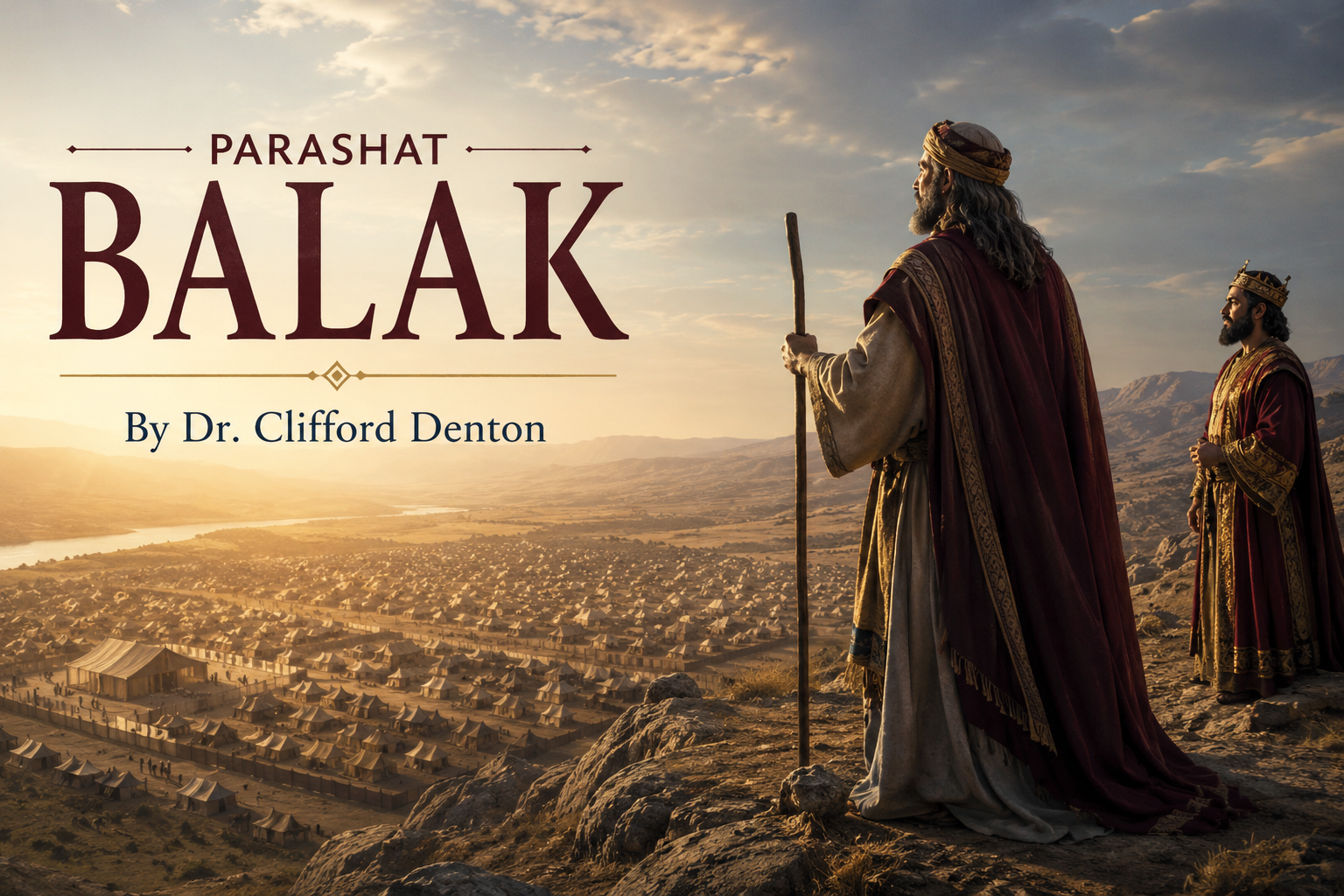
Balak (Balak), Numbers 22:2-25:9
Weekly Torah Studies for 2025/26 (5786).
On the road to Emmaus, Yeshua met with two of His disciples and, beginning at Moses and all the Prophets, He expounded to them in all the Scriptures the things concerning Himself. (Luke 24:27). For our Torah studies this year, therefore, week by week we will seek to discover how all of Torah prepared the way for the coming Messiah.
27th June 2026 (12 Tammuz)
Balak (Balak), Numbers 22:2-25:9
In the Christian Church we can so focus on a personal application of a Bible account, that we forget its deeper and ongoing reality in the world today. The Bible is not a book of theology, founded on Greek academic principles of interpretation: it is a book that is full of the history of God and His people. Here, for example, is a paraphrase of a portion of a typical sermon personalising the account of Balaam and Balak:
Balak’s story reminds us of the futility of opposing God’s plans, where fear and pride influence our actions. His attempts to curse Israel reveal God’s sovereignty and faithfulness to His people. No human effort can reverse what God plans for us, challenging us to consider our own response to difficult circumstances, whether we trust God’s divine authority or not. It challenges us to reflect on our own responses to situations beyond our control—will we resist or trust in divine authority? Worldly solutions will always fall short when put in opposition to God’s ultimate power in our life.
Whilst we can find understanding concerning God’s character in our Bible study, and there can be some personal application, we must be careful not, as many do, to treat the Bible as only for this purpose, and thereby miss the main point.
It is so easy to read the account of Balaam and Balak as if we are watching a modern-day pantomime, rather than reading a clear account of what actually happened. It would be the nature of our spiritual adversary to blind our eyes to this. Indeed, our spiritual adversary has blinded many eyes.
Every nation of the world should study this week’s Torah portion, especially those who seek to do Israel harm. Yet, the world is full of those who follow false gods or no gods at all, relying on their own intellect to seek to discern a logical path and thereby making great errors, especially concerning God’s continuing purposes for Israel.
Israel was soon to enter the Promised Land, chosen by God for His own purposes not because of their innate righteousness. Here we are today with signs all around concerning the final steps in God’s eternal plan of redemption and Israel is back in its own land – that same land that God promised long ago to Abraham. How more relevant could our Torah portion be, therefore?
When the State of Israel was proclaimed anew as a nation in their own land, on May 14th 1948, Israel’s Torah Portion in the Diaspora was Kedoshim (Leviticus 19:1–20:27). This Parasha emphasises the call for the Israelites to live a life of holiness and social justice, including the commandments to love one’s neighbour as oneself, observe the Sabbath, and care for the poor. It would not have been out of place for the nations of the world, in response, to read about Balak and Balaam, as we are this week, and welcome Israel to their homeland instead of, as has happened in all the years since, seek to destroy them.
When Abraham’s son, Ishmael, left home to settle on the other side of the Jordan, he became the head of the nation that became known as Edom. He knew about the One True God of His father Abraham and so it is likely that his people, hundreds of years later, also knew about the God of Israel. This is why Balaam could, despite his confusion and sorcery, understand that it was Almighty God to whom he could pray for guidance when Balak summoned him to curse Israel.
Words have power. They are both spiritual and physical in nature. So blessing and cursing is more than human words of kindness or hatefulness. Balak knew this and sought to place on Israel a power that would ultimately destroy them. The massed nation of Israel in the valleys beneath them had the potential of being a formidable foe, they having also recently defeated the neighbouring Amorites.
Balaam may have remembered, at least in part, the promise God had given to Abraham, when he found himself blessing Israel instead of cursing them:
How shall I curse whom God has not cursed? And how shall I denounce whom the Lord has not denounced?(Numbers 23:8)
The full promise to Abraham, as a consequence, should have been considered by Balak, that he might repent of his folly:
I will bless those who bless you,
And I will curse him who curses you;
And in you all the families of the earth shall be blessed. (Genesis 12:3)
Indeed, God gave Balak a second warning in Balaam’s third prophecy:
How lovely are your tents, O Jacob!
Your dwellings, O Israel!
……He bows down, he lies down as a lion;
And as a lion, who shall rouse him?’
“Blessed is he who blesses you,
And cursed is he who curses you. (Numbers 24:5-9)
It is the same in the world today. In the Middle East there is a partial understanding of Abraham and the God of Abraham, but distorted enough that, just as Balak feared Israel and sought to do them harm, the same goes on today among the nations round about. Meanwhile, in the wider world, there is so much ignorance of God’s purposes for Israel that they are often needing to stand alone, yet still fulfilling what God has ordained for them of His covenant purposes.
Greater even than Israel’s place in God’s purposes is another level of prophecy spoken by Balaam, concerning Israel’s coming Messiah:
His king shall be higher than Agag, and his kingdom shall be exalted. (Numbers 24:7)
I see Him, but not now;
I behold Him, but not near;
A Star shall come out of Jacob;
A Sceptre shall rise out of Israel,
And batter the brow of Moab,
And destroy all the sons of tumult.
And Edom shall be a possession;
Seir also, his enemies, shall be a possession,
While Israel does valiantly.
Out of Jacob One shall have dominion,
And destroy the remains of the city. (Numbers 24:17-19)
Yeshua HaMashiach was foreseen by Balaam. Yeshua is the King of the Jews (Luke 23:3), and will fulfil all the promises given to Abraham. The entire world will shake prior to His coming and He will judge the nations in all righteousness. Not just Balaam, but all the biblical Prophets speak of this. Haggai had this to say, as is also recalled and put into the context of today by the Writer to the Hebrews (Hebrews 12):
For thus says the Lord of hosts: ‘Once more (it is a little while) I will shake heaven and earth, the sea and dry land; and I will shake all nations, and they shall come to the Desire of All Nations, and I will fill this temple with glory,’ says the Lord of hosts. ‘The silver is Mine, and the gold is Mine,’ says the Lord of hosts. ‘The glory of this latter temple shall be greater than the former,’ says the Lord of hosts. ‘And in this place I will give peace,’ says the Lord of hosts. (Haggai 2:6-9)
When the Children of Israel were on the borders of the Jordan at that time, it was planned by the God of Abraham that, in the future, Israel would bring forth the long awaited Messiah. It is no wonder that by every means available, satan would seek to destroy or discredit Israel. Thereby, satan would be opposing the God of Israel and His Son, Yeshua HaMashaich.
If satan does not win a battle by one means he will try another. At the end of our study, we find that his next trick is assimilation. If Israel can be made to intermarry with other nations and follow their gods then they will disappear, as will their remembrance and their purpose in God’s covenant plan. The battle goes on to our day on this and many other fronts. Wars erupt because of satan’s schemes, but Israel will prevail through all their troubles, however painful, and however much they themselves will be answerable to God for their own errors.
Our portion this week should be read in this way, especially in the Christian Church, who must look beyond academic theology and personal application of scriptural principles. If the strange prophet Balaam could speak the words of God, how much more should all God’s people perceive the more important prophetic purposes of God today.
Dr Clifford Denton
Founder and Director
Tishrei Bible School
