
The Solitary Shepherd
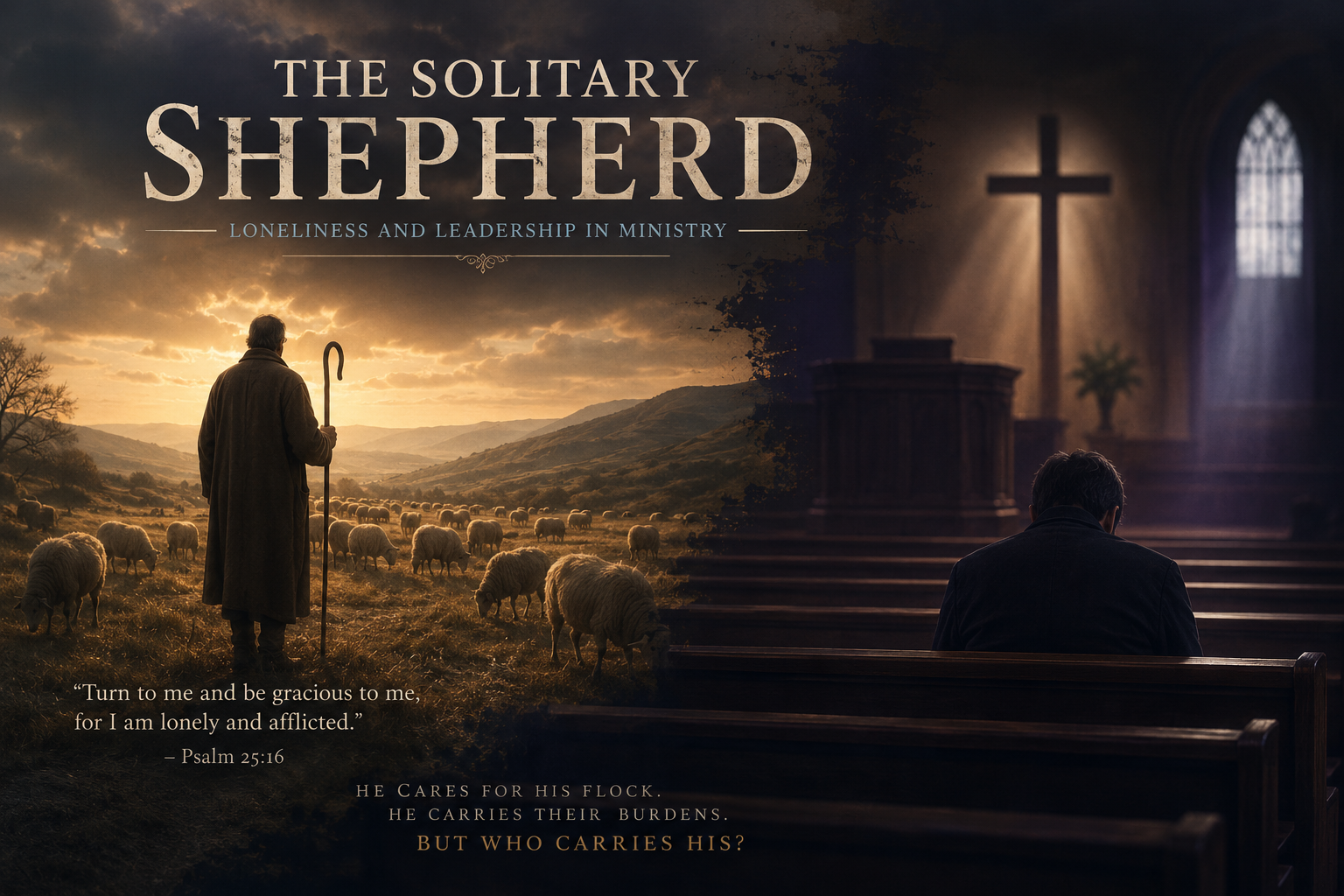
Loneliness and Leadership in Ministry
“Turn to me and be gracious to me, for I am lonely and afflicted” (Ps. 25:16).
Introduction
David in his loneliness, isolation and distress turns to the Lord with profound transparency. He is facing internal struggles and external threats. When it seems that all have turned away from him, David’s fear is that the Lord has also turned away from him. While our circumstances may differ from his, many shepherds know what it is to carry burdens that cannot easily be shared, to stand before people while feeling unseen, and to wonder whether anyone truly understands the weight we bear.
While it may seem strange, given how socially and technologically connected society is today, loneliness is now described by US Surgeon General, Dr. Vivek Murthy, as an epidemic. In an advisory he issued regarding the impact of chronic loneliness and social isolation he concluded that it is as deadly as smoking fifteen cigarettes a day.[1] Despite unprecedented connectivity, social networking, and access to communication, increasing numbers of Americans report feeling isolated and disconnected. While much has been written about loneliness among young adults, the elderly, and those living alone, far less attention has been given to a group that often experiences profound isolation while surrounded by people. If you are reading this, you probably know this category well: pastors.
Pastoral loneliness is one of the least discussed and most misunderstood challenges facing the Church today. It is rarely addressed publicly, seldom acknowledged openly, and often shouldered silently by faithful men and women who spend their lives caring for others.
Over years of ministry, I have witnessed the impact of loneliness among the faithful and those who shepherd them. Specific to pastors, it does not seem to be confined to one denomination, association, theological tradition, or church size. It affects pastors of large congregations and small congregations, full-time and bi-vocational, seasoned clergy and newly ordained ministers. While the causes vary, the result is often the same: shepherds are attempting to carry burdens they were never meant to bear alone.
The Church must begin speaking honestly about this reality. If we fail to care for those who care for the Lord’s people, we should not be surprised when burnout, discouragement, moral failure, and ministerial shortage continues to increase.
A Biblical Reality, Not a Modern Invention
Pastoral loneliness is not simply a product of contemporary culture. Scripture reveals that many of the Lord’s servants experienced seasons of profound isolation. Moses understood the crushing weight of leadership. Charged with leading Israel through the wilderness, he eventually reached a breaking point and cried out to the Lord: “I am not able to bear all these people alone, because the burden is too heavy for me” (Num. 11:14).
What is the Lord’s response? The Lord did not rebuke Moses for admitting his limitations. Instead, He instructed him to gather seventy elders and distributed the responsibility among them. The solution was not greater endurance, but shared leadership (Num. 11).
Similarly, Elijah experienced the loneliness that often follows seasons of intense ministry. After his triumph on Mount Carmel, he found himself exhausted, discouraged, and convinced that he alone remained faithful. He says to the Lord: “I, even I only, am left” (1 Kgs. 19:10). Though Elijah’s perception was incomplete, his loneliness was real. The Lord did not respond with condemnation, but with care. He then provided rest, nourishment, renewed perspective, and companionship.
Jeremiah, the weeping prophet, knew the isolation that accompanies prophetic faithfulness. Paul carried what he described as the daily pressure of concern for all the churches (2 Cor. 11:28). Near the end of his life, he lamented that many had abandoned him in his hour of need, yet he testified that the Lord stood by him and strengthened him (2 Tim. 4:16-17).
Even the Lord Yeshua/Jesus experienced solitude and loneliness (Isa. 53:3; Heb. 4:15). After ministering to the multitudes, He withdrew to solitary places to pray. In Gethsemane He asked His closest disciples to remain awake and watch with Him. They could not. At the cross, many who once followed Him disappeared. The solitude and loneliness of Messiah was unique in its redemptive purpose, but it reminds us that loneliness itself is not evidence of spiritual weakness or failure.
Solitude is a Gift; Isolation is a Danger
One of the most important distinctions we ministers must learn is the difference between solitude and isolation. Solitude can be received as a gift from the Lord. Isolation is often a tactic used by the enemy.
Solitude creates space for prayer, reflection, study, and communion with the Lord. Every pastor needs seasons of intentional withdrawal from the demands of ministry. Jesus modeled this example for us.
Isolation, however, is something different. Isolation occurs when pastors become disconnected from meaningful relationships, trusted friendships, and healthy support systems. It leaves leaders carrying burdens without assistance, processing struggles without counsel, and enduring hardships without encouragement. The two can look similar externally, but they produce very different results: Solitude renews. While isolation depletes. Solitude strengthens. Isolation produces weakness.
Many ministers mistakenly believe they are practicing spiritual solitude when they have actually drifted into unhealthy isolation.
The Unique Loneliness of Leadership
Leadership itself creates a certain, but often necessary distance between shepherds and those entrusted to their care. Pastors are entrusted with responsibilities that many within their congregation or ministry do not see. We carry concerns involving marriages, finances, family crises, leadership conflicts, congregational tensions, and spiritual struggles. Most, if not all of this information cannot be shared publicly and often cannot even be discussed with anyone. As a result, as pastors we frequently find ourselves carrying emotional and spiritual burdens in silence.
The irony is that pastors are often surrounded by people while feeling profoundly alone. We preach to crowds, counsel families, lead meetings, visit hospitals, and oversee ministries. Yet we have few confidants with whom we can speak openly and honestly. A pastor may be known by hundreds of people while being deeply known by very few.
The pastoral office naturally creates boundaries. Relationships become complicated by leadership dynamics. Others are constrained by confidentiality. Over time, these realities can leave pastors with numerous acquaintances but few trusted friends. We can easily see that Scripture affirms the necessity of meaningful companionship: “Two are better than one, because they have a good reward for their toil. For if they fall, one will lift up his fellow. But woe to him who is alone when he falls and has not another to lift him up! (Eccles. 4:9-10). Yet many pastors have no one readily available to help lift them when they stumble.
The Ministry of Friendship
A casualty of modern ministry is the loss of genuine friendship. We may not like to think about this, but it is true. Pastors often have many acquaintances, ministry contacts, colleagues in the wider denomination, and social media connections. We attend conferences, participate in ministerial gatherings, and exchange messages with other leaders. Yet despite being connected to many people, what research organizations such as the Barna Group have found, is that pastors report having very few close friends.[2] This reality is both unfortunate and unbiblical.
From the beginning, the Lord declared that it was not good for man to be alone (Gen. 2:18). While speaking directly to marriage, it also reflects a broader truth regarding humanity itself. Created in the image and likeness of the Lord, we are created for relationship. We are not designed to carry life’s burdens in isolation.
The Scriptures repeatedly demonstrate the importance of friendship in the lives of the Lord’s servants. David, despite being the anointed king, was strengthened through his covenant relationship with Jonathan. At a time when Saul sought David’s life, Jonathan came to him and “strengthened his hand in God” (1 Sam. 23:16). While Jonathan could not remove David’s trials, his presence reminded David that he did not face them alone.
The apostle Paul also understood the necessity of companionship. We find in his letters that he regularly mentions fellow laborers, co-workers, and beloved companions. Timothy, Titus, Luke, Silas, Barnabas, Epaphroditus, among others, shared in the work of ministry with him. Paul’s ministry was never that of a solitary figure carrying the mission alone. Even the great apostle depended upon relationships that provided encouragement, accountability, and support.
The transparency that usually defines close friendships can be challenging to cultivate due to the unique nature of pastoral ministry. Confidentiality places limits on what can be shared. Leadership responsibilities create relational boundaries. And many of us fear that vulnerability may diminish credibility or invite criticism. Moreover, the pain of broken trust is all too familiar and often we are reluctant to expose ourselves to hurt again. Isolation, however, is not the answer.
Every shepherd needs at least a few trusted individuals with whom he can speak honestly. We need someone who knows the struggle behind the sermon, the burden often hidden behind a smile, and the challenges that remain hidden from public view. We all need relationships where there is no expectation to perform, impress, or lead, only the blessing to be known. Dear pastor, friendship is not a distraction from ministry. Friendship is one of the Lord’s provisions for sustaining ministry itself.
The Church rightly, and broadly, emphasizes discipleship, leadership development, and ministry training. Yet we must recover something equally important: the ministry of friendship. This is not a luxury reserved for “extra” time; it is a gift from the Lord to help His servants endure faithfully to the end.
The Weight of Unrealistic Expectations
Another contributor to pastoral loneliness is the burden of unrealistic expectations. Some of these expectations come from congregations. Others arise from denominational structures. But many are self-imposed. Ministers today are often expected to be preacher, theologian, counselor, administrator, strategist, fundraiser, teacher, conflict mediator, community leader, social media celebrity, builder, financial planner, and visionary leader simultaneously. No human being can effectively fulfill all of these roles at the highest level or with competence. Yet many of us continue to strive toward an impossible standard.
The rise of ministry media has intensified this pressure. Congregants now have access to gifted communicators, bestselling authors, conference speakers, and ministry influencers from around the world. While these resources can enrich the Church, they often create unrealistic comparisons.
The local pastor who faithfully shepherds a congregation of seventy-five people is measured against leaders supported by executive teams, media departments, communications staff, and multimillion-dollar budgets. Such comparisons are neither fair nor healthy. Pastors increasingly find themselves competing with ministry images that do not reflect the realities of local church life.
The Forgotten Faithful Pastor
Perhaps one of the greatest challenges of this era in church history is that the faithful local pastor is becoming increasingly invisible. Why? The digital age rewards visibility, influence, reach, and platform. Yet, the Kingdom of God has always depended on faithful shepherds laboring quietly among the people entrusted to them. Every week thousands of pastors visit hospital rooms, sit beside grieving families, disciple the faithful, pray with the sick, teach Scripture, officiate weddings and funerals, and walk alongside people through every season of life. Most of these faithful men and women are never invited to speak at conferences. Most will not write a bestselling book. Few will cultivate large social media followings. But the work they do to serve the people of God remains indispensable.
Increasingly, congregations are being formed more by distant voices than by local shepherds. According to some leadership experts, many in the local church are receiving many more hours of “discipleship” via social media on their phone than they do in the congregation. This is not actually discipleship. Discipleship is not just learning, it is actual lived relationship.
This creates an unintended but significant consequence. The local pastor becomes just one among many voices rather than the primary shepherd entrusted with the spiritual care of the flock. Peter’s words remain profoundly relevant: “Shepherd the flock of God that is among you” (1 Pet. 5:2). Presence still matters, as that is the apostolic model given to us in the Word. Embodied practical ministry still matters. The shepherd who knows the flock personally performs a ministry that no podcast, livestream, or social media account can replace.
These realities speak directly to the causes of isolation, and thereby, loneliness in the ministerial life.
When Help Feels Out of Reach
It is assumed that pastors can simply turn to denominational leadership, bishops, overseers, or ministry colleagues when struggling. Unfortunately, the reality is often more complicated. In some ministry structures, pastors fear that admitting struggles may be perceived as weakness. Others worry about political consequences, reputational damage, or limitations on future opportunities. Some have experienced breaches of trust that make vulnerability difficult.
Even where support structures exist, pastors may not know whom they can safely approach. This creates a painful paradox. Those responsible for caring for others frequently feel unable to seek care themselves. As bishops, overseers, and ministry leaders, we must recognize this reality and intentionally create cultures where honesty is welcomed and confidentiality is respected. As pastors, we should never have to choose between receiving help and protecting our ministry.
This reality has created other complications.
The Growing Shortage of Shepherds
The challenge of pastoral loneliness is further compounded by a growing shortage of clergy throughout much of the church. Across denominations, fellowships, associations, and independent congregations, fewer qualified individuals are entering pastoral ministry while increasing numbers are retiring, transitioning, or leaving ministry well before retirement age.
Smaller congregations often bear the greatest burden.
The reality facing many churches today is that they are attempting to serve their communities with increasingly limited resources. More and more pastors are bi-vocational, this author was at one time as well. The bi-vocational minister balances ministry responsibilities with full-time employment. Other ministers oversee aging congregations with shrinking budgets and volunteer pools while attempting to meet increasing demands.
Many bi-vocational pastors live in two worlds simultaneously. They carry the demands of secular employment while also bearing responsibility for congregational leadership. Their work week does not end when they leave one vocation because another awaits them. While bi-vocational ministry has deep biblical precedent, Paul himself labored as a tentmaker, it often creates unique pressures that full-time ministry may not fully appreciate.
In the small church context, one pastor frequently performs the work that several staff members might share in larger churches. The cumulative effect is predictable. Increasing responsibility and expectation lead to greater stress. Greater stress often leads to deeper isolation. Isolation contributes to discouragement and burnout. Burnout frequently results in turnover.
As ministry leaders, we cannot address clergy shortages just by recruiting more people to the ministry. We must also learn how to sustain those already serving.
Family is Part of Faithful Ministry
As pastors we must resist the temptation to sacrifice family on the altar of ministry. This is one of my great regrets from when my sons were younger. Far too often, we as leaders justify neglecting spouses, children, health, and personal well-being in the name of serving the Lord. Yet part of the qualifications provided by Paul is that we manage our households well before leading the Lord’s people publicly (1 Tim. 3:4-5).
Healthy marriages matter. Strong families matter. Presence at home matters. Time invested in family is not a distraction from ministry; it is an important aspect of faithful ministry. When we neglect our family in order to build a successful ministry, we ultimately undermine both.
Pastors Need Friends and Lives Beyond Ministry
A common expectation among the people of God is that pastors are perpetually available, or constantly engaged in church-related activities. This expectation is neither biblical nor sustainable. The Lord calls everyone to a Sabbath rest. Jesus had friends. He attended meals. He participated in celebrations. He rested. He withdrew from crowds. And He spent time with people who were not demanding something from Him.
Likewise, present day ministers need friendships that are not based on leadership. They need healthy activities that refresh the mind, body, and spirit. Whether through recreation, creative pursuits, outdoor activities, or personal interests, pastors should not feel guilty for enjoying aspects of life unrelated to ministry and leadership.
A healthy pastor is not one who works constantly. A healthy pastor is one who embraces the Lord’s commanded rhythm of work, worship, rest, and relationship.
What Must Be Done
Pastoral loneliness will not disappear through awareness alone. Intentional action is required. Pastors must cultivate meaningful friendships with trusted peers who understand the unique burdens of ministry. Every pastor should have relationships where honesty is possible and confidentiality is assured.
Congregations must develop realistic expectations of their leaders. Members should recognize that pastors are human beings, not spiritual service providers available on demand. And when they are not reachable, this should not become a judgment on their worth as a minister.
Denominations, associations, and ministry fellowships must invest seriously in clergy care. Peer cohorts, mentoring relationships, pastoral retreats, spiritual direction, counseling resources, and regular opportunities for mutual encouragement should be viewed as necessities rather than luxuries.
Bishops and overseers must move beyond just supervising pastors, and actively shepherd them. The care of clergy is not secondary work. It is essential work.
Most importantly, the Church must recover the biblical principle of shared burden-bearing. Paul writes, “Bear one another’s burdens, and so fulfill the law of Christ” (Gal. 6:2). Pastors spend much of their lives helping others carry burdens. They need others willing to help carry theirs.
For pastors:
Develop, or continue to cultivate, at least three trusted relationships. Schedule regular time away with your spouse and family. Maintain a hobby unrelated to ministry. Join with and participate in a clergy cohort.
For congregations:
Continue to pray regularly for pastoral families. Encourage and develop healthy boundaries. Encourage pastors to take time off and take vacations. Avoid unrealistic expectations and comparisons.
For bishops and overseers:
Conduct pastoral care visits and phone/Zoom calls. Create peer cohorts. Establish confidential support systems. Model the vulnerability you hope to see in other ministers.
The Shepherds Need Shepherding
One of the great ironies of ministry is that those entrusted with shepherding others often struggle to receive shepherding themselves. Yet Scripture never portrays pastors as self-sustaining spiritual machines. We are disciples before we are leaders, sheep before we become shepherds, and members of Christ’s Body before we become servants of it.
Moses needed others. Elijah needed companionship. Paul needed co-laborers. The apostles needed each other. Even Messiah Jesus invited His disciples to watch and pray with Him.
The lesson is clear. Pastors need pastors. Shepherds need shepherding. Leadership experts and seminaries have spent generations teaching pastors to care for congregations. Perhaps, in this generation, we can recover the equally biblical responsibility of teaching congregations, bishops, and fellow ministers to care for pastors. The health of the flock is inseparably connected to the health of its under-shepherds.
Dear colleague, we must reject the myth of the solitary minister and recover a culture of mutual care, encouragement, and accountability. The Lord calls men and women into ministry never intending us to walk alone.
To every weary pastor, isolated elder, discouraged bishop, and exhausted ministry leader, hear again the promise of Scripture: “Those who wait on the Lord shall renew their strength” (Isa. 40:31).
Those of us who serve in episcopal ministry are not exempt from these challenges, nor are we exempt from the responsibility of addressing them in our own lives. Bishops often carry concerns involving multiple congregations, pastors, and ministries while also having few peers with whom to share those burdens openly. The question, “Who shepherds the shepherd?” eventually becomes, “Who shepherds the bishop?” The answer must be the same: no servant of the Lord was intended to walk alone. This is why within days of my election as bishop of Restoration Fellowship International I selected a chaplain, and I have seen the deep value of this choice. Even bishops need someone who can speak honestly, pray faithfully, and ask difficult questions without fear or pretense.
The Good Shepherd has not forgotten His under-shepherds. He sees our labor, knows our burdens, and walks beside us still. And one of the ways He often provides His care is through the presence, friendship, and support of fellow servants who understand the road we each travel.
Ultimately, pastoral health is not just a clergy issue. It is a Kingdom issue. Healthy shepherds are better able to care for healthy flocks, and healthy flocks are better equipped to fulfill the mission entrusted to the Body of Christ.
In the service of Messiah and His Church
Bishop Justin D. Elwell
Restoration Fellowship International
[1] Murthy, Vivek; Our Epidemic of Loneliness and Isolation 2023; page 4; https://www.hhs.gov/sites/default/files/surgeon-general-social-connection-advisory.pdf
[2] Barna Group; Inside the Friendship Gap for Pastors; January 13, 2026; https://www.barna.com/trends/pastors-friendship-gap/
