
Shepherds: Pastoral Care in an Age of Management
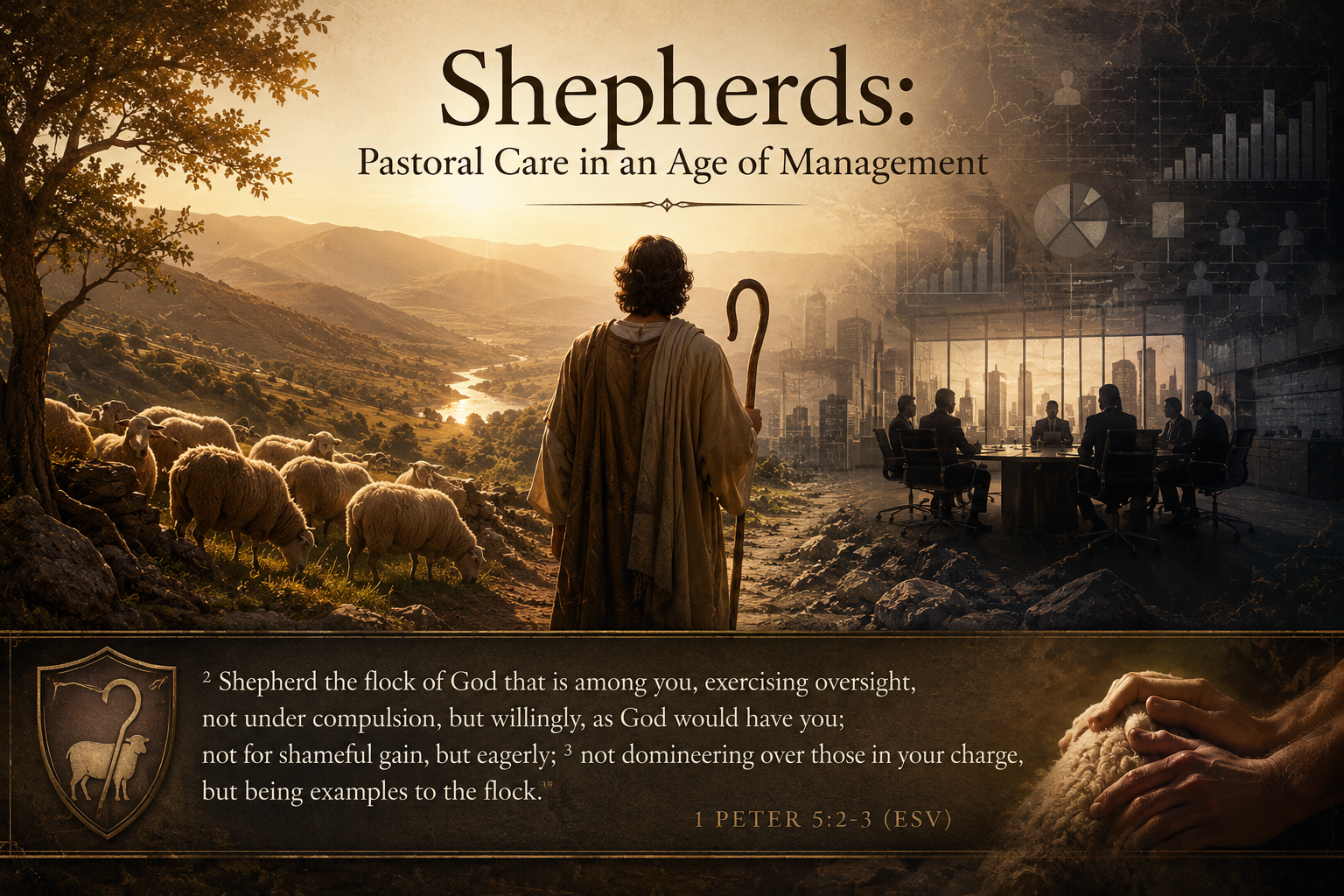
“So I exhort the elders among you, as a fellow elder and a witness of the sufferings of Christ, as well as a partaker in the glory that is going to be revealed: shepherd the flock of God that is among you, exercising oversight, not under compulsion, but willingly, as God would have you; not for shameful gain, but eagerly; not domineering over those in your charge, but being examples to the flock. And when the chief Shepherd appears, you will receive the unfading crown of glory” (1 Pet. 5:1-4).
Ministry leaders today often find themselves caught between two competing models. On one hand stands the biblical image of the shepherd as a leader who knows the flock, guards the vulnerable, feeds the hungry, and bears responsibility before the Lord for the well-being of the people entrusted to his care. On the other hand stands a contemporary managerial model, borrowed largely from the corporate world, which emphasizes organizational efficiency, strategic planning, measurable outcomes, and institutional growth.
While administrative competence is certainly vital for the stewardship of congregational life, a troubling shift has occurred in many churches and ministries. Pastoral leadership is increasingly redefined in managerial terms. As I have referenced in other articles, leaders are evaluated by attendance figures, budget growth, social media influence, and organizational expansion rather than by the spiritual health of the people under their care. The result is that pastoral oversight has become detached from shepherding, authority has become separated from responsibility, and leadership has been reduced to management.
Scripture presents a far different vision. Biblical oversight is fundamentally the care of souls.
The Shepherd Paradigm in Scripture
From the earliest pages of Scripture, leadership is described through the imagery of shepherding. Abraham, Isaac, Jacob, and Moses were all shepherds before becoming leaders of the Lord's people. David was called from tending sheep to shepherd Israel. The Lord Himself is repeatedly described as Israel's Shepherd. Even this author was a shepherd and sheepdog handler/trainer prior to answering the call to ministry.
Psalm 23 remains perhaps the most beloved portrait of biblical leadership: "The Lord is my shepherd; I shall not want."
The shepherd's role was not primarily administrative, at least in the modern sense. His responsibility was relational, protective, and sacrificial. He knew the condition of the flock because he lived among them. He understood their strengths, weaknesses, dangers, and needs. His authority existed, not for his advantage, but for their welfare. This theme continues throughout the prophets. One of the Lord's recurring judgments against Israel's leaders was that they had ceased shepherding the flock entrusted to them.
Through Ezekiel, the Lord declared: "Woe to the shepherds of Israel who feed themselves! Should not the shepherds feed the flocks?" (Ezek. 34:2). This indictment was not that these leaders lacked organizational skill. Their failure was that they neglected the people while advancing themselves. They exercised authority without embracing responsibility. The Lord's remedy was not better management, but faithful shepherding. "I will seek what was lost and bring back what was driven away, bind up the broken and strengthen what was sick" (Ezek. 34:16). Again, the biblical model of leadership is care of the soul.
Messiah as the Chief Shepherd
All biblical leadership ultimately finds its pattern in Yeshua/Jesus, the Good Shepherd. In John 10, Yeshua contrasts Himself with hired servants who abandon the sheep when danger appears. Unlike the hireling, the shepherd remains because the flock belongs to him. "I am the good shepherd; and I know My sheep, and am known by My own" (Jn. 10:14). Notice that the defining characteristic is relationship.
Modern leadership literature often emphasizes influence, vision, strategy, and execution. While these have their place, Jesus emphasizes knowing and being known. Pastoral ministry begins with relationship. The shepherd bears responsibility for the condition of the congregational flock because he lives in covenant relationship with them. Yeshua's authority flowed from sacrificial service. He did not dominate the flock; He laid down His life for it. He is the model concerning the care of His people.
This stands in sharp contrast to worldly concepts of leadership that often seek authority without sacrifice, influence without accountability, and position without burden. The shepherd's burden is the willingness to carry responsibility for those entrusted to his care, as the Torah says of the Levites who would serve in the tabernacle, some were called to “the service of bearing burdens in the tent of meeting” (Num. 4:47). This aspect of ministry is nothing new.
Paul's Model of Leadership
The apostle Paul provides one of the clearest examples of shepherd leadership in the apostolic era. Unfortunately, Paul is often viewed primarily as a church planter, theologian, or organizational strategist. While he certainly functioned in these capacities, his understanding of leadership remained deeply rooted in Hebraic concepts of stewardship and covenant responsibility. Paul did not view congregations as organizations to be managed. He viewed them as communities to be nurtured by those set in positions of responsibility. Writing to the Thessalonians, he described his ministry in remarkably pastoral terms: "We were gentle among you, just as a nursing mother cherishes her own children" (1 Thess. 2:7).
He later adds: "As you know how we exhorted, and comforted, and charged every one of you, as a father does his own children" (1 Thess. 2:11). Paul's leadership combined both tenderness and accountability. He did not lead at a distance, even when he was physically distant. He knew their circumstances, even from a distance. He celebrated victories and mourned losses. He invested himself personally in the spiritual formation of those leading as well as the faithful under his care. His concern extended far beyond attendance or numerical success. He labored until Messiah was formed within them (Gal. 4:19).
Paul's understanding of oversight is perhaps most clearly seen in his farewell address to the Ephesian elders. He reminded them that he had served "with all humility, with many tears and trials" (Acts 20:19), and charged them to "take heed to yourselves and to all the flock, among which the Holy Spirit has made you overseers, to shepherd the church of God" (Acts 20:28). Paul's concern was not institutional maintenance, but the protection and nurture of Messiah’s people.
This language reflects a profoundly Hebraic understanding of leadership. In Jewish thought, authority was inseparable from responsibility. A leader was not measured primarily by power but by faithfulness to his stewardship. In rabbinic Judaism we find the concept of “achrayut” (אַחֲרָיוּת). From a root meaning “the other,” it speaks of leadership taking responsibility, being accountable, or providing faithful care. While not explicitly connected, we could say that Paul consistently viewed ministry through this lens: "Moreover it is required in stewards that one be found faithful" (1 Cor. 4:2). We must remember, as leaders we are not the owners of God's people. We are stewards entrusted with their care and health.
Oversight as Accountability Before God
One of the most neglected dimensions of biblical leadership is the reality of responsibility and accountability. The writer of Hebrews instructs the faithful: "Obey those who rule over you, and be submissive, for they watch out for your souls, as those who must give account" (Heb. 13:17). The phrase "watch out for your souls" reveals the true nature of pastoral oversight. Leaders are not just supervising programs. They are watching over souls. The language evokes the image of the watchman in Ezekiel, who stood responsible for warning the Lord’s people of approaching danger. Like the watchman, the shepherd bears responsibility not only for feeding the flock the Word of God, but for protecting it from spiritual harm.
Such vigilance carries tremendous responsibility. Pastoral authority in Scripture is never autonomous. It exists under the authority of the Lord, is accountable to Him, and is implemented according to Scripture. The pastor works in concert with others of spiritual maturity, the presbytery. But the shepherd will one day answer for how he cared for the flock entrusted to him. This reality should transform our understanding of and approach to leadership.
As I have previously written, the pastor is not just a CEO managing organizational assets. He is a steward entrusted with eternal souls. He cannot measure success solely by growth charts, budgets, or attendance reports alone. He must ask deeper questions.
Are people growing in holiness?
Are they becoming more faithful disciples?
Are they beginning to disciple others?
Are marriages being strengthened?
Are the wounded being restored?
Are the vulnerable being protected?
Are the saints being equipped for faithful service?
These are the concerns of a shepherd.
The Danger of Managerial Ministry
The managerial model becomes dangerous when it replaces rather than supports shepherding. From personal experience, I know that organizations require administration. Budgets must be managed. Facilities must be maintained. Plans must be developed. Scripture itself affirms orderly administration. However, when management becomes the defining paradigm of leadership, people inevitably become viewed as resources rather than souls. Efficiency begins to take precedence over relationship. Productivity becomes more important than formation. Numeric growth becomes more important than faithfulness. Leaders become executives rather than shepherds. To this point, Dr. John Piper named one of his books: Brothers, We are Not Professionals.
This shift often occurs gradually and unintentionally. As ministries grow, administrative demands increase. Meetings multiply. Strategic initiatives expand. Leaders become consumed with organizational concerns. Before long, we spend more time managing systems than shepherding people. The result is frequently exhaustion among leaders and spiritual neglect among congregations. Programs flourish while pastoral care declines. Metrics improve while relationships weaken. Institutions expand while discipleship stagnates.
The problem is not administration itself. The problem arises when administration displaces shepherding, often from a sense of necessity.
The Burden of Knowing the Flock
Biblical shepherding requires proximity. As pastors, we cannot care for sheep we do not know. Peter exhorted elders: "Shepherd the flock of God which is among you, serving as overseers" (1 Pet. 5:2). The phrase "among you" is significant. The shepherd lives among the flock. We are present with them. We share life with them. We understand their struggles because we walk alongside them.
This is one reason pastoral ministry is often burdensome. Genuine oversight requires emotional, spiritual, and relational investment. It is a heavy investment indeed. The shepherd carries the concerns of the flock in prayer. He rejoices in their victories. He grieves over their failures. He bears their burdens. Like Moses interceding for Israel, like Paul carrying daily concern for the assemblies, faithful leaders often carry unseen weights known only to God.
Such burdens cannot be delegated entirely to systems, structures or flow charts. They belong to the calling itself.
Recovering a Theology of Pastoral Care
The primary need for the church today is not better managers. It needs faithful shepherds. It needs leaders who understand that oversight is not control, but care. Authority is not privilege, but stewardship. Leadership is not advancement, but responsibility. This recovery begins with a renewed theology concerning the souls in our care.
Every person entrusted to our care bears the image of God. Every believer is precious to the Chief Shepherd. Every soul represents someone for whom Messiah died. Pastoral ministry therefore becomes challenging, but sacred work.
When leaders embrace this perspective, the priorities of ministry begin to change. Prayer regains its central place. Personal discipleship becomes essential. Pastoral presence becomes valued. Teaching becomes formative rather than solely informative. Authority becomes servant-hearted. Leadership becomes relational. The shepherd once again stands at the center of ministry.
Conclusion
The health of the church today depends largely upon whether ministry leaders recover the biblical understanding of pastoral oversight. Again, the shepherd's burden is not simply to lead an organization. It is to care for souls. This burden cannot be measured by attendance records, financial reports, or organizational achievements. It is measured in faithfulness, stewardship, covenant responsibility, and contact with the lives entrusted to us.
The model given by Moses, David, the prophets, Paul, and ultimately by Yeshua Himself calls leaders back to a higher standard. The shepherd knows the flock. The shepherd feeds the flock. The shepherd protects the flock. The shepherd bears responsibility for the flock. And one day, the shepherd will give account to the Chief Shepherd. What did we do with, for, and to His flock?
May those entrusted with leadership embrace anew the sacred burden of pastoral oversight, not as managers of religious institutions, but as faithful stewards of the souls the Lord has placed within their care. We are shepherding in a season captivated by platforms, metrics, and organizational success. We must recover the ancient calling of the shepherd. Programs may grow institutions, but only shepherds care for souls. The Chief Shepherd has not called us simply to manage His flock, but to know them, feed them, guard them, and one day present them faithfully before Him (2 Cor. 11:2).
In the service of Messiah and His Church,
Bishop Justin D. Elwell
Restoration Fellowship International
