
Ministry of Mentorship
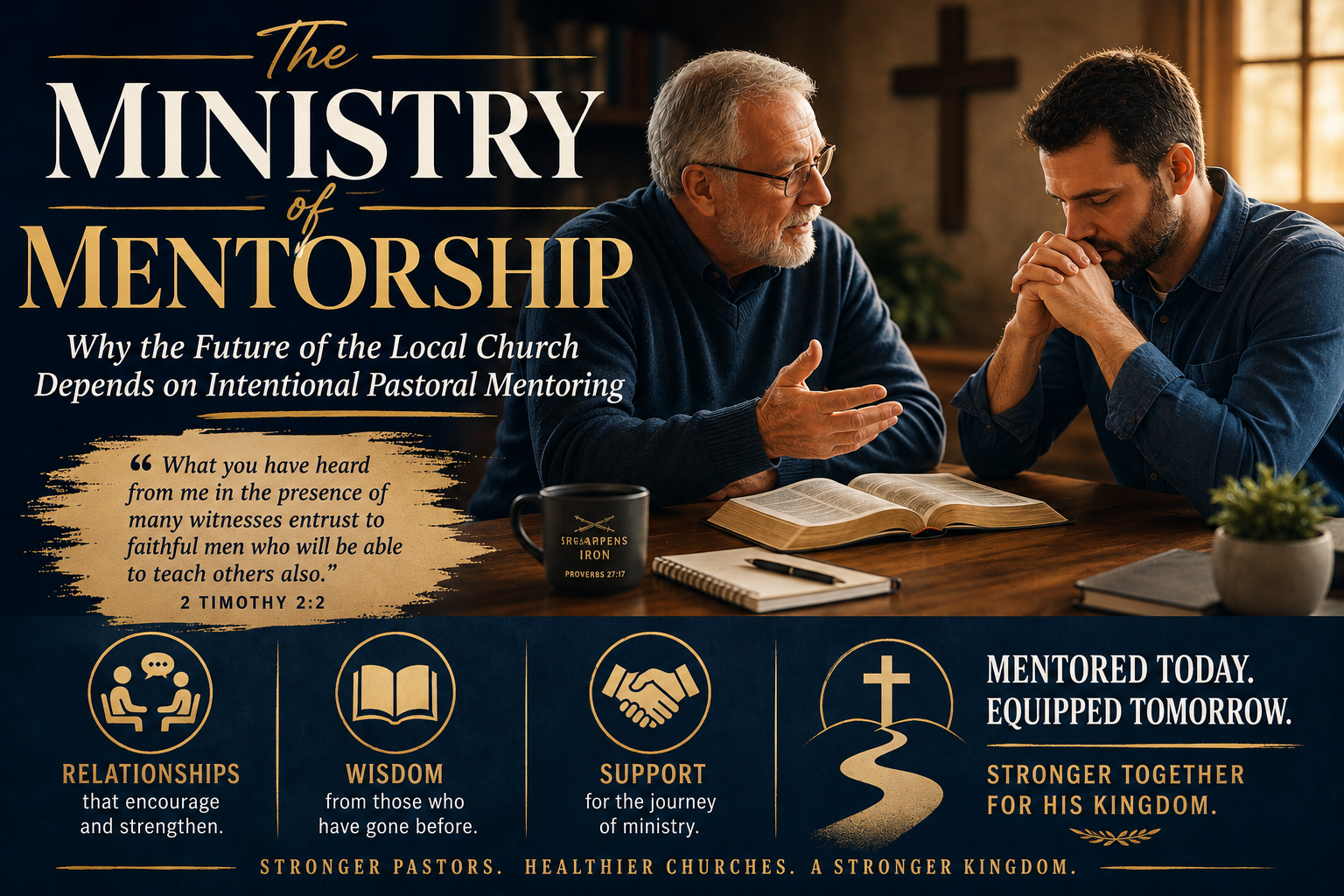
Why the Future of the Local Church Depends on Intentional Pastoral Mentoring
During my years in ministry, I have had the privilege of serving alongside pastors from a wide variety of backgrounds, traditions, and church settings. While every congregation has its own unique challenges, I have noticed a growing concern that continues to surface in conversations with younger ministers. These are people who are devoted to their calling, biblically grounded, and genuinely committed to shepherding the Lord’s people, yet they find themselves struggling under the weight of responsibilities they never anticipated when they first answered the call to ministry.
The issue is not a lack of passion. It is not a lack of theological conviction. In many cases, it is not even a lack of ministry skill. Rather, it is the growing reality that local church leadership has become increasingly complex, particularly in congregations with fewer than one hundred and fifty people.
Most churches in America are not megachurches. Nationwide (USA), according to recent research surveys, the average median weekly church attendance for in-person services is seventy adults. They do not have multiple pastors, administrative departments, communications teams, or extensive staff. They are faithful local congregations led by pastors who often carry responsibilities that extend far beyond preaching, teaching, and pastoral care. In many cases, the pastor is expected to be the chief shepherd, administrator, counselor, teacher, fundraiser, facility manager, technology coordinator, and organizational leader all at the same time.
When I speak with younger pastors, I often hear the same refrain. They entered ministry because they desired to care for people and proclaim the gospel. Yet they find themselves spending a significant portion of their week dealing with budgets, insurance policies, facility maintenance, legal requirements, social media, volunteer coordination, and administrative details. While these tasks are necessary, they can slowly consume the very ministry to which a pastor was called.
The apostles themselves recognized this tension. In Acts 6:4, practical concerns threatened to divert their attention from prayer and the ministry of the Word. Their solution was not to ignore the practical needs of the community, but to establish structures that allowed leadership responsibilities to be shared (Acts 6:3). The lesson remains important today. Healthy ministry requires healthy support systems.
Unfortunately, many younger pastors do not have those support systems.
Alongside administrative pressures, they are also navigating a cultural environment that has become increasingly challenging. Today’s pastor is expected to respond to issues that emerge at a pace unlike anything previous generations experienced. Political polarization, cultural division, social media controversies, and rapidly changing societal expectations create a leadership environment that can be exhausting. Every statement is scrutinized. Every decision is questioned by someone. Every attempt to lead requires navigating a complex web of competing expectations.
Pastors of smaller congregations often feel these pressures even more acutely because they lack the layers of leadership and staff support available in larger ministries. They stand at the intersection of multiple generations, differing viewpoints, and competing priorities, all while trying to faithfully lead their congregations according to the Word of God.
Yet in my observation, the greatest challenge facing younger pastors is neither administrative nor cultural pressure. It is isolation. I wrote at length on this subject in my article The Solitary Pastor.
Ministry can be a lonely calling. While pastors are surrounded by people, we often have very few friends with whom we can speak honestly about our struggles. Congregants look to us for leadership. Boards look to us for direction. Families look to us for stability. In the midst of serving everyone else, many of us discover that we have no one consistently shepherding us.
This is not how ministry was intended to function.
When we examine the Scriptures, we find that leadership was rarely exercised in isolation. Moses had Joshua. Elijah had Elisha. Paul had Timothy and Titus. The New Testament presents ministry as a relational endeavor in which leaders are strengthened through fellowship, accountability, encouragement, and shared labor. Even the Apostle Paul did not walk alone. He surrounded himself with trusted companions and invested deeply in the next generation of leaders.
The relationship between Paul and Timothy is particularly instructive. Paul did not simply ordain Timothy and send him into ministry. He walked alongside him. He taught him. He corrected him. He encouraged him. He prepared him for difficulties and remained a source of wisdom throughout his ministry. The Pastoral Epistles reveal not only a theological exchange but a mentoring relationship rooted in spiritual fatherhood.
This biblical model is one we must recover.
As I look across the broader landscape of the church, I am increasingly convinced that one of the greatest threats to the future of local church leadership is not recruitment but retention. We continue to raise up leaders, but too many are becoming discouraged, exhausted, or overwhelmed before they reach their full effectiveness. The issue is not that the Lord has stopped calling people into ministry. The issue is that too many of those whom He has called are attempting to carry burdens they were never meant to carry alone.
This reality places a unique responsibility upon ministerial associations and networks such as Restoration Fellowship International. Associations exist for more than credentialing and organizational affiliation. They exist to cultivate relationships, provide encouragement, and strengthen those who labor in the service of Christ and His Church.
For many younger pastors, an association may be the only place where genuine peer relationships can be formed with others who understand the unique challenges of ministry leadership. It may be the only place where a pastor can admit uncertainty, ask questions, and receive wisdom from those who have already walked the road before him.
I believe the days ahead will require associations to become increasingly intentional about pastoral mentoring. We must move beyond annual conferences and occasional fellowship gatherings. We must create structures that foster ongoing relationships between younger and older leaders. We must encourage peer-to-peer cohorts where pastors can discuss the realities of ministry life. We must provide opportunities for seasoned ministers to invest directly in emerging leaders. Most importantly, we must cultivate a culture in which seeking help is viewed as a mark of wisdom rather than weakness.
The church has always advanced through relationships. Paul reminded Timothy to entrust what he had learned to faithful men who would teach others also. Within that single instruction we see four generations of leadership connected through intentional discipleship. The Kingdom of God advances when one generation intentionally invests in the next.
As a bishop, I am deeply grateful for the experienced leaders who invested in me throughout my own ministry journey and development. Their counsel, encouragement, and example helped me navigate seasons that I could not have endured alone. Every pastor deserves that same blessing. Every younger leader deserves access to trusted mentors who can help them discern, persevere, and grow.
The future of the local church depends not only upon our ability to identify leaders but also upon our willingness to walk beside them. Healthy churches require healthy pastors. Healthy pastors require healthy relationships. If we fail to shepherd the shepherds, we should not be surprised when many become weary along the way.
Yet if we commit ourselves to intentional mentoring, genuine fellowship, and biblical discipleship among leaders, I believe we can help raise up a generation of pastors who are not only surviving ministry, but thriving in it. Such leaders will strengthen their congregations, serve their communities, and faithfully pass the torch to those who come after them.
The question before us is simple: Who is shepherding the shepherds?
If we are serious about the future of the local church, then we must be equally serious about the care, encouragement, and development of those whom the Lord has called to lead it. How we answer that question may well determine not only our pastors, but the health of our congregations and the strength of our witness for generations to come.
In the service of Messiah and His Church
Bishop Justin D. Elwell
Restoration Fellowship International
