
Tzav (Command) Leviticus 6:8:1-8:36
Weekly Torah Studies for 2025/26 ( 5786).
On the road to Emmaus, Yeshua met with two of His disciples and, beginning at Moses and all the Prophets, He expounded to them in all the Scriptures the things concerning Himself. (Luke 24:27). For our Torah studies this year, therefore, week by week we will seek to discover how all of Torah prepared the way for the coming Messiah.
28th March 2026 (10 Nisan)
Tzav (Command) Leviticus 6:8:1-8:36
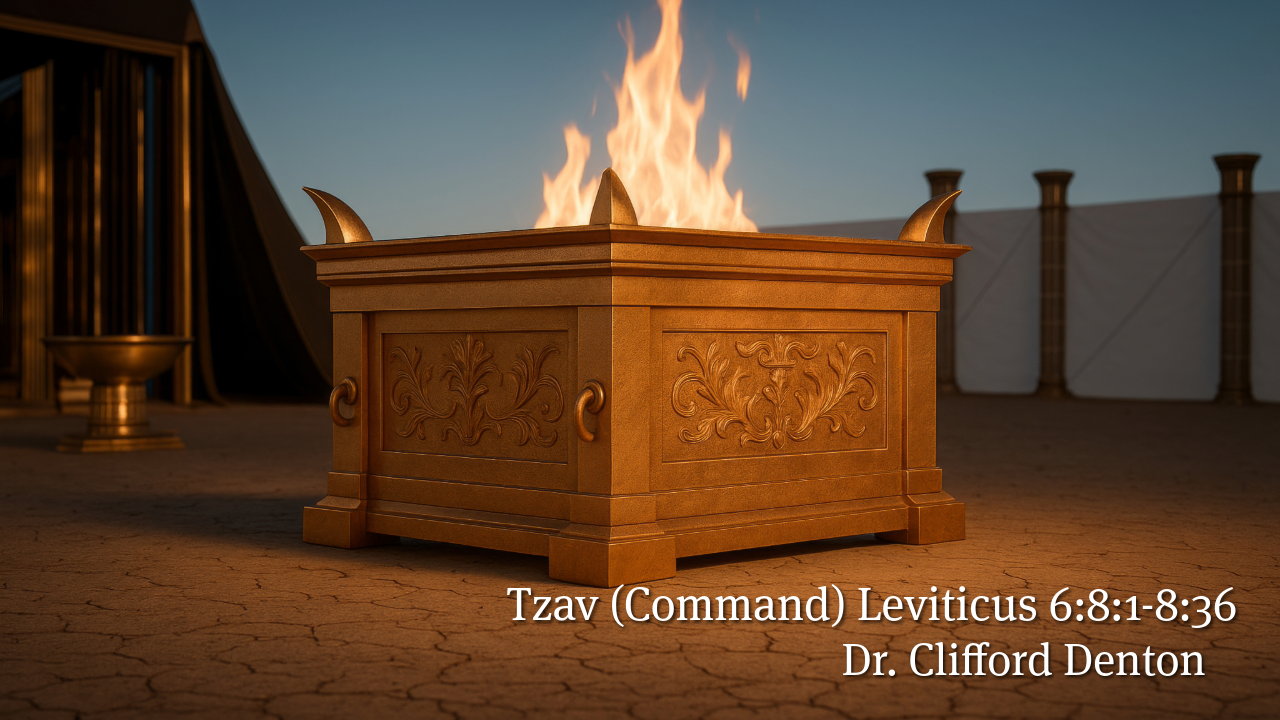
A fire shall always be burning on the altar; it shall never go out. (Leviticus 6:13). This is God’s requirement of His people on earth. It was a physical reality in Aaron’s day and bears implications for all God’s people forever.
The Tabernacle and its ordinances were a representation of a heavenly reality, as was made clear by the writer to the Hebrews. The priests made their offerings on the altar,
the copy and shadow of the heavenly things, as Moses was divinely instructed when he was about to make the tabernacle. For He said, “See that you make all things according to the pattern shown you on the mountain.”(Hebrews 8:5)
God’s chosen people were to live out on earth the ministry that is in Heaven. In God’s heart, despite the Fall, is the ongoing and continuous desire that His people will live in harmony with Him. This is the deep meaning of the ministry for which Aaron and his sons were prepared.
We read in our portion this week how the appointed Priests were prepared for this service exactly according to the pattern given to Moses, in obedience, order, dignity and honour.
It was at a cost. The lives of beautiful, healthy animals were sacrificed, and they were offered to God at the altar, so that the priestly ministry would be acceptable to God and that the priests could come into His presence on behalf of the people.
An era was to begin whereby there would be a continuous burning fire on the altar of sacrifice, just as there is a continuous ministry before God in Heaven on our behalf. It was necessary for God’s people to bring to earth the ministry of Heaven. There can be nothing more important for us than to be constantly in fellowship with our Creator God, for blessing on earth as well as preparation for the Heavenly reality when we leave this earth.
There is an image that is a forerunner of this, when Moses stood on a mountain with his arms raised as Joshua led Israel in battle with the Amalekites (Exodus 17:8-16). Aaron and Hur were with him and they experienced how when Moses’ arms were raised there was victory for Joshua, but when they dropped, Amalek prevailed. Perhaps Aaron would remember this when, in later days, he was to keep the fire of God burning continually, as well as the lamps shining in the Holy place.
We must interpret all these outward symbols as a matter of the heart: our prayers are continually and forever to be alive towards God – intercessory prayer for forgiveness as well as prayers that God will bring blessing to our lives, the lives of our family and all the community of His people.
The fact that the fire on the altar should always be burning is recalled throughout the history of the Children of Israel. It was not easy to maintain this. The Babylonian captivity, for example, brought an end to sacrifice and offering for 70 years, following the destruction of the Temple. This came about when fellowship with God had declined, coincident with the time when sacrifice and offering fell from the height of meaning made known at the time of Aaron’s inauguration. Even when Zerubbabel, Ezra and Nehemiah were to bring restoration to the Temple and its ordinances after the long captivity, prophets such as Malachi were still needed to remind the people of the importance of unblemished sacrifice and offering.
Prior to the Assyrian invasion of Israel and the later Babylonian captivity of Judah, warnings were given constantly by prominent prophets, including Isaiah and Jeremiah. Israel’s responsibility was not simply in the ordinances of the Tabernacle and Temple, but they were to be manifest in all aspects of justice and mercy of the Torah. The purity of sacrifice and offering and consequent intercessory prayer was to coincide with the righteousness of the nation. The light towards God was to be simultaneous with the light in the community and, as a consequence, to the world. But when one aspect decayed, the rest did also, even to the worship of false gods of the nations replacing pure undivided worship of the One True God.
Amos was among those who spoke clearly about this in his earnest plea to Israel (Amos 5):
Woe to you who desire the day of the Lord!
For what good is the day of the Lord to you?
It will be darkness, and not light.
It will be as though a man fled from a lion,
And a bear met him!
Or as though he went into the house,
Leaned his hand on the wall,
And a serpent bit him!
Is not the day of the Lord darkness, and not light?
Is it not very dark, with no brightness in it?
I hate, I despise your feast days,
And I do not savour your sacred assemblies.
Though you offer Me burnt offerings and your grain offerings,
I will not accept them,
Nor will I regard your fattened peace offerings.
Take away from Me the noise of your songs,
For I will not hear the melody of your stringed instruments.
But let justice run down like water,
And righteousness like a mighty stream.
Did you offer Me sacrifices and offerings
In the wilderness forty years, O house of Israel?
You also carried Sikkuth your king
And Chiun, your idols,
The star of your gods,
Which you made for yourselves.
Therefore I will send you into captivity beyond Damascus,”
Says the Lord, whose name is the God of hosts. (Amos 5:18-27)
When the fire did not burn continually on the altar according to God’s intent, it signalled the heart issue of God’s people, where the flame of God’s Spirit should always burn.
Mankind may fail, but God’s purposes prevail. His Heavenly fire and zeal has not dimmed. Thus, embedded in the prophetic Scriptures is always a word of hope and ultimate purpose of God. He covenanted with Abraham to draw from all nations a family to fulfil those purposes. History shows, sadly, that what gloriously began in the wilderness at the time of Moses and Aaron did not fully succeed, but that a greater and living sacrifice would fulfil the same purpose – the eternal fire will not go out and will find its representation on earth in God’s people in an even better way.
Strive though we may, to reinstate the Temple and its sacrifices such as at the time of Zerubbabel, we will always fail, by this means alone, to reach the perfection that God requires. God teaches this through the outworking of history, measured against His Torah, and through the message of the Prophets.
Isaiah, therefore, speaks clearly of the coming Sacrifice that would restore God’s people fully, through faith. It was at an infinitely greater cost than the old covenant sacrifice of beautiful animals on the altar:
Who has believed our report?
And to whom has the arm of the Lord been revealed?
For He shall grow up before Him as a tender plant,
And as a root out of dry ground …..
Surely He has borne our griefs
And carried our sorrows;
Yet we esteemed Him stricken,
Smitten by God, and afflicted.
But He was wounded for our transgressions,
He was bruised for our iniquities;
The chastisement for our peace was upon Him,
And by His stripes we are healed……
He was led as a lamb to the slaughter,
And as a sheep before its shearers is silent,
So He opened not His mouth…..
Yet it pleased the Lord to bruise Him;
He has put Him to grief.
When You make His soul an offering for sin,
He shall see His seed, He shall prolong His days,
And the pleasure of the Lord shall prosper in His hand.
He shall see the labour of His soul, and be satisfied.
By His knowledge My righteous Servant shall justify many,
For He shall bear their iniquities.
Therefore I will divide Him a portion with the great,
And He shall divide the spoil with the strong,
Because He poured out His soul unto death,
And He was numbered with the transgressors,
And He bore the sin of many,
And made intercession for the transgressors. (Isaiah 53)
The Prophets foresaw the sacrifice of Yeshua on the Cross. He is both the sacrifice and the High Priest that was modelled first in the ministry of Aaron, but which was not sustainable, as later history shows.
Isaiah was able to burst forth through the wonderful Scriptures that end his prophecies, based on the expectation of the coming Messiah. He was able to speak of a light that cannot be dimmed and that would break forth among both a remnant of the Children of Israel and also the Gentiles who are redeemed by faith in the Jewish Messiah, Yeshua HaMashiach:
Arise, shine;
For your light has come!
And the glory of the Lord is risen upon you.
For behold, the darkness shall cover the earth,
And deep darkness the people;
But the Lord will arise over you,
And His glory will be seen upon you.
The Gentiles shall come to your light,
And kings to the brightness of your rising.
Lift up your eyes all around, and see:
They all gather together, they come to you;
Your sons shall come from afar,
And your daughters shall be nursed at your side.
Then you shall see and become radiant,
And your heart shall swell with joy…. (Isaiah 60:1-5)
We began by considering the fire that should always be burning on the altar before God, representing a reality that is forever in Heaven. Yeshua also spoke of that light.
He spoke of the constancy of prayer that emanates from the Light of the Holy Spirit within His disciples, whilst our High Priest, Yeshua HaMashiach, ministers continually on our behalf.
He is also able to save to the uttermost those who come to God through Him, since He always lives to make intercession for them. (Hebrews 7:25)
He calls us into a new priesthood:
You are a chosen generation, a royal priesthood, a holy nation, His own special people, that you may proclaim the praises of Him who called you out of darkness into His marvellous light. (1 Peter 2:9)
We have a responsibility which is the fulfilment of that given to the Aaronic priesthood:
Therefore, brethren, having boldness to enter the Holiest by the blood of Jesus, by a new and living way which He consecrated for us, through the veil, that is, His flesh, and having a High Priest over the house of God, let us draw near with a true heart in full assurance of faith, having our hearts sprinkled from an evil conscience and our bodies washed with pure water. Let us hold fast the confession of our hope without wavering, for He who promised is faithful. And let us consider one another in order to stir up love and good works, not forsaking the assembling of ourselves together, as is the manner of some, but exhorting one another, and so much the more as you see the Day approaching. (Hebrews 10:19-25)
This is because of the New Covenant prophesied by Jeremiah (Jeremiah 31).
In so doing, we fulfil what Aaron was commanded concerning the fire always burning on the altar. Yeshua’s sacrifice is forever before God as the fire on the heavenly altar. We, in Him, are the light that must not go out on this earth:
You are the light of the world. A city that is set on a hill cannot be hidden. Nor do they light a lamp and put it under a basket, but on a lampstand, and it gives light to all who are in the house. Let your light so shine before men, that they may see your good works and glorify your Father in heaven. (Matthew 5:14-16)
Dr Clifford Denton
Founder and Director
Tishrei Bible School
