
Ki Tisa (When you elevate): Exodus 30:11-34:35
Weekly Torah Studies for 2025/26 ( 5786).
On the road to Emmaus, Yeshua met with two of His disciples and, beginning at Moses and all the Prophets, He expounded to them in all the Scriptures the things concerning Himself. (Luke 24:27). For our Torah studies this year, therefore, week by week we will seek to discover how all of Torah prepared the way for the coming Messiah.
7th March 2026 (18 Adar)
Ki Tisa (When you elevate): Exodus 30:11-34:35
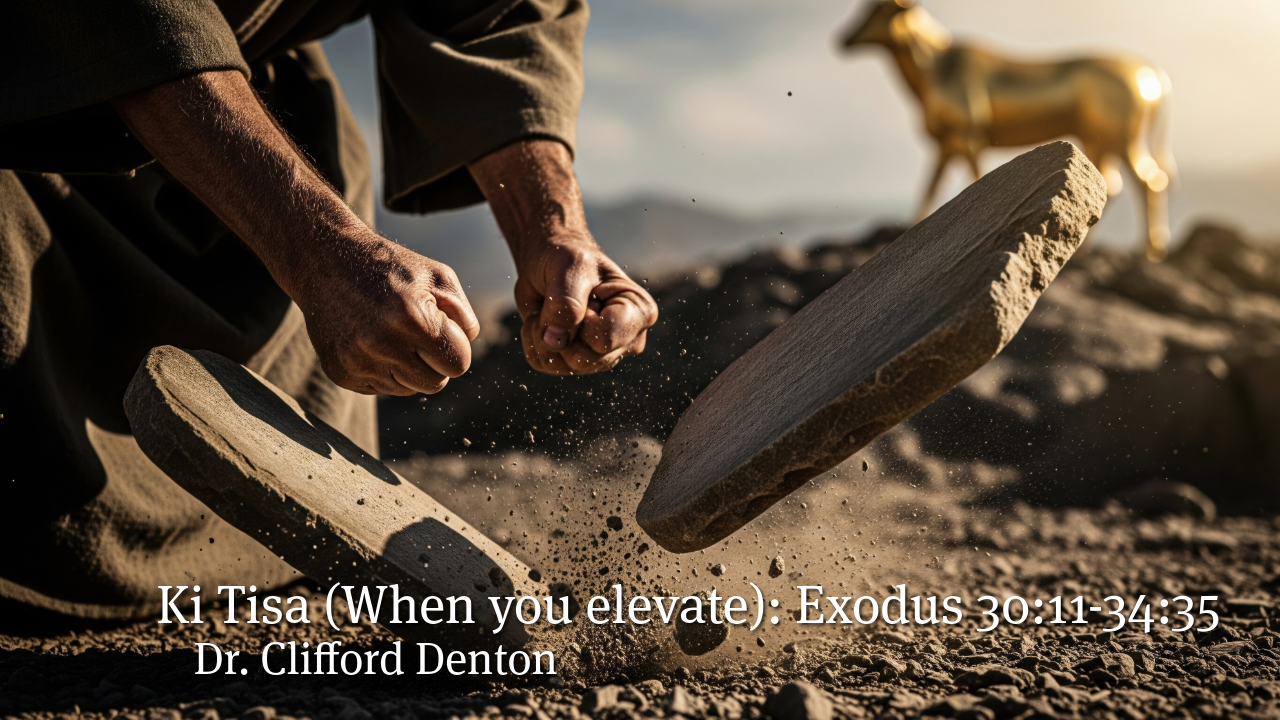
How well do we know our God and Father? We who have known His love may find it hard to also understand His wrath. The question is, how can the heart of pure love also seem to flip to an anger that is only quietened when the perpetrators of evil are taken from this world, as in our portion this week? After the Children of Israel made a golden calf for themselves, first the sons of Levi killed 3,000 of the leaders of the rebellion, and then God sent a plague to the camp of Israel (Exodus 32:28 and 35). How well did the Children of Israel know the God of Abraham, to have turned so quickly from Him when Moses was away for what seemed like a long time?
Just at the point in time when the laws of God were becoming known, and after the death of those who transgressed, would the Israelites then have understood the true character of God? They may have found it difficult to see beyond God’s wrath to His loving mercy. Perhaps the God of Israel has continued to be misunderstood over many centuries and, for some, even to today.
Surely, however, the justice of God was not vindictive, hateful or simply retributional. The word punishment is used in Exodus 32:34, but is this the complete picture? God said to Moses that He would blot out the entire nation of Israel and build a nation again through him (Exodus 32:10). Out of the entire earth, at that time, it seemed that God would have been satisfied if there was just one man who would live in pure obedient relationship with Him, at the expense of all other men and women who would not. This is the same God who regretted creating mankind and had wiped all of them away at the Great Flood and built again through one righteous man, Noah, and his close family. It must be taken seriously what God said He would do again, this time through Moses. Yet, we must look beyond even this if we are to know God as He truly is.
We can begin to understand the Father heart of God if we are parents ourselves. This is the closest we can understand the heart of God through our own human experience. If we desire the best for our children borne out of loving relationship, does it not tear into the depth of our heart if they stray from the right path, as all do in small or great measure at some time? Our parental response is to bring discipline and establish a right path but at cost to ourselves, as deep love responds in corrective measures.
The parable of the prodigal son, told by Yeshua (Luke 15:11-32), for example, stands testimony to the loving heart of Father God.
This indicates how deeply we must seek to understand what we are reading this week. We are at the beginning of the time when God in Heaven sought to form a covenant family here on earth. We, like they, must mature in our knowledge of our Father in Heaven.
The great warning to us is that during the long time that Moses was on the mountain with God, his own people were not patient and trusting. This was despite all that they had witnessed by the Hand of God in bringing them out of Egypt to Sinai. The Golden Calf becomes a teaching of what can happen when human beings forget the promises of God and even the evidence of His care for them, and invent gods of their own making.
Beware over-reaction in times of waiting and seeming silence from God!
Look at the world today. We have the truths of the Bible accessible to every country, and we have the testimony of Yeshua proclaimed in the Gospel message over many centuries, and witnessed by those who have been called into His worldwide community of faith. We were not at Sinai with Moses but every generation can recount how God has intervened in the affairs of men, whether it be through spiritual revivals within the community of believers, through the testimony of God’s care and guidance of individuals, in families and even in nations that have sought to be founded on biblical truths and values. Many times we have been brought through major crises including, at the national level, recent wars, diseases and financial problems.
Yet the world is still full of images of false gods and distorted ideas about the way to live. It is as if mankind looks for every excuse to ignore or undermine the God of Abraham, be it through science or humanistic endeavours which cause us to look inward to ourselves and our potential, rather than upward to God. This influences our politics as well as our religion. The Book of Revelation prophesies a coming world system, whose people bow the knee to the false god called the antichrist. This is comparable to the Golden Calf of Moses’ day.
There is a parallel with Moses going up to the mountain with God for an indeterminate time, when Yeshua ascended to the Father after His sacrificial death. Indeed, His sacrificial death brings echoes of Moses’ intercessions for Israel, when God said that He would destroy Israel and build again through him. In the One Man Yeshua, all the building of the covenant community is now taking place. He is the single focus as Moses was not to be.
Returning for a moment to our first question, if we need to learn of God’s love, we have the entire life, ministry and sacrifice of Yeshua to consider. If we consider Yeshua on the Cross, we are witnesses to the full depth, breadth and fulness of God’s love for us. The outpouring of wrath that should come to mankind, was shared between Father and Son, in the deepest response to what the pure but uncompromising love of God means.
Evidence of the completeness of what occurred through the Cross came at the first Shavuot (Pentecost) following Yeshua’s death and resurrection. Were not the 3,000 who died at the hands of the sons of Levi in mind when, at the outpouring of the Holy Spirit, 3,000 from many nations were redeemed to God (Acts 2:41)? Was not the giving of the Torah through Moses the first Shavuot, and the giving of the Holy Spirit to write the Torah on our hearts, the first Shavuot of the New Covenant? These are evidences of how the ministry of Yeshua was greater than but comparable to that of Moses.
The Father came and lived with His people through His Son. Yeshua made this clear to His disciples:
Philip said to Him, “Lord, show us the Father, and it is sufficient for us.”
Jesus said to him, “Have I been with you so long, and yet you have not known Me, Philip? He who has seen Me has seen the Father; so how can you say, ‘Show us the Father’? Do you not believe that I am in the Father, and the Father in Me? The words that I speak to you I do not speak on My own authority; but the Father who dwells in Me does the works. (John 14:8-10)
We must consider the condition for our own lives as we reflect on what happened in Israel, when Moses went up to spend time with God on the mountain. Because of what seemed like a long time for Moses to be away, the people wondered if he was ever coming back. So let us also consider our own situation – personally, in our family and in our believing community - as we now wait for the return of Yeshua.
Remember first, what was said of Him when He ascended to be with God the Father:
…. while they watched, He was taken up, and a cloud received Him out of their sight. And while they looked steadfastly toward heaven as He went up, behold, two men stood by them in white apparel, who also said, “Men of Galilee, why do you stand gazing up into heaven? This same Jesus, who was taken up from you into heaven, will so come in like manner as you saw Him go into heaven.” (Acts 1:9-11)
If we find ourselves wondering if Yeshua will return, we must stand firm on the promise that He will – at the right time. Always remember how this compares directly with the situation of Moses on the mountain at Sinai with God, preparing for the time when the community of Israel was to be organised as a nation under God. We do not want to lose heart, or be impatient, as the Children of Israel did.
Yeshua, using a parable about an unjust judge, caused His disciples to consider the difficulties of being in an unjust world waiting for His return. He asked:
Shall God not avenge His own elect who cry out day and night to Him, though He bears long with them? I tell you that He will avenge them speedily. Nevertheless, when the Son of Man comes, will He really find faith on the earth? (Luke 18:7-8)
It is a stark warning that it is possible to fall away from faith during the time when we wait for Yeshua’s return. Yeshua also emphasised this in His prophecy concerning troubled times before His return, as recorded in Matthew 24, Mark 13 and Luke 21:
Then they will deliver you up to tribulation and kill you, and you will be hated by all nations for My name’s sake. And then many will be offended, will betray one another, and will hate one another. Then many false prophets will rise up and deceive many. And because lawlessness will abound, the love of many will grow cold. But he who endures to the end shall be saved. And this gospel of the kingdom will be preached in all the world as a witness to all the nations, and then the end will come. (Matthew 24:9-14)
There will be a falling away, typified by the Golden Calf at Sinai. Yeshua, time and again, warned us about difficulties in the period before His return and reiterated His warning that even among His people there can be those who fall away, illustrated by the parable of the wise and foolish virgins (Matthew 25).
Always, He told us to watch out for Him, prepare for Him and to constantly be in prayer.
Watch therefore, for you know neither the day nor the hour in which the Son of Man is coming. (Matthew 25:13)
This is a strong lesson for us from the Torah Portion this week. There is a clear parallel between Moses and Yeshua. Paul the Apostle, who studied the Torah under Gamaliel prior to his revelation of Yeshua, knew this very well:
For whatever things were written before were written for our learning, that we through the patience and comfort of the Scriptures might have hope. (Romans 15:4)
We return to our initial question as to how well we know God - to have a personal trusting relationship with Him - that will keep us steadfast in the faith whatever comes.
Remember the purpose of Yeshua’s sacrificial life and death, as prayed in the High Priestly prayer of John 17:
Father, the hour has come. Glorify your Son, that your Son may glorify you. For you granted him authority over all people that he might give eternal life to all those you have given him. Now this is eternal life: that they know you, the only true God, and Jesus Christ, whom you have sent. (John 17:1-3)
Dr Clifford Denton
Founder and Director
Tishrei Bible School
