
Tetzaveh (You shall command): Exodus 27:20-30:10
Weekly Torah Studies for 2025/26 ( 5786).
On the road to Emmaus, Yeshua met with two of His disciples and, beginning at Moses and all the Prophets, He expounded to them in all the Scriptures the things concerning Himself. (Luke 24:27). For our Torah studies this year, therefore, week by week we will seek to discover how all of Torah prepared the way for the coming Messiah.
28th February 2026 (11 Adar)
Tetzaveh (You shall command): Exodus 27:20-30:10
Imagine that you are called into the presence of the president of a big corporation for whom you work. Your future prosperity depends on how you appear, how you answer questions, how respectful you are and how good his reports of you seem. Most likely, you would tidy yourself up, and rehearse all your answers to expected questions, ready to make your case and defend yourself if necessary.
Now imagine going into the presence of an earthly king, perhaps as Esther went into the presence King Ahasuerus. This could be even more fearful. Surely, you would set out to look your very best, do all that the monarch required, following all courtly protocol. Esther, remember was prepared with precious ointments for one year in advance of her being taken to the King’s palace (Esther 2:12). Ahasuerus had earlier set up a court with curtains of white, blue and purple fine linen (Esther 1:6) for a special feast.
Now try to conceive how it would be, to be called into the presence of the Creator of the universe, to the heavenly throne-room: a place of awe, wonder, infinite beauty and purity. Isaiah was so privileged. Would our response be the same as his?
In the year that King Uzziah died, I saw the Lord sitting on a throne, high and lifted up, and the train of His robe filled the temple. Above it stood seraphim; each one had six wings: with two he covered his face, with two he covered his feet, and with two he flew. And one cried to another and said:
“Holy, holy, holy is the Lord of hosts;
The whole earth is full of His glory!”
And the posts of the door were shaken by the voice of him who cried out, and the house was filled with smoke.
So I said:
“Woe is me, for I am undone!
Because I am a man of unclean lips,
And I dwell in the midst of a people of unclean lips;
For my eyes have seen the King,
The Lord of hosts.” (Isaiah 6:1-5)
It is with such thoughts as these that we should read this week’s portion.
Aaron and his sons were to be dressed, and prepared for their priestly ministry as God specified through Moses. Only then, could they approach God in the place prepared for Him. Daily, they must tend the lamps, prepare the shewbread and perform the sacrifices, with the help of the Levites. Once a year the High Priest, first Aaron, and thereafter for future generations his appointed successor, must go into the very presence of God.
In what attitude should Aaron approach the throne of God? He was not to go in to have a trivial conversation, ask for a pay rise, or defend his actions to some human employer, or even defend his life, as in the presence of some worldly kings. He dressed in holy garments made for glory and honour (Exodus 28:2). Then he made his way from the brazen altar, through the outer court to the threshold of the inner court. The inner court was bathed in the light of the burning lamps on the golden menorah, showing the ornamental design of the curtains, woven with blue, purple and scarlet thread. Perhaps he would pause and prepare himself wondering at the symbolism before him. Is not blue symbolic of the heavens and red symbolic of the earth? Purple is made from an expensive dye, often symbolising kingship. Yet it is also a blend of red and blue, mixing the colour of earth with the colour of heaven, an intermediary as it were between heaven and earth, between God and mankind. Was this his role, to intercede for his nation, rather than look to his own personal needs?
The ephod and the breastplate were also woven with these same colours, of gold, blue, purple and scarlet. The High Priest carried symbols of the twelve tribes of Israel in engraved onyx stones carried on his shoulder, and also twelve precious stones, carried over his heart (Exodus 28).
This was not a personal visit to the King of the Universe, but a dutiful visit on behalf of his people, Israel. All the symbols point to the ministry of intercession. This was not simply a ministry of the spoken word but a complete embodiment of it. It is a necessary ministry, answering the need of fallen mankind in a fallen world. God, by His grace, brought His heavenly presence to earth and allowed a bridge to be built to Himself that He might, in all royal dignity and purity, give a means for mankind to regain fellowship with Him that was lost through Adam and Eve.
The tiny nation of Israel was chosen so that all of mankind could learn their need and a way for redemption.
Inevitably there was failure. It would take more than representatives of fallen mankind with fallen nature to make the way of redemption permanent. The outer appearance and magnificence of the ordinances of the Tabernacle and Temple were not sufficient. As God said, sometime later concerning King David, the Lord does not see as man sees; for man looks at the outward appearance, but the Lord looks at the heart.(1 Samuel 16:7)
A crisis came for Judah when God allowed the Babylonians to take the nation into captivity. Ezekiel prophesied at that time concerning the great falling away of the nation. The Temple would soon fall at the time of the Babylonian invasion. The very place set aside for the High Priest to meet with God would soon be removed. Ezekiel 22 lays the sins of Judah bare, ending with the following:
The people of the land have used oppressions, committed robbery, and mistreated the poor and needy; and they wrongfully oppress the stranger. So I sought for a man among them who would make a wall, and stand in the gap before Me on behalf of the land, that I should not destroy it; but I found no one. Therefore I have poured out My indignation on them; I have consumed them with the fire of My wrath; and I have recompensed their deeds on their own heads,” says the Lord God. (Ezekiel 22:29-31)
This speaks of the importance of the ministry of the Priests of the Tabernacle, and how eventually even that wonderful system failed and God’s glory departed from the Temple. It speaks, therefore, also of the need for a greater priesthood, and a High Priest with a pure heart, willing to give Himself for His people. That High Priest is Yeshua HaMashiach. The writer to the Hebrews identifies Him as being typified by Melchizedek (Hebrews 7), a personal calling not in the line of Levi.
Now this is the main point of the things we are saying: We have such a High Priest, who is seated at the right hand of the throne of the Majesty in the heavens, a Minister of the sanctuary and of the true tabernacle which the Lord erected, and not man.
For every high priest is appointed to offer both gifts and sacrifices. Therefore it is necessary that this One also have something to offer. For if He were on earth, He would not be a priest, since there are priests who offer the gifts according to the law; who serve the copy and shadow of the heavenly things, as Moses was divinely instructed when he was about to make the tabernacle. For He said, “See that you make all things according to the pattern shown you on the mountain.” But now He has obtained a more excellent ministry, inasmuch as He is also Mediator of a better covenant, which was established on better promises. (Hebrews 8:1-6)
But Messiah came as High Priest of the good things to come, with the greater and more perfect tabernacle not made with hands, that is, not of this creation. Not with the blood of goats and calves, but with His own blood He entered the Most Holy Place once for all, having obtained eternal redemption. For if the blood of bulls and goats and the ashes of a heifer, sprinkling the unclean, sanctifies for the purifying of the flesh, how much more shall the blood of Messiah, who through the eternal Spirit offered Himself without spot to God, cleanse your conscience from dead works to serve the living God? And for this reason He is the Mediator of the new covenant, by means of death, for the redemption of the transgressions under the first covenant, that those who are called may receive the promise of the eternal inheritance. (Hebrews 9:11-15)
Just as Aaron and his sons carried the burden of intercession for the entire nation of Israel, so Yeshua HaMashiach carried the burden of the sins of the entire world. He is also able to save to the uttermost those who come to God through Him, since He always lives to make intercession for them. (Hebrews 7:25)
Sin is both individual and corporate. We each affect others around us for good or evil so that we cannot avoid the consequences of our interactions with one another, whether it be through interactions in our family, our neighbourhood or our nation. What sometimes seem like relatively small matters can scar lives of others, and they us, for many years. At its height our corporate sins lead to all the problems in our world, even wars, hunger and poverty.
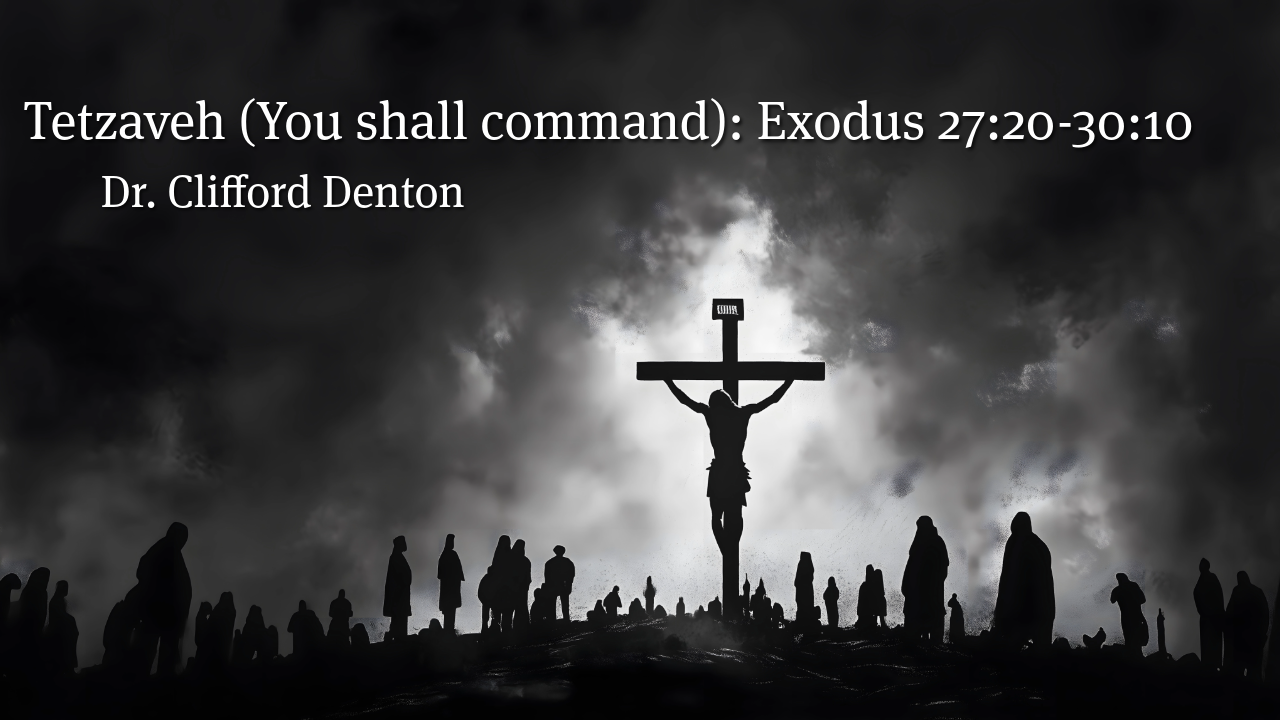
All these considerations move us to consider Yeshua’s sacrifice on the Cross, fulfilling in His death both the sacrifice and the ministry of intercession. His prayers were first for His own people, the nation of Israel. They were also for the wider world, both individuals and communities. His intercessory prayer for us all echoes through all time.
Father, forgive them, for they do not know what they do. (Luke 23:34)
Such prayer, at the moment of deepest personal pain, came from the purest and most sacrificial of hearts, the very heart of God, for us all. This is the fulfilment of the ministry of the High Priest which begins in our Bible study this week.
Dr Clifford Denton
Founder and Director
Tishrei Bible School
