
When They Don't Need You
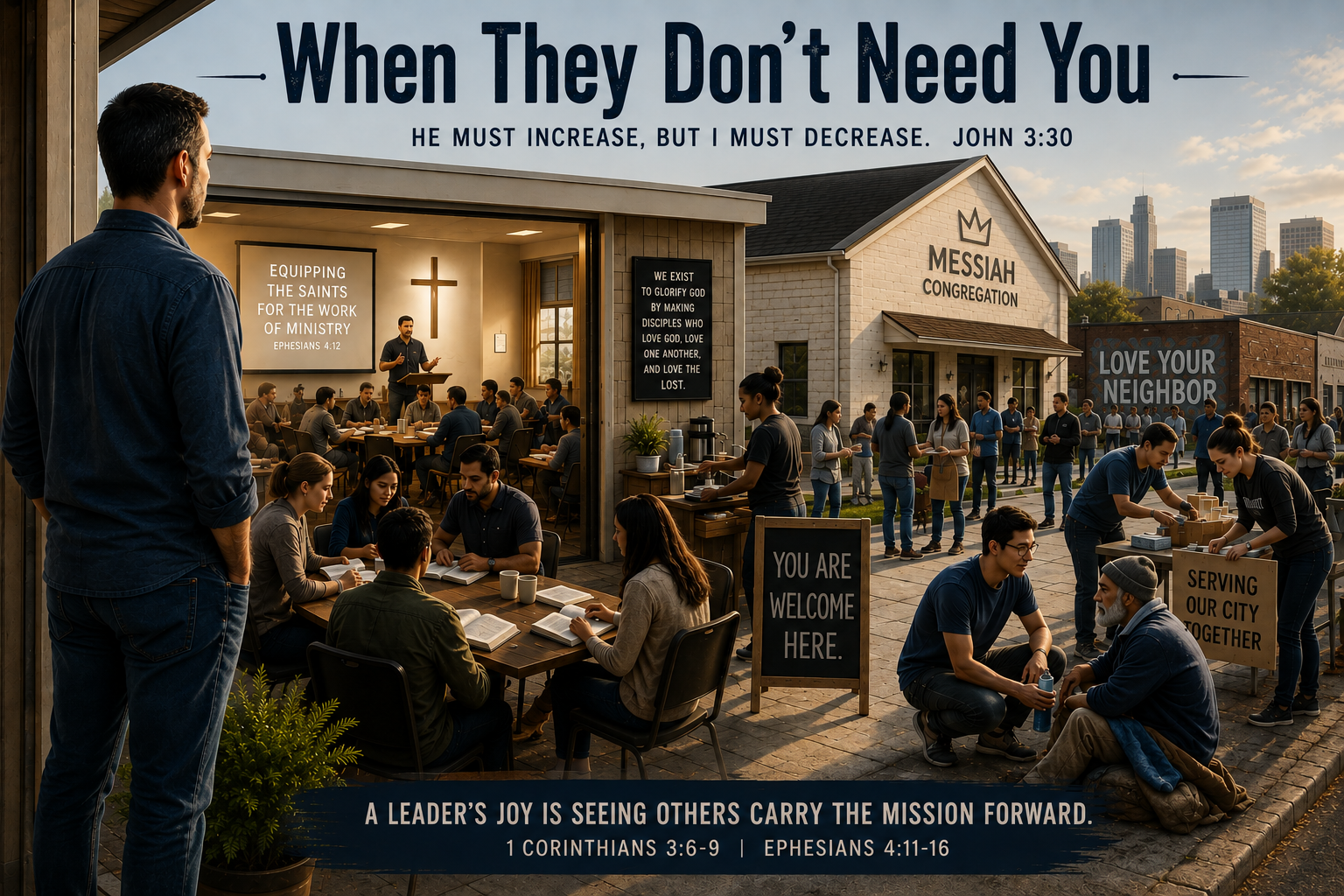
What happens when everyone wants to be their own brand? It is an especially important question in an era of consumer-driven media, where nearly everyone has the opportunity to develop a platform, cultivate an audience, and become recognizable through the content they produce. We have become accustomed to following personalities. We subscribe to individuals, listen to their opinions, watch their videos, read their posts, and often measure influence by numbers of followers, views, and engagements. There is nothing inherently wrong with having a recognizable voice or communicating through contemporary media, I do it on a weekly basis. The question for Christian leadership, however, is more fundamental: where does the gospel fit into the management of a personal brand?
There is a danger when the messenger gradually becomes more important than the mission (1 Cor. 3:5-9). What happens when our brand replaces the work we were called to do? What happens when a congregation becomes so accustomed to hearing one voice that it cannot imagine the ministry continuing without that person? What happens when the pastor’s personality, preaching style, presence, and leadership become so closely identified with the congregation that his absence creates uncertainty about what comes next? These are not just questions about succession. They are questions about whether we have built something around ourselves or whether we have faithfully built something that belongs to Messiah.
I have had to think about these questions more as I have grown older, yes, I know I am only 35 plus 17, but indulge me, and as family circumstances have changed. When I was younger, I could manage a great deal. Administrative responsibilities, music, preaching, teaching, pastoral care, and the countless things that accompany congregational life could all be carried at the same time. In many cases, I did those things simply because there was no alternative. If something needed to be done, I did it. If there was a need, I tried to meet it. My motivation was missional. I wanted the work to move forward, and I was willing to do whatever was necessary to make that happen, unfortunately, these missional blinders did not always serve the mission very well.
What I did not recognize at the time was that faithful service can unintentionally produce an unhealthy dependency. Without intending to do so, I was establishing patterns of expectation. Week after week, people heard me preach. They looked to me for direction. They became accustomed to my voice, my teaching, my leadership, and my presence. I was not consciously trying to build a personal brand. I was trying to serve the congregation. Yet over many years, the two can become difficult to distinguish. A leader can become the face of the mission simply because he has been faithfully present for a very long time.
There is an important difference between being known and becoming indispensable. Every pastor should desire to be known by the people he serves. Shepherding requires relationship, presence, trust, and familiarity. But there is a danger when the health of the congregation becomes dependent upon the continued presence of one individual. If the ministry cannot function without its primary leader, then something has gone wrong in the process of equipping the saints.
Paul presents a very different vision of ministry in Ephesians 4. The ministry gifts given to the Church are not intended to create perpetual dependence upon the minister. They are given “for the equipping of the saints for the work of ministry, for the edifying of the body of Messiah.” The goal of ministry is not to make the minister indispensable. The goal is to equip the body.
That realization has caused some intentional redirection in my own ministry. We have a wonderful, experienced, and well-prepared ministry team at Messiah Congregation. From our elders to our ministers, these men and women know the mission. They understand who we are as a unique congregation, what we believe, and what we have been commissioned to accomplish. More importantly, they are capable of advancing that mission.
Due to circumstances in my own life, I have had to depend upon them more than I once allowed myself to. At first, there can be something uncomfortable about stepping back. When you have spent decades carrying responsibility, it is easy to assume that everything depends upon you. There can even be a subtle sense of guilt when you are not doing what you have always done. But something unexpected happened when I began to step back: I discovered that the work continued.
Not only did it continue, it flourished.
The people I had been serving were capable of serving others. The ministers I had been working alongside were capable of leading. The elders understood their responsibility. The congregation was not waiting helplessly for me to return and make everything work again. They were doing what they had been equipped to do. That realization has been one of the great blessings of this season of my life.
I am able to step away as necessary. I can take time off. I am able to give greater attention to my wife as we face her health challenges together. And I am able to do these things without the fear that everything is falling apart because I might not be there.
Perhaps that is one of the clearest tests of leadership. Can you leave the room and trust what the Lord has built in His people?
Can you take a weekend off without worrying that the congregation will somehow cease to be what God called it to be? Can someone else preach without you wondering whether people will prefer your preaching? Can another leader make a decision without you feeling that your authority has been diminished? Can the mission continue when your voice is temporarily silent?
I’ve personally wrestled with the Lord over these questions, or perhaps I was wrestling my own ego. But what about you? How would you answer? If the answer is yes, then perhaps you have not lost your importance. Perhaps you have fulfilled part of your responsibility as a leader.
Here is something all of us in pastoral ministry must learn: there is a profound difference between influence and indispensability. A leader should have influence. A shepherd should have a voice. A pastor should be known and trusted by his congregation. But the mature leader understands that his authority is a stewardship, not an ownership. The flock belongs to the Lord. The mission belongs to Him. The people belong to Messiah. We are servants and stewards of what has been entrusted to us. We are carrying His purpose for the time He has entrusted it to us.
Paul understood this. He could say, “I planted, Apollos watered, but God gave the increase” (1 Cor. 3:6). Paul was important to the work, but Paul was not the work. Apollos was important to the work, but Apollos was not the work. The work belonged to the Lord.
That is particularly important in a culture that increasingly rewards, and ultimately expects, personal branding. The temptation is to make everything point back toward ourselves. Our name. Our voice. Our platform. Our ministry. Our content. Our following. Even our testimony can subtly become another means of drawing attention to ourselves. But Christian leadership ultimately points in another direction. John the Baptist understood it: “He must increase, but I must decrease” (Jn. 3:30). We are to make the name of Jesus/Yeshua great and known.
John the Baptist’s words are not about becoming irrelevant. It is a statement about being rightly ordered. The purpose of Christian leadership is not to make ourselves increasingly central. It is to make Messiah increasingly central.
Perhaps the greatest compliment a leader can receive is not, “We don't know what we would do without you.” Perhaps it is, “What you taught us prepared us to continue faithfully when you were not here.” Admittedly, I used to process that negatively, but now, I am overwhelmed by His faithfulness.
That changes the way we think about succession. Succession is not just something that happens when a pastor retires or answers his upward calling. Succession begins while the pastor is still very much actively serving. It begins when we intentionally develop people who can teach, shepherd, lead, administer, and carry the mission forward. It begins when we stop asking, “How can I do this?” and begin asking, “Who can I equip to do this?”
There is also a freedom in this that I wish I had understood earlier, that I now share with you as I reflect on life in ministry: You do not have to do everything yourself. You do not have to preach every message. You do not have to make every decision. You do not have to be present at every meeting. You do not have to be the answer to every question. And you certainly do not have to be the brand.
Dear pastor, our responsibility is to be faithful with what the Lord has entrusted to us, and to help others become faithful with what will eventually be entrusted to them.
As I look back over more than two decades of ministry, I can see so many things I would have done differently. Perhaps I could have delegated sooner. Perhaps I could have created more opportunities for others to lead. Perhaps I could have recognized earlier that equipping people is not stepping away from ministry; it is ministry (Eph. 4:11-16).
But I am grateful that the Lord has given me the opportunity to learn it.
The circumstances that have required me to step back a bit have also allowed me to see the strength of those around me. I have discovered that the mission is bigger than my particular role in it. I have been reminded that the congregation does not belong to me. And I have discovered something else: there is tremendous peace in knowing that the work of God does not depend upon one person.
That may be one of the most important lessons we as leaders can learn.
The goal is not to make them need you forever. The goal is to serve faithfully enough, teach faithfully enough, equip faithfully enough, and love faithfully enough that when they do not need you, you can rejoice.
Because when they don't need you, it does not necessarily mean that you failed. It may mean that you succeeded.
In the service of Messiah and His Church,
Bp. Justin D. Elwell
Restoration Fellowship International
