
When the Shepherd Is Weary
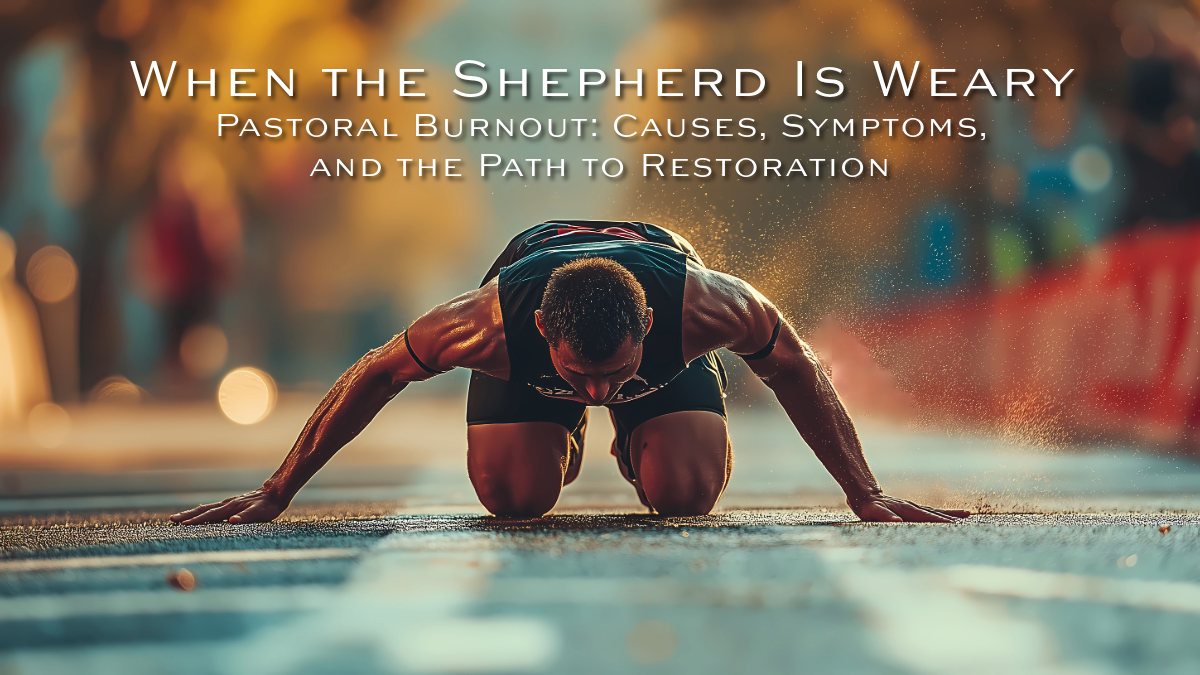
Pastoral Burnout: Causes, Symptoms, and the Path to Restoration
Pray: Psalm 23:1-6
Dear pastor, let’s get to the heart of it: burnout is not a failure of faith. It is not evidence of theological weakness, spiritual compromise, or ministerial inadequacy. It is, far more often, the consequence of prolonged faithfulness under unrelenting demand without sufficient time for rest, repair, or support.
In Scripture, the Lord does not hide the frailty of those called to lead His people. From Moses under the weight of an unmanageable burden (Ex. 18:17–18), to Elijah collapsing beneath the broom tree (1 Kgs. 19:4), to Paul confessing: “For we do not want you to be unaware, brothers, of the affliction we experienced in Asia. For we were so utterly burdened beyond our strength that we despaired of life itself” (2 Cor. 1:8). The biblical witness is clear: exhaustion can visit even the most faithful, anointed, prominent, and seasoned of the Lord’s servants.
With this in mind, it is important to recognize that burnout is not a crisis of faith. It is a very human response to sustained depletion. It is a time when the cup needs refreshing (Ps. 23:5).
What Burnout Is, and What It Is Not
Sadly, some have imagined that burnout is akin to laziness, indifference, or even a loss of calling. It is none of these, and neither is it synonymous with discouragement alone, as if burnout only requires encouragement to remedy. It is the erosion of emotional, physical, relational, and spiritual reserves over time. In most cases, a pastor facing burnout is still orthodox in faith, is likely preaching faithfully, praying earnestly, and loving the people of God; yet he can still be profoundly depleted.
Messiah Yeshua/Jesus acknowledges our human limitation when He says to the disciples, “Come away by yourselves to a desolate place and rest a while.’ For many were coming and going, and they had no leisure even to eat” (Mk. 6:31). This invitation follows active ministry, miracles, teaching, and compassion. Consider this, they were in the physical presence of the Messiah! Yet they were tired. The problem was not a lack of zeal; it was that “many were coming and going, and they had no leisure even to eat.” They were responding to a seemingly endless train of human need, and it exhausted them.
Moreover, burnout is not due to a single hard season, but from accumulated strain without adequate recovery. When the body and the spirit are not permitted to refresh, burnout settles in.
Common Causes of Pastoral Burnout
1. Unrelenting Emotional Labor: Pastors carry grief that is not their own, sit with families in crisis, absorb congregational anxiety, and mediate conflict, so often without time or space to process their own pain. Proverbs reminds us, “Hope deferred makes the heart sick” (Prov. 13:12). Over time, unexpressed sorrow settles deep in the soul.
2. Boundary Erosion: The call to shepherd the Lord’s people is holy, but it is not without limits and boundaries. Many of us struggle to say “no,” equating constant availability with faithfulness. However, even Jesus withdrew from the crowds (Lk. 5:16). When boundaries collapse, vocation quietly becomes captivity.
3. Isolation in Leadership: Faithful leaders are often surrounded by people, yet profoundly alone. Issues of confidentiality, expectations, and perceived strength can prevent honest vulnerability in friendships. Ecclesiastes warns that “Two are better than one, because they have a good reward for their toil. For if they fall, one will lift up his fellow. But woe to him who is alone when he falls and has not another to lift him up!” (Eccl. 4:9–10).
4. Chronic Overextension: Volunteer shortages, financial strain, cultural polarization, and post-pandemic faith-fatigue have expanded pastoral responsibilities beyond what many leaders were trained or resourced to bear. Even well-educated and seasoned pastors are not immune. Exhaustion does not discriminate because of experience or credentials.
5. Internalized Pressure to Perform: When identity becomes subtly tethered to outcomes and performance, such as attendance, approval, and growth, pastors begin to labor under a weight the Lord never assigned. These are man’s pressures, not the Lord’s. Paul reminds us, “So neither he who plants nor he who waters is anything, but only God who gives the growth” (1 Cor. 3:7).
Recognizing the Symptoms
Burnout often announces itself quietly before it becomes undeniable.
1. Persistent fatigue that rest does not easily resolve.
2. Emotional numbness or irritability in the home.
3. Loss of joy in ministry without loss of faith.
4. Difficulty concentrating or making even minor decisions.
5. Withdrawing from relationships and self-isolating as a means of coping.
6. Cynicism or internal detachment, not necessarily voiced, but quietly shaping one’s inner posture toward people, ministry, and even oneself.
7. Physical ailments with no clear cause.
8. A sense of being “used up” rather than poured out.
These are not signs of spiritual collapse. They are warning lights on the dashboard of the soul indicating underlying weariness that needs our immediate attention and repair.
Elijah’s story is instructive, and will speak to the weary heart of pastors who listen closely. When he cries out in despair, the Lord does not rebuke him! He feeds him. He lets him sleep. He restores his strength before addressing anything else (1 Kgs. 19:5–8). The Lord treats exhaustion before He treats direction.
The Remedy: Rest, Repair, and Reordering
1. Recover the Theology of Rest: Rest is not optional; it is commanded. The Sabbath was given not as a burden, but as a gift and a sign (Ex. 20:8–11; cf. Ex. 31:13). Rest affirms that the Lord governs the world without our constant involvement. Dear colleagues, we must resist the lie that everything depends on us; it doesn’t, and we need to be reminded of that. Jesus’ words remain liberating: “Come to me, all who labor and are heavy laden, and I will give you rest” (Matt. 11:28). Pastor, there is a theology to rest - take time to study it.
2. Seek Repair, Not Just Relief: A vacation may relieve symptoms, but repair requires deeper attention. This may include spiritual direction, pastoral counseling, medical evaluation, or a season of adjusted responsibilities, even a sabbatical. Paul’s counsel to Timothy acknowledges embodied care: “Use a little wine for the sake of your stomach and your frequent ailments” (1 Tim. 5:23). The apostle does not spiritualize or dismiss physical need or healing, and neither should we. I’ve oft said to members of my congregation, if you find me in the hospital, with one of my limbs hanging by a thread, do not spiritualize the situation, let the doctors treat the situation, while you pray into the situation.
3. Restore Shared Leadership: Burnout thrives where leadership is solitary. Unfortunately, many pastors are sole practitioners by necessity, not by choice. Scripture envisions shared oversight, mutual submission, and distributed responsibility (Acts 14:23; Eph. 4:11–12). No pastor was meant to carry the work of ministry alone, even for the purpose of congregational convenience.
4. Reaffirm Identity in Christ, Not Output: Pastors are first children of the Lord before they are servants of His church. Yeshua/Jesus anchors identity not in labor, but in belonging: “Rejoice that your names are written in heaven” (Lk. 10:20). Ministry flows from sonship, not the other way around. Remember, you are a son of the house, not a hireling to be used up.
5. Allow the Body of Christ to Minister to You: Receiving care is not weakness; it is humility. The same grace proclaimed from the pulpit must be allowed to reach you dear shepherd. “Bear one another’s burdens,” Paul writes, “and so fulfill the law of Christ” (Gal. 6:2). His flock can and will be a great comfort to the heart of a hurting shepherd.
6. Churches, Give Your Pastors Time: The care of a pastor’s life and faith is not a private matter; it is a shared responsibility within the Body of Messiah. Churches must recognize that faithful ministry requires time for rest, prayer, study, family, and renewal. When pastors are expected to be endlessly available, constantly productive, and always responsive, they are quietly, or not so quietly, being asked to live beyond human limits the Lord has established.
Scripture reminds us that “the laborer deserves his wages” (1 Tim. 5:18), and those wages include not only financial provision, but the gift of time: time to be restored, time to attend to one’s own household, and time to be with the Lord apart from public ministry. A well-rested pastor is not a distracted pastor; he is better able to shepherd the flock with clarity, patience, and love.
Congregations ensure their own spiritual health when they encourage sabbaticals, honor days off, protect study time, and resist the urge to measure faithfulness by constant visibility and availability. Remember, even the Lord withdrew from the crowds to pray (Mk. 1:35), was He unfaithful in doing so? Churches that make room for their pastors to rest are not losing ground, they are investing in the long-term health, wellness, and faithfulness of their shepherd.
To give your pastor time is to affirm that the work belongs to God, not to one individual. By doing so, the church participates in the ministry of restoration, allowing shepherds to lead not from exhaustion, but from renewed strength (Isa. 40:31).
A Word of Hope
Burnout is not the end of a calling. Often, it is the moment when the Lord intervenes to realign, restore, and deepen the work He began in you. The Good Shepherd neither despises weary under-shepherds nor abandons them. He restores their souls (Ps. 23:3).
For pastors walking through exhaustion, hear this clearly: you are not broken or worn out beyond use. You are not disqualified. You are not alone. You are tired, and the Lord who called you knows how to heal the tired. Make time to rest, make it a practice of your faith.
Faithfulness sometimes looks like continuing the work through hardship. At other times, it looks like resting in the care of the One who said, “My grace is sufficient for you, for my power is made perfect in weakness” (2 Cor. 12:9). And, dear pastor, that grace remains sufficient still.
In the service of Messiah and His Church,
Bishop Justin D. Elwell
Restoration Fellowship International
