
Paul and the Stewardship of Souls
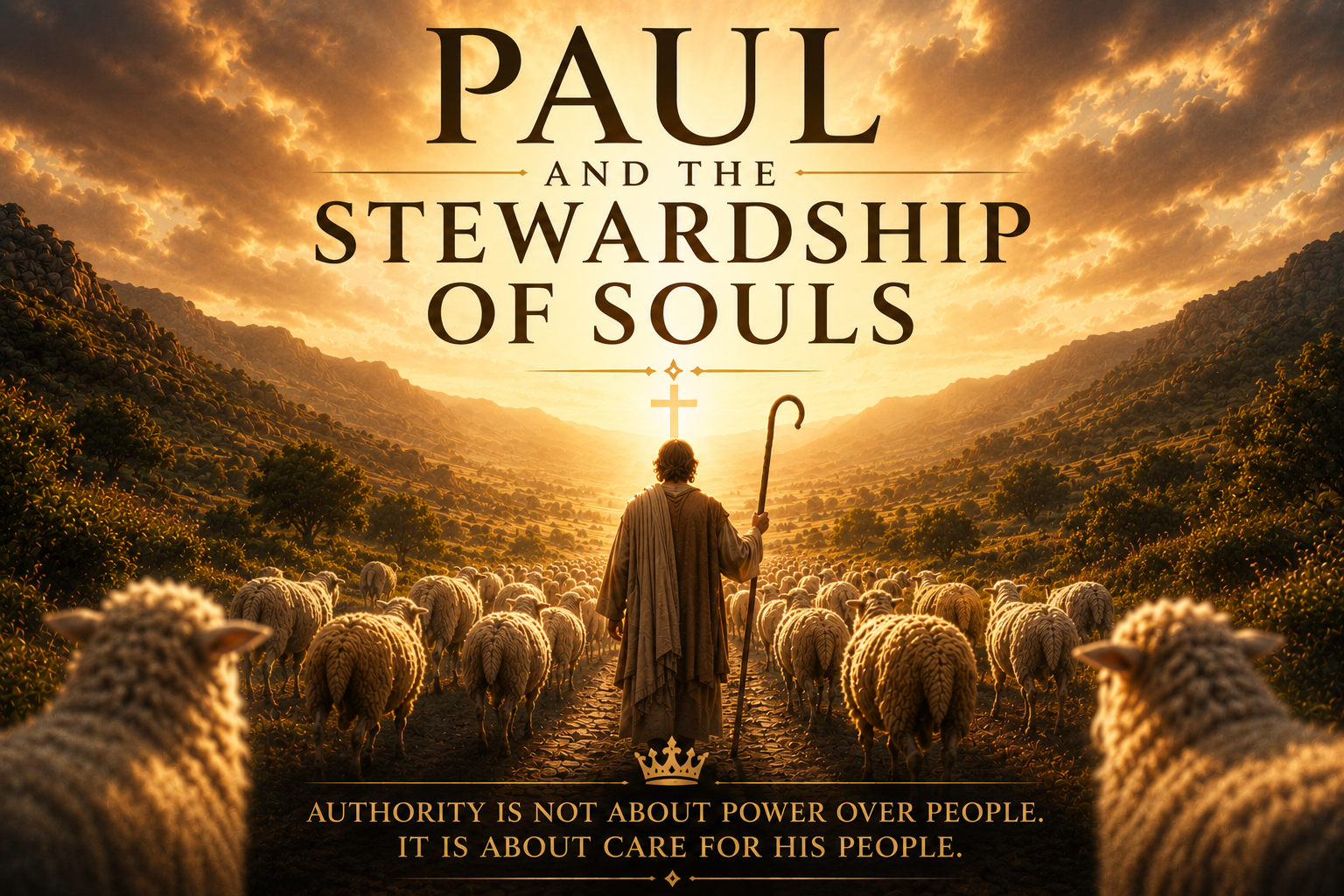
A Vision of Pastoral Authority in the Body of Messiah
There are few subjects more misunderstood in modern ministry than the question of authority. Some reject it altogether because they have witnessed or experienced spiritual abuse. Others embrace distorted forms of it, confusing pastoral oversight with domination, personality, or control. Yet the apostle Paul speaks openly and unapologetically about the authority entrusted to him by the Lord. He does not deny its existence, nor does he minimize its seriousness. Instead, he defines its purpose. Paul writes: “ For even if I boast a little too much of our authority, which the Lord gave for building you up and not for destroying you, I will not be ashamed” (2 Cor. 10:8; cf. 2 Cor. 12:19).
Again, near the close of the same epistle: “For this reason I write these things while I am away from you, that when I come I may not have to be severe in my use of the authority that the Lord has given me for building up and not for tearing down” (2 Cor. 13:10).
These statements are among the clearest apostolic descriptions of pastoral authority in the New Testament. The authority Paul possesses is not self-created, personality-driven, or institutionally manufactured. It is received. It is delegated. It is stewardship. Most importantly, it is given for edification.
The Greek term Paul uses is ἐξουσία (exousia), a word that speaks of delegated authority, jurisdiction, or the lawful right to act. In the New Testament, exousia can be used positively or negatively depending upon its source and purpose. Messiah Himself possesses all authority in heaven and earth (Matt. 28:18). Civil rulers possess delegated authority from the Lord (Rom. 13:1). Apostolic and pastoral ministry carries authority for the ordering and strengthening of the assemblies of God. Yet the same term can also describe hostile spiritual powers.
Paul writes in Ephesians 6:12: “For we do not wrestle against flesh and blood, but against the rulers, against the authorities [exousiai], against the cosmic powers over this present darkness, against the spiritual forces of evil in the heavenly places.” Authority itself is therefore not automatically righteous. Its legitimacy is determined by its source, its fruit, and its purpose. This distinction is desperately needed in the ekklesia today.
Authority Exists for the Building of the Body
Paul’s understanding of ministerial authority cannot be separated from his theology of the Body of Messiah. Ministry gifts are not instruments of personal elevation or advancement; they are divine gifts for the maturation of the Lord’s people. Ephesians 4:11–13 declares:
“And he gave the apostles, the prophets, the evangelists, the shepherds and teachers, to equip the saints for the work of ministry, for building up the body of Christ, until we all attain to the unity of the faith and of the knowledge of the Son of God, to mature manhood, to the measure of the stature of the fullness of Christ.”
The ministry exists to build His people, not platforms.
Further, the shepherd is not called to create dependence upon himself, but maturity in Messiah. Faithful pastoral authority therefore produces spiritual health, stability, growth, repentance, wisdom, and holiness within the Lord’s flock. Its fruit is visible in strengthened and maturing disciples.
This is why Paul consistently ties authority to edification (upbuilding). Even correction is restorative in its intention. When Paul warns Corinth, he does so as a father seeking restoration, not destruction (2 Cor. 13:10). His rebukes are sharp because spiritual sickness requires honest treatment, but the purpose of the treatment is healing. Biblical authority is medicinal, not tyrannical (Jer. 8:22).
What Pastoral Authority Is Not
Because authority can be abused, it must also be carefully defined by its boundaries. Pastoral authority is not personal authority. The minister is not the source of authority; Messiah is. Any authority exercised apart from submission to Christ and fidelity to Scripture will become corrupt. Leaders are servants under authority before they are leaders with authority.
Pastoral authority is not totalitarian authority. The under-shepherd does not possess ownership over the souls entrusted to his care. The flock belongs to God. Peter exhorts elders: “Shepherd the flock of God that is among you, exercising oversight, not under compulsion, but willingly, as God would have you; not for shameful gain, but eagerly; not domineering over those in your charge, but being examples to the flock” (1 Pet. 5:2–3).
The moment leadership becomes domination, it has departed from the spirit of Messiah. Moreover, pastoral authority is not lordship. Yeshua explicitly warned His disciples against imitating the hierarchical oppression of worldly systems: “And he said to them, “The kings of the Gentiles exercise lordship over them, and those in authority over them are called benefactors. But not so with you. Rather, let the greatest among you become as the youngest, and the leader as one who serves.” (Lk. 22:25–26).
Kingdom leadership is cruciform leadership. It bears burdens. It washes feet. It serves.
Pastoral authority is not unquestioned. The Bereans were called noble because they searched the Scriptures daily to examine apostolic teaching (Acts 17:11). Spiritual authority is never an invitation to abandon discernment. Rather, healthy oversight invites accountability because truth does not fear examination. Where authority demands silence, isolation, fear, or blind submission, it has ceased to resemble apostolic ministry.
In pastoral ministry, leaders quickly discover that most people do not arrive within the fellowship of the ekklesia untouched. Some have suffered under domineering and heavy-handed leadership that demanded submission while neglecting compassion, accountability, or holiness. Others have endured the opposite problem entirely: relaxed and passive shepherding that abandoned the flock to confusion, disorder, theological instability, or spiritual neglect. I have personally shepherded men and women deeply wounded by both extremes. Some carried profound distrust toward spiritual leadership because authority had been weaponized against them. Others rejected authority altogether because they had rarely seen it exercised faithfully or courageously.
In many instances, their resistance was not simply rooted in rebellion as some would argue; but in pain, disappointment, betrayal, and disillusionment. Yet Paul neither abandoned authority because it could be abused, nor distorted it into domination because he possessed it. Instead, he consistently returned to its holy purpose: “for building up and not tearing down” (2 Cor. 13:10). This has likewise shaped my own pastoral approach as both a congregational shepherd and a bishop serving ministers and ministries. Wounded souls are not healed through coercion, nor are they restored through the absence of spiritual guidance. They are restored through patient shepherding, trustworthy presence, truthful teaching, accountability rooted in love, and leadership that reflects the gentleness and firmness of Messiah Himself. Healthy authority neither crushes the bruised reed nor abandons the sheep to wander alone.
Delegated Stewardship of Souls
Pastoral authority in the New Testament is also rarely exercised in isolation. Apostolic ministry functioned within a community of recognized leaders, elders, and fellow laborers. Paul traveled with companions, appointed elders in every city, submitted matters of dispute to the council in Jerusalem, and consistently spoke of co-laborers in his epistles. Spiritual oversight in the ekklesia was not designed to center upon the unchecked authority of a single personality, but upon faithful shepherding exercised in communion, accountability, and shared discernment under the Lordship of Messiah. Even episcopal authority, rightly understood, exists within the life of the Body and for the health of the Body (Acts 15:6, 22). Healthy congregational leadership therefore reflects mutual submission, humility, and spiritual maturity among those entrusted with the care of God’s people.
Paul understood himself not as an owner of congregations, but as a steward among stewards who were entrusted with souls.
This is why his language is so pastoral, relational, and deeply personal. His authority was inseparable from his sacrificial care. He travailed for congregations in prayer. He suffered for their growth. He wept over their failures. He defended them against error. He corrected them when necessary. Yet all of this emerged from covenant responsibility, not institutional power. The authority was divine in origin, but constructive in purpose. Its legitimacy was revealed through spiritual fruit rather than coercive control.
This is perhaps nowhere more beautifully displayed than in Romans 16. Paul closes the epistle with greetings to approximately twenty-nine individuals by name, alongside several unnamed believers known within the Roman assemblies. Remarkably, Paul had not yet visited Rome. Yet he knew these people. He knew their labor, their sacrifices, their travels, and in many cases their suffering.
He writes not as a distant administrator, but as a spiritual father attentive to souls.
“Greet Priscilla and Aquila…”
“Greet Mary, who bestowed much labor on us…”
“Salute Andronicus and Junia…”
“Greet Amplias my beloved in the Lord…”
The list continues with warmth, familiarity, and affection. What an extraordinary testimony to pastoral attentiveness. To be remembered by name is no small thing. To be known in one’s labor is an act of pastoral care. Paul’s authority was not exercised from abstraction. It was relational. He knew the flock because he loved the flock. Why do we, as leaders, love the flock? Because Christ died for it.
This remains one of the clearest marks of authentic ministry. Shepherds are not just managers of institutions or communicators to crowds. They are caretakers of souls.
Authority That Reflects the Chief Shepherd
At its best, pastoral authority reflects the heart of the Chief Shepherd Himself (1 Pet. 5:4). Messiah’s authority healed the broken, restored the fallen, confronted hypocrisy, defended the vulnerable, and formed disciples. His authority was unquestionable, yet profoundly humble. He never manipulated. He never exploited. He never crushed the weak. Paul’s vision of ministry follows this same pattern. Pastoral authority exists for upbuilding.
It exists to strengthen faith, establish order, protect doctrine, cultivate maturity, and preserve the spiritual health of the Body of Messiah. Even correction serves redemption. Even discipline serves restoration. When authority ceases to build the people of God, it has lost its apostolic center.
The Church in this generation does not need less spiritual leadership. In many places, there has been a steady drift in this direction as an overcorrection to genuine abuses. Rather, it needs leadership that resembles Messiah more faithfully. It needs shepherds who understand that authority is neither privilege nor personal power, but delegated stewardship exercised in humility, accountability, courage, and love of His people.
In the end, the measure of pastoral authority is not how much control a leader possesses, but how faithfully the flock is built up into the fullness of Messiah.
In the service of Messiah and His Church,
Bishop Justin D. Elwell
Restoration Fellowship International
