
Abiding Before Leading
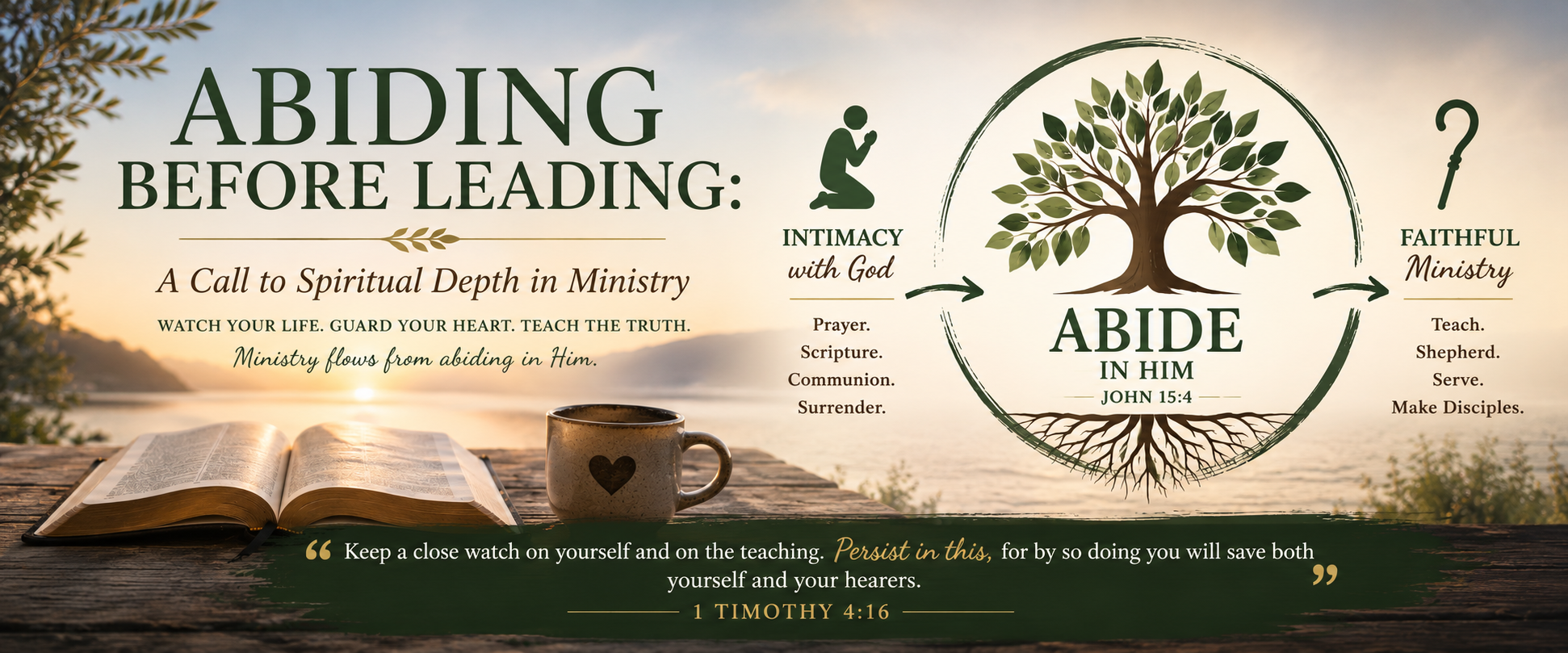
A Call to Spiritual Depth in Ministry
In every generation, the people of God face the temptation to substitute outward appearance for inward reality. The forms may change with time, but the danger remains remarkably consistent. In our present age, ministry leaders are under increasing pressure to produce, perform, expand, maintain visibility, and meet ever-growing expectations. The polish of our digital platforms is often valued more highly than the inner condition of our spiritual lives. The metrics by which success is often measured include attendance, social media engagement, productivity, influence, and the ability to sustain constant activity. Yet beneath all the noise and movement, Scripture continues to ask a more searching question: What is the condition of the leader’s soul?
The apostle Paul’s words to Timothy remain profoundly relevant for ministry leaders today: “Keep a close watch on yourself and on the teaching. Persist in this, for by so doing you will save both yourself and your hearers” (1 Tim. 4:16).
This exhortation is both pastoral and urgent. Paul does not begin with strategy, growth models, or organizational structure. His focus is not the latest trends. He begins with the spiritual life and character of the leader himself. Timothy is instructed first to watch himself, and then his teaching. The order matters. Ministry that lacks spiritual depth and integrity may continue outwardly for a season, but eventually the absence of inner devotional life becomes evident.
Our modern ministry environment often rewards visibility more than holiness, charisma more than maturity and character, and performance more than faithfulness. Yet the Kingdom of God has never advanced primarily through spectacle. It advances through surrendered lives, faithful proclamation, prayerful dependence, and leaders who walk closely with the Lord as they share the Gospel.
The Danger of Performing Ministry Without Devotional Living
One of the great dangers facing ministry leaders today is the gradual separation between public ministry and private devotion. It is possible to preach sermons while neglecting prayer. It is possible to lead worship while spiritually dry. It is possible to organize programs while losing intimacy with God. I know this personally, for I have found each of these struggles present in my own life at different times.
A leader may become highly skilled in the mechanics of ministry while slowly drifting from the presence of the Lord. This rarely happens suddenly. More often, it occurs through small compromises: prayer becomes preparation rather than communion, Scripture becomes material to teach rather than truth to live, busyness replaces stillness, and ministry activity crowds out spiritual attentiveness.
The tragedy is that outward effectiveness can temporarily mask inward emptiness. Congregations may still grow. Events may still succeed. People may still applaud. Yet the soul of the leader may quietly weaken beneath the weight of constant performance and pressure.
The Scriptures repeatedly warn against this disconnect. In the prophets, the Lord rebuked outward religious activity that lacked inner devotion. Through Isaiah, He declared: “This people draw near with their mouth and honor me with their lips, while their hearts are far from me” (Isa. 29:13; cf. Matt. 15:8–9; Mk 7:6–7).
Yeshua Himself confronted the same issue among religious leaders of His day. The concern was never merely external obedience, but the condition of the heart. As ministry leaders we must ask ourselves difficult questions:
Am I cultivating intimacy with God apart from ministry responsibility?
Is my spiritual life sustained only by public demands?
Have I become more concerned with producing ministry than abiding in Messiah?
Am I shepherding from overflow, or merely from obligation?
These are not questions of condemnation, but of spiritual honesty.
Watching Yourself Before Watching Others
Paul’s instruction to Timothy begins with self-watchfulness: “Keep a close watch on yourself…” Leaders are often highly attentive to the spiritual condition of others while neglecting their own souls. Shepherds naturally focus on caring for the flock, resolving problems, teaching truth, counseling families, and carrying the burdens of the congregation. Yet Scripture consistently calls leaders to guard their own hearts as well.
This self-watchfulness involves several areas.
1. Guarding the Heart
Proverbs 4:23 teaches: “Keep your heart with all vigilance, for from it flow the springs of life.”
The heart of the ministry leader matters deeply because ministry flows from the inner life. Resentment, pride, exhaustion, bitterness, hidden sin, discouragement, or spiritual apathy will eventually affect the congregation. What, then, is flowing from our hearts?
A guarded heart is not a hardened heart. Rather, it is a heart regularly brought before the Lord in humility, repentance, and openness.
2. Watching Motives
Ministry can subtly become entangled with personal ambition. As leaders, we may begin seeking validation through growth, recognition, or influence. Social media culture especially intensifies the temptation to compare ministries and measure worth through visibility.
Yet ministry was never intended to be self-exalting. John the Baptist modeled the proper posture when he declared: “He must increase, but I must decrease” (Jn. 3:30). The goal of ministry is not to build personal platforms, but to glorify God and form disciples.
3. Watching Emotional and Spiritual Health
Many of us in pastoral ministry carry profound emotional fatigue while continuing to function publicly. Constant caregiving without replenishment often produces burnout, cynicism, or numbness. Even Jesus withdrew regularly to pray. He stepped away from crowds. He rested. He sought solitude with the Father.
Leaders who never slow down eventually lose clarity, tenderness, and discernment. Ministry must flow from abiding, not merely striving.
Watching the Teaching
Paul also instructs Timothy to keep watch “on the teaching.” Spiritual depth and doctrinal faithfulness belong together. A deep spiritual life without sound teaching can drift into emotionalism or confusion. Sound doctrine without spiritual vitality can become cold and lifeless. As ministry leaders, we must remain rooted in the Scriptures.
In an age shaped by shallow, immediate, viral content, fragmented attention spans, and social-media theology, congregations desperately need leaders who: handle Scripture carefully, teach contextually and faithfully, remain anchored in truth, and resist the pressure to dilute biblical teaching for cultural approval. We cannot allow ourselves to be swayed by social conventions that dishonor the Word of God.
Theological depth is especially important in a time of growing confusion regarding identity, morality, truth, and the authority of Scripture. For leaders serving within Messianic Jewish and Hebraic ministry contexts, there is also increasing importance in recovering the continuity of the biblical story: understanding the Jewish roots of the faith, recognizing the covenantal framework of Scripture, appreciating the unity of Jew and Gentile in Messiah, and presenting the Gospel within its first-century context. Faithful teaching protects both the leader and the hearers. Paul’s words are sobering: “Persist in this, for by so doing you will save both yourself and your hearers.”
This does not suggest salvation by human effort, but rather perseverance in faithful doctrine and godly living as evidence of genuine spiritual life and faithful ministry.
The Crisis of Superficiality
Modern culture encourages speed, immediacy, and constant visibility. As leaders, we can easily feel pressured to continually produce new sermons, new content, new graphics, new programs, new strategies. It is a need to be visible. Yet depth develops slowly.
Prayer cannot be microwaved. Character cannot be manufactured instantly. Wisdom grows through years of obedience, suffering, repentance, and walking with the Lord. Many congregations are no longer impressed by polished presentations. Increasingly, people are searching for authenticity, spiritual substance, and leaders whose lives reflect genuine communion with God. People no longer want detached ministers hiding their personal struggles, but leaders willing to testify how the Lord faithfully leads them through deep valleys.
The Church does not ultimately need more religious performers. It needs shepherds, teachers, intercessors, and spiritually mature leaders. The greatest danger is not always persecution from outside the Church. Sometimes it is emptiness within it.
Returning to the Secret Place
One of the most urgent needs for ministry leaders is a return to the secret place of prayer and communion with the Lord. Before public ministry comes private surrender. Before authority comes intimacy. Before proclamation comes listening.
Leaders must resist the subtle belief that productivity equals faithfulness. It doesn’t. Some of the most spiritually transformative moments in ministry occur unseen: prayer in solitude, tears before the Lord, quiet repentance, meditating on Scripture, interceding for others, waiting silently in the Lord’s presence. These hidden places often sustain the visible ministry.
The pattern of Messiah Himself demonstrates this repeatedly. Though surrounded by crowds and constant demands, Yeshua/Jesus regularly withdrew to lonely places to pray. His ministry flowed from communion with the Father.
If the Son of God prioritized prayer and withdrawal, how much more must leaders charged with the care of His flock do the same?
Faithfulness Over Celebrity
The ministry landscape increasingly rewards personalities and platforms. Yet Scripture consistently emphasizes faithfulness over prominence. Paul did not instruct Timothy to become influential. He instructed him to persevere faithfully. The Kingdom often grows through quiet obedience: faithful teaching, patient discipleship, compassionate shepherding, consistent prayer, and enduring love for people.
Some of the most important ministry work will never trend online or receive public recognition. Yet heaven sees what earthly systems and algorithms often overlook.
The measure of ministry success in Scripture is not celebrity status, but faithfulness.
A Call to Persevere
Paul tells Timothy: “Persist in this…” Spiritual depth is not sustained accidentally. It requires perseverance. As leaders we must intentionally cultivate habits that nourish the soul: daily prayer, Scripture meditation, Sabbath rest, accountability, humility, repentance, and ongoing dependence upon the Holy Spirit.
There will always be pressure to prioritize activity over abiding. Yet leaders who neglect the inner life eventually minister from depletion rather than overflow.
Our calling is not simply to become innovative leaders, but to be more deeply rooted in Him. The Church needs leaders whose: private lives match their public message, theology is rooted in Scripture, hearts remain tender before God, and ministries flow from genuine intimacy with the Lord.
Final Pastoral Exhortation
Paul’s instruction remains timeless: “Keep a close watch on yourself and on the teaching. Persist in this, for by so doing you will save both yourself and your hearers.” Before ministry leaders watch attendance numbers, social metrics, budgets, or public perception, we must watch over our own souls. We must also have at least one trusted brother in ministry with whom we can confide and seek godly counsel. For when our spiritual depth weakens, ministry eventually becomes performance. But when leaders abide deeply in the presence of God, our ministry carries authenticity, wisdom, conviction, and spiritual life that no performance can manufacture.
The need in this hour is not simply for louder voices, larger platforms, or greater visibility. The need is for leaders who know and love the Lord, and His people, deeply. For from that place, faithful ministry flows.
In the service of Messiah and His Church,
Bishop Justin D. Elwell
Restoration Fellowship International
