
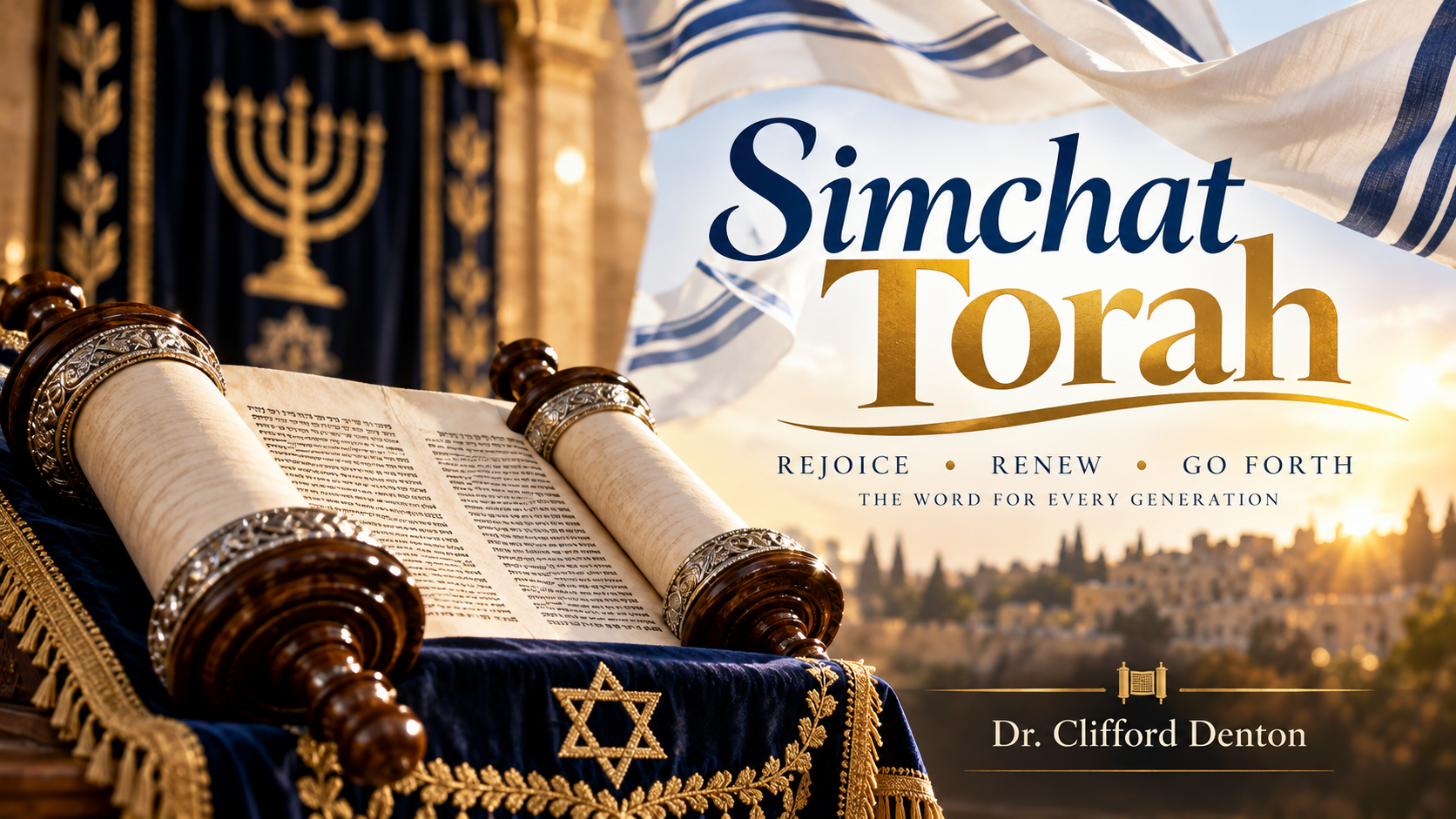
Simchat Torah (Joy of the Torah)
Weekly Torah Studies for 2025/26 (5786).
On the road to Emmaus, Yeshua met with two of His disciples and, beginning at Moses and all the Prophets, He expounded to them in all the Scriptures the things concerning Himself. (Luke 24:27). For our Torah studies this year, therefore, week by week we will seek to discover how all of Torah prepared the way for the coming Messiah.
3rd October 2026 (22 Tishrei)
Simchat Torah (Joy of the Torah): Deuteronomy 33:1-34:12, Genesis 1:1-2:3
The Torah reading cycle ends with the last two chapters of Deuteronomy. But it is not a full stop – it is a continuous process from one year to the next. To ensure that the life of Torah continues, the first chapter of Genesis is read. The last words of Moses are followed by the first words of God, through which He created the universe.
Life goes on in all its fulness, and the transition of the pattern of weekly readings from Torah is emphasised by a celebration of joy. The arks of every synagogue are opened and the precious scrolls are taken out to be carried around the congregation. Each person reaches out to gently touch the scrolls as they pass by, thanking God for the gift of His written word which brings life.
When the scrolls are read this Shabbat, as the words of Moses once more send blessing to every tribe of Israel, members of the one fully identifiable tribe who are gathering from the four corners of the world back to their ancient Land will surely be moved to hear the blessing over Judah:
And this he said of Judah:
“Hear, Lord, the voice of Judah,
And bring him to his people;
Let his hands be sufficient for him,
And may You be a help against his enemies.” (Deuteronomy 33:7)
How poignant is Moses’ prayer for Judah in today’s world!
Moses ascended Mount Nebo, his earthly service completed, and died peacefully and privately in God’s presence. His ministry was so wonderfully complete that we read his teaching and rejoice in its truth day by day, year by year.
So great was Moses, that the person who added the final words concerning Moses’ death to the end of the Book of Deuteronomy, foresaw throughout history the truth of his words:
Since then there has not arisen in Israel a prophet like Moses, whom the Lord knew face to face, in all the signs and wonders which the Lord sent him to do in the land of Egypt, before Pharaoh, before all his servants, and in all his land, and by all that mighty power and all the great terror which Moses performed in the sight of all Israel. (Deuteronomy 34:10-12)
Yet balanced with this was the expectation that a great Prophet would arise, one day, as foretold by Moses himself:
The Lord your God will raise up for you a Prophet like me from your midst, from your brethren. Him you shall hear, according to all you desired of the Lord your God in Horeb in the day of the assembly, saying, ‘Let me not hear again the voice of the Lord my God, nor let me see this great fire anymore, lest I die.’ And the Lord said to me: ‘What they have spoken is good. I will raise up for them a Prophet like you from among their brethren, and will put My words in His mouth, and He shall speak to them all that I command Him. And it shall be that whoever will not hear My words, which He speaks in My name, I will require it of him. (Deuteronomy 18:15-19)
Though Joshua was appointed to lead the Israelites after Moses, he was not that Prophet. Neither was Elijah. Indeed, it was not until Moses and Elijah stood in the presence of Yeshua on the Mount of Transfiguration that it could be made known that Moses’ prophecy of His coming was proved true:
Now after six days Jesus took Peter, James, and John his brother, led them up on a high mountain by themselves; and He was transfigured before them. His face shone like the sun, and His clothes became as white as the light. And behold, Moses and Elijah appeared to them, talking with Him. Then Peter answered and said to Jesus, “Lord, it is good for us to be here; if You wish, let us make here three tabernacles: one for You, one for Moses, and one for Elijah.” (Matthew 17:1-4)
It seems that Peter saw this as the fulfilment of the Feast of Tabernacles – the Messiah had come. It was time to express this in the making of the temporary shelters that typify the Feast. Of course, in hindsight, he would later realise that there was much more to Yeshua’s coming than the great identification of who He is on that day. He had yet to fulfil Pesach as the sacrificial Lamb to take away the sins of the world.
Moses was probably filled with both wonder and joy to meet the One of whom he had prophesied. Yeshua was more than a prophet. He is the Son of God, as the Father confirmed in the presence of Moses and Elijah:
Behold, a bright cloud overshadowed them; and suddenly a voice came out of the cloud, saying, “This is My beloved Son, in whom I am well pleased. Hear Him!” (Matthew 17:5)
“Hear Him” – the confirmation of the instruction that Moses gave concerning the coming Prophet: “Him you shall hear” (Deuteronomy 18:15)
It is appropriate that we read Genesis 1 as part of our studies this week, which commences (verses 1-4):
In the beginning God created the heavens and the earth. The earth was without form, and void; and darkness was on the face of the deep. And the Spirit of God was hovering over the face of the waters. Then God said, “Let there be light”; and there was light. And God saw the light, that it was good; and God divided the light from the darkness.
Yeshua’s disciple John, who was with Him when Moses and Elijah appeared on the mountain, understood clearly that this Prophet who we are to hear was the One through whom God had already spoken at Creation:
In the beginning was the Word, and the Word was with God, and the Word was God. He was in the beginning with God. All things were made through Him, and without Him nothing was made that was made. In Him was life, and the life was the light of men. And the light shines in the darkness, and the darkness did not comprehend it. (John 1:1-5)
The written Word of God came to Moses, who faithfully passed it on for all to read, study and obey. The Living Word was manifest in Yeshua. God abided with His people in the form of a Man. Just as the written Word is received with joy each Simchat Torah, as it is moved around a body of descendants of Israel meeting for worship on that day, so the Living Word moved among the Jews of His day in the form of the Man, Yeshua. Those who in faith reached out to touch Him were filled with joy; some healed, many saved from their sins.
In Yeshua was and is the fulfilment of the joy of Torah: the joy of God’s Word made flesh who dwells among His people, though we do not see Him now as once He was seen on earth. When He returns, that will be another great fulfilment of Simchat Torah.
When the disciple John leaned on Yeshua at the Passover meal shortly before Yeshua was crucified for our sins (John 13:25, John 21:20), was he recalling another of Moses’ blessings in this week’s reading:
The beloved of the Lord shall dwell in safety by Him,
Who shelters him all the day long;
And he shall dwell between His shoulders. (Deuteronomy 33:12)
Was John also understanding Yeshua’s fulfilment of Simchat Torah, the time when all who express their joy reach out to touch, when he wrote:
That which was from the beginning, which we have heard, which we have seen with our eyes, which we have looked upon, and our hands have handled, concerning the Word of life - the life was manifested, and we have seen, and bear witness, and declare to you that eternal life which was with the Father and was manifested to us - that which we have seen and heard we declare to you, that you also may have fellowship with us; and truly our fellowship is with the Father and with His Son Jesus Christ. And these things we write to you that your joy may be full. (1 John 1:1-4)
Dr Clifford Denton
Founder and Director
Tishrei Bible School
