
Ha’azinu (Give Ear) and Yom Kippur (Day of Atonement)
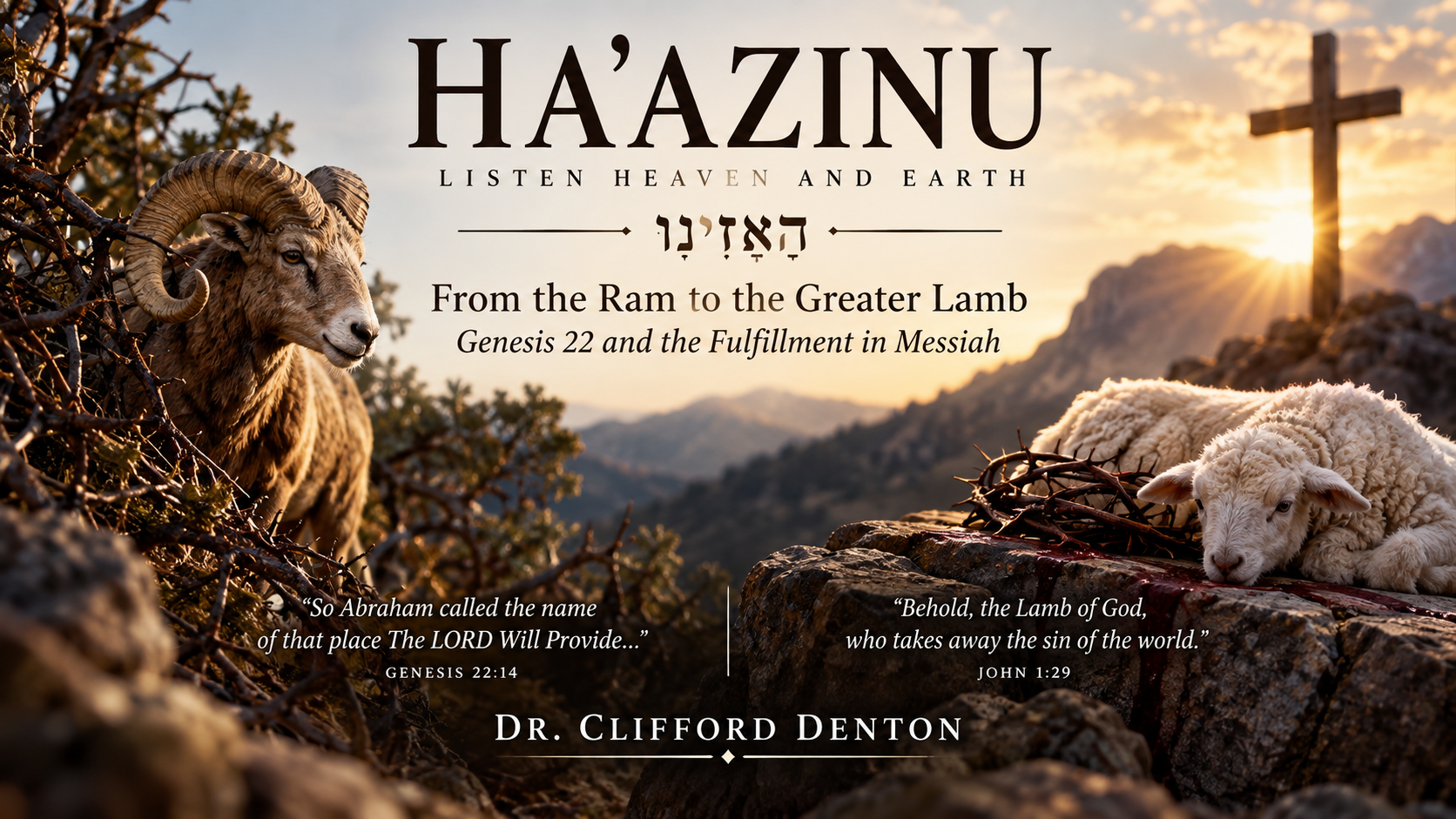
Weekly Torah Studies for 2025/26 (5786).
On the road to Emmaus, Yeshua met with two of His disciples and, beginning at Moses and all the Prophets, He expounded to them in all the Scriptures the things concerning Himself. (Luke 24:27). For our Torah studies this year, therefore, week by week we will seek to discover how all of Torah prepared the way for the coming Messiah.
19th September 2026 (8 Tishrei)
Ha’azinu (give ear): Deuteronomy 32:1-52, Yom Kippur (Day of atonement): Leviticus 16
We begin with an illustration that could apply to any God-fearing, Bible believing family who have sought throughout their life to bring up their children in the ways of the Lord. Eventually, a child will leave home to embark on his or her personal journey of life.
To consider a Torah observant family in the line of direct descent from those who stood with Moses on the East side of the Jordan River, brings special emphasis to what we are considering.
Imagine a Jewish father at the head of the family table, with his wife and children before him. The table is set for the meal and prayers must be said. He wears his prayer shawl. He has chosen this night to also wear his phylacteries on his head and arm, small boxes with verses reminding him of the Torah of Moses, especially the command of Deuteronomy 6:6-8:
And these words which I command you today shall be in your heart. You shall teach them diligently to your children, and shall talk of them when you sit in your house, when you walk by the way, when you lie down, and when you rise up. You shall bind them as a sign on your hand, and they shall be as frontlets between your eyes.
The father and mother have instructed their children concerning all that Moses taught, including the Song of Moses, as they have been growing up, but now the oldest child is leaving home. The father knows how it is to grow up. He too was instructed by his parents, and he too, as a young person, left home. He had to face the realities of life for himself, with all its struggles - and find the path to walk with God through these personal experiences.
The father knows that, with his wife, he has done as well as he could to teach his children but he also knows what lies before them. He knows about the nature of fallen humanity and it is with a deep sense of both love and foreboding that he feels a prophetic utterance rising from deep within. He opens his mouth to speak and out pours a prophetic warning of what lies ahead for his children as they deepen their personal walk with God.
This is the heartache that comes to many parents as a new generation of children grow up to take their personal responsibility before God.
It also comes, in a more general way, from a pastoral heart of one who cares for his people, yet knowing the reality of a fallen world. This is the heart of God for His people and it is the heart that God put in Moses’ inner being on the verge of Jordan. Not only did Moses pronounce the blessings and curses, which determined Israel’s future from that time forward, but now he prophesied the inevitable course that would be taken. Like every child leaving a caring home, each Israelite knew the ways of God but pressures and temptations would at times be overwhelming as the path of life was taken. Israel would inevitably be taken aside by foreign gods:
Jeshurun grew fat and kicked;
You grew fat, you grew thick,
You are obese!
Then he forsook God who made him,
And scornfully esteemed the Rock of his salvation.
They provoked Him to jealousy with foreign gods;
With abominations they provoked Him to anger.
They sacrificed to demons, not to God,
To gods they did not know,
To new gods, new arrivals
That your fathers did not fear. (Deuteronomy 32:15-17)
What Moses spoke was like a prophetic cloud that has hung over Israel from that day to this. Indeed, the context of the prophecy, known as the Song of Moses, was for our very day:
……after my death you will become utterly corrupt, and turn aside from the way which I have commanded you. And evil will befall you in the latter days, because you will do evil in the sight of the Lord, to provoke Him to anger through the work of your hands. (Deuteronomy 31:29)
Moses saw ahead to the latter days. There was a reason. We will come to it.
The picture of a family, as we began this study, is relevant to how the life of the entire nation proceeds. Every home is intended to be the place where education is founded. The character of how a nation lives before God begins in every home. The best of fathers knows the dangers and the temptations that lie ahead for his children. By contrast, where there is neglect in the home, children are ill-prepared for the future. The sum total of how each individual lives is the way that the nation lives. Thus Moses’ prophecy is directly relevant to each family and to each individual.
This is why the Song of Moses is also entirely relevant for the preparations for Yom Kippur when, at individual level, God’s people are drawn to put matters right in their lives and before God.
Now that we are also in those latter days of history, we know that what Moses prophesied has been proved true. The biblical Prophets bear witness to this. We are thankful for the times of repentance that will come again this Yom Kippur, but we also know that something more is needed if we are to find a full and permanent redemption before God.
There is a clue to how this was to come about. It is such a small part of the Song of Moses as to be missed completely. But God’s promise, contained in the Song, is as powerful as when Abraham, taking his only son to Mount Moriah (Genesis 22) as a living sacrifice, said:
My son, God will provide for Himself the lamb for a burnt offering. (Genesis 22:8)
The ram that replaced Isaac as the sacrifice pointed to Yeshua, the Lamb of God – the greater fulfilment of the Day of Atonement. His Apostle John expressed it as:
He is the atoning sacrifice for our sins, and not only for ours but also for the sins of the whole world. (1 John 2:2)
The ram of Genesis 22 did not only replace Isaac, but replaced all of Isaac’s descendants, pointing to Yeshua the Lamb of God, whose atonement covers the sins of all who will believe from the entire world.
Returning to the Song of Moses, the prophetic cloud which this song brought was to be finally removed through the sacrifice of Yeshua. God promised this when Moses said, in the final verse of his Song:
Rejoice, O Gentiles, with His people;
For He will avenge the blood of His servants,
And render vengeance to His adversaries;
He will provide atonement for His land and His people. (Deuteronomy 32:43)
God has provided atonement for both the land of Israel and the people of Israel through Yeshua, and added as many as will believe from the Gentile nations.
Yom Kippur – the Day of Atonement – is a day of heart searching and mourning, but a new song can begin when the fulness of God’s atonement is understood and received through faith. There are seasons for a new song, as the Psalmists often said:
Sing to the Lord a new song,
And His praise in the assembly of saints.
Let Israel rejoice in their Maker;
Let the children of Zion be joyful in their King.
Let them praise His name with the dance;
Let them sing praises to Him with the timbrel and harp.
For the Lord takes pleasure in His people;
He will beautify the humble with salvation. (Psalm 149:1-4)
The Song of Moses preceded the history of Israel from which we learn the need of a greater Day of Atonement to fulfil the yearly celebration. The new song is the song that arises because of the victory of Yeshua over all our spiritual enemies. It expresses redemption, by the transforming power of the Holy Spirit, where the nature of fallen mankind is able to be brought into conformity with the nature of God through our Saviour:
They sing the song of Moses, the servant of God, and the song of the Lamb, saying:
“Great and marvellous are Your works,
Lord God Almighty!
Just and true are Your ways,
O King of the saints!
Who shall not fear You, O Lord, and glorify Your name?
For You alone are holy.
For all nations shall come and worship before You,
For Your judgments have been manifested.” (Revelation 15:3-4)
Fathers and mothers, who gather with your families around the meal table, this is the answer to your yearning for your children to live closely with our God.
Dr Clifford Denton
Founder and Director
Tishrei Bible School
