
Bamidbar (in the wilderness), Numbers 1:1-4:20
Weekly Torah Studies for 2025/26 ( 5786).
On the road to Emmaus, Yeshua met with two of His disciples and, beginning at Moses and all the Prophets, He expounded to them in all the Scriptures the things concerning Himself. (Luke 24:27). For our Torah studies this year, therefore, week by week we will seek to discover how all of Torah prepared the way for the coming Messiah.
16thMay 2026 (29 Iyyar)
Bamidbar (in the wilderness), Numbers 1:1-4:20
What a wonderful thing it is to be called by God - by name!
Now God spoke to Moses……these are the names of the men who will stand with you…… (Numbers 1)
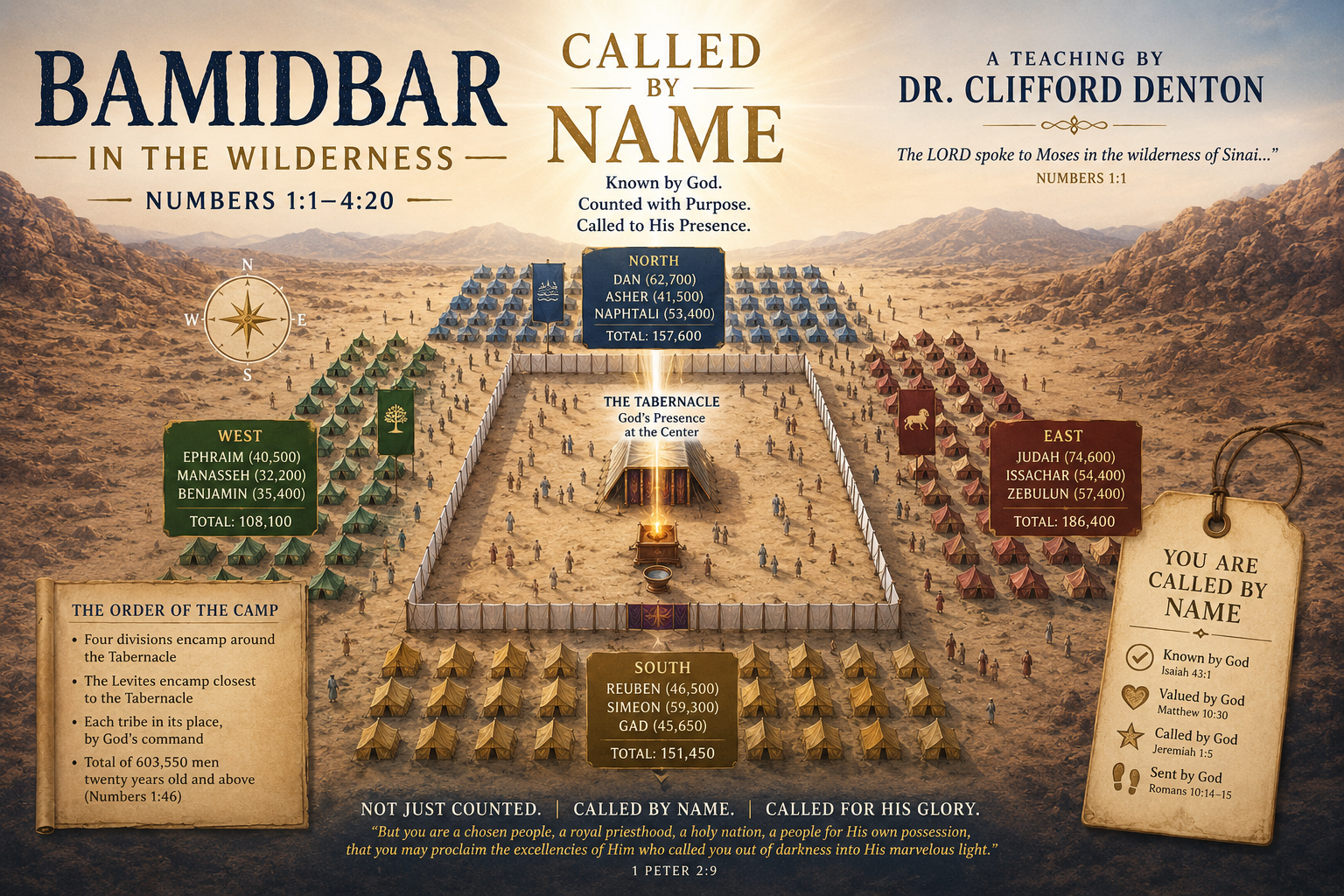
Israel’s time camped around Mount Sinai came to an end at the beginning of the second year after leaving Egypt (Numbers 1:1). Now came the pilgrimage through the wilderness to the Promised Land. It was time to order the nation. A census was taken to list the men of war – Israel was numbered by the tribal armies (Numbers 1:3). God’s choice of Israel would be contested by other nations – as it has been to this day.
God knows His people and their history. Their origins were known, going back to the beginning of time and particularly through their ancestors - to Abraham, Isaac and Jacob:
… and they assembled all the congregation together on the first day of the second month; and they recited their ancestry by families, by their fathers’ houses, according to the number of names, from twenty years old and above, each one individually. (Numbers1:18)
The community was ordered and prepared for times of dignified breaking and setting up of camp, each Tribe in its order by its Standard, and each named person taking his allotted responsibilities. The Tabernacle was to be taken down, carried and re-assembled according to a strict routine. Only those appointed from the Priesthood should handle the holy things and wrap them carefully before the appointed Levites would be brought forward to carry them. Contravening these commands would be subject to the penalty of death.
And when Aaron and his sons have finished covering the sanctuary and all the furnishings of the sanctuary, when the camp is set to go, then the sons of Kohath shall come to carry them; but they shall not touch any holy thing, lest they die.
These are the things in the tabernacle of meeting which the sons of Kohath are to carry.
The appointed duty of Eleazar the son of Aaron the priest is the oil for the light, the sweet incense, the daily grain offering, the anointing oil, the oversight of all the tabernacle, of all that is in it, with the sanctuary and its furnishings.
Then the Lord spoke to Moses and Aaron, saying: “Do not cut off the tribe of the families of the Kohathites from among the Levites; but do this in regard to them, that they may live and not die when they approach the most holy things: Aaron and his sons shall go in and appoint each of them to his service and his task. But they shall not go in to watch while the holy things are being covered, lest they die.” (Numbers 4:15-20)
When we read our portion this week, we are able to imagine the ordered community marching forward from camp to camp through the wilderness in the sight of any other nation through whom they passed.
Surely this picture of the covenant family of God is to be retained for all time. The Bible does not list every name of the thousands of families that marched forth, but each individual person had a role in God’s purposes, from the ordering of their own families to the oversight of the nation. Together they made up a nation that was a prophetic sign to the entire world, speaking of the existence of God, the order of God, and what it is to be the people of God.
O seed of Abraham His servant,
You children of Jacob, His chosen ones!
He is the Lord our God;
His judgments are in all the earth.
He remembers His covenant forever,
The word which He commanded, for a thousand generations,
The covenant which He made with Abraham,
And His oath to Isaac,
And confirmed it to Jacob for a statute,
To Israel as an everlasting covenant,
Saying, “To you I will give the land of Canaan
As the allotment of your inheritance,”
When they were few in number,
Indeed very few, and strangers in it.
When they went from one nation to another,
From one kingdom to another people,
He permitted no one to do them wrong;
Yes, He rebuked kings for their sakes,
Saying, “Do not touch My anointed ones,
And do My prophets no harm.” (Psalm 105: 6-15)
God calls by name and appoints each one He chooses for His purpose. Nowhere in the Bible do we find anyone deciding for himself or herself what to be, in the service of God’s Kingdom. Search and you will find through the Torah and the Prophets that, time and again, only God calls by name and appoints for service. In the days of the wilderness journeys, one can imagine those whom the Scriptures identified by name to carry the various parts of the Tabernacle. Each one surely recognised the honour that had been bestowed, and carried out their ministry with dignity.
But did this always continue? From time to time, did one look at another and wonder why he was given that particular task and not me? We know that this can be so from the time when the authority of Moses was questioned. Even Aaron challenged the authority of Moses (we will come to this in Numbers 12). The authority of both Moses and Aaron was also questioned (Numbers 16 and 17).
When the order of God’s call is challenged, disorder comes to the community of God’s people and their prophetic witness is marred. This can even be through good intent. Recall, for example when Uzza sought to steady the Ark of the Covenant which was being joyfully and victoriously brought back to Jerusalem by King David. Uzza was not permitted to touch the Ark and so lost his life:
And David and all Israel went up to Baalah, to Kirjath Jearim, which belonged to Judah, to bring up from there the ark of God the Lord, who dwells between the cherubim, where His name is proclaimed. So they carried the ark of God on a new cart from the house of Abinadab, and Uzza and Ahio drove the cart. Then David and all Israel played music before God with all their might, with singing, on harps, on stringed instruments, on tambourines, on cymbals, and with trumpets.
And when they came to Chidon’s threshing floor, Uzza put out his hand to hold the ark, for the oxen stumbled. Then the anger of the Lord was aroused against Uzza, and He struck him because he put his hand to the ark; and he died there before God. (1 Chronicles 13:6-10)
When Yeshua came to earth, a new ordering of God’s covenant family began – it was to be expanded into a new worldwide community covering the entire earth, but no loss of dignity or order was intended:
Simon Peter, a bondservant and apostle of Jesus Christ, to those who have obtained like precious faith with us by the righteousness of our God and Saviour Jesus Christ:
Grace and peace be multiplied to you in the knowledge of God and of Jesus our Lord, as His divine power has given to us all things that pertain to life and godliness, through the knowledge of Him who called us by glory and virtue, by which have been given to us exceedingly great and precious promises, that through these you may be partakers of the divine nature, having escaped the corruption that is in the world through lust.
But also for this very reason, giving all diligence, add to your faith virtue, to virtue knowledge, to knowledge self-control, to self-control perseverance, to perseverance godliness, to godliness brotherly kindness, and to brotherly kindness love. (2 Peter 1:1-7)
You are a chosen generation, a royal priesthood, a holy nation, His own special people, that you may proclaim the praises of Him who called you out of darkness into His marvellous light……you as sojourners and pilgrims(1 Peter 2:9-11)
Our Bible reading this week, of an ordered pilgrim people journeying through a worldly wilderness, helps us to envision the present journey of life and faith of today’s family of God on a pilgrimage to the New Jerusalem in Yeshua’s Kingdom to come. Just as the world could observe the Israelites on their journey to Canaan, so the modern world observes God’s people today. Is our witness worthy of our corporate prophetic calling?
Each of us is still called by name to salvation and then for particular service. Yeshua demonstrated the importance of understanding this when He spent all night in prayer, no less, before appointing His first Apostles:
Now it came to pass in those days that He went out to the mountain to pray, and continued all night in prayer to God. And when it was day, He called His disciples to Himself; and from them He chose twelve whom He also named apostles: Simon, whom He also named Peter, and Andrew his brother; James and John; Philip and Bartholomew; Matthew and Thomas; James the son of Alphaeus, and Simon called the Zealot; Judas the son of James, and Judas Iscariot who also became a traitor. (Luke 6:12-16)
He also made it clear, later, through the commissioning of Peter and John to different ministries, that God’s choice of service is still central to His order. Peter had been reinstated when the risen Lord met them on the shores of Galilee. Peter was to be like a shepherd to God’s people. He asked what John’s ministry was to be - it was indicated that this was different and not a matter for Peter to know:
Then Peter, turning around, saw the disciple whom Jesus loved following, who also had leaned on His breast at the supper, and said, “Lord, who is the one who betrays You?” Peter, seeing him, said to Jesus, “But Lord, what about this man?”
Jesus said to him, “If I will that he remain till I come, what is that to you? You follow Me.”
Then this saying went out among the brethren that this disciple would not die. Yet Jesus did not say to him that he would not die, but, “If I will that he remain till I come, what is that to you?” (John 21:20-23)
As we go on to read Luke’s account of the Acts of the Apostles and read on to the end of the Bible, we see more clearly what Yeshua had in mind for the individual commissioning of each of the Apostles, as they set about ordering God’s expanding worldwide community.
One after another person has been called by name to salvation offered through the shed blood of Yeshua. According to Paul’s teaching, God then appoints each of us for specific purpose. It is no longer the carrying of the dismantled Tabernacle from one place to another in ordered procession, but to unique appointments of service to establish a worldwide prophetic community to honour Yeshua in unity and dignity, before a watching world.
There are diversities of gifts, but the same Spirit. There are differences of ministries, but the same Lord. And there are diversities of activities, but it is the same God who works all in all. But the manifestation of the Spirit is given to each one for the profit of all: for to one is given the word of wisdom through the Spirit, to another the word of knowledge through the same Spirit, to another faith by the same Spirit, to another gifts of healings by the same Spirit, to another the working of miracles, to another prophecy, to another discerning of spirits, to another different kinds of tongues, to another the interpretation of tongues. But one and the same Spirit works all these things, distributing to each one individually as He wills. (1 Corinthians 12:1-11)
With this, comes the encouragement to carefully seek what God specifically requires of each of us and not be envious of another or manufacture some work of service that has not been given, because this leads to disorder, disunity and false witness, even headstrongness that is harmful, just as it would have been in the days of Moses and King David.
For as the body is one and has many members, but all the members of that one body, being many, are one body, so also is Christ. For by one Spirit we were all baptized into one body—whether Jews or Greeks, whether slaves or free—and have all been made to drink into one Spirit. For in fact the body is not one member but many.
If the foot should say, “Because I am not a hand, I am not of the body,” is it therefore not of the body? And if the ear should say, “Because I am not an eye, I am not of the body,” is it therefore not of the body? If the whole body were an eye, where would be the hearing? If the whole were hearing, where would be the smelling? But now God has set the members, each one of them, in the body just as He pleased. And if they were all one member, where would the body be? (1 Corinthians 12:12-19)
When God called Paul, by name, to be an Apostle (Acts 9), he sought the Lord daily in prayer to confirm and fulfil his ministry. By contrast, here and there were so-called super-apostles (e.g. 2 Corinthians 11) who had endowed themselves with self-appointed ministries and led people after them, to the harm of the body of the Lord.
We live in a turbulent age and there are multitudes of Christians seeking their role in the Kingdom of God, yet are we in the dignified unity that we picture from this week’s Torah study? Let us take the opportunity of considering our own wonderful call by name into the community of God’s people, and ensure through prayer and the testing with others that we have recognised accurately our particular place of service in the body of the Lord. God is still ordering His army against the powers of darkness, as witnesses and overcomers – truly a prophetic people for these last wilderness days. We must all be in the right place, for witness, strength, protection and unity.
Dr Clifford Denton
Founder and Director
Tishrei Bible School
