
The Ministry of Presence: Shepherding By Holy Nearness
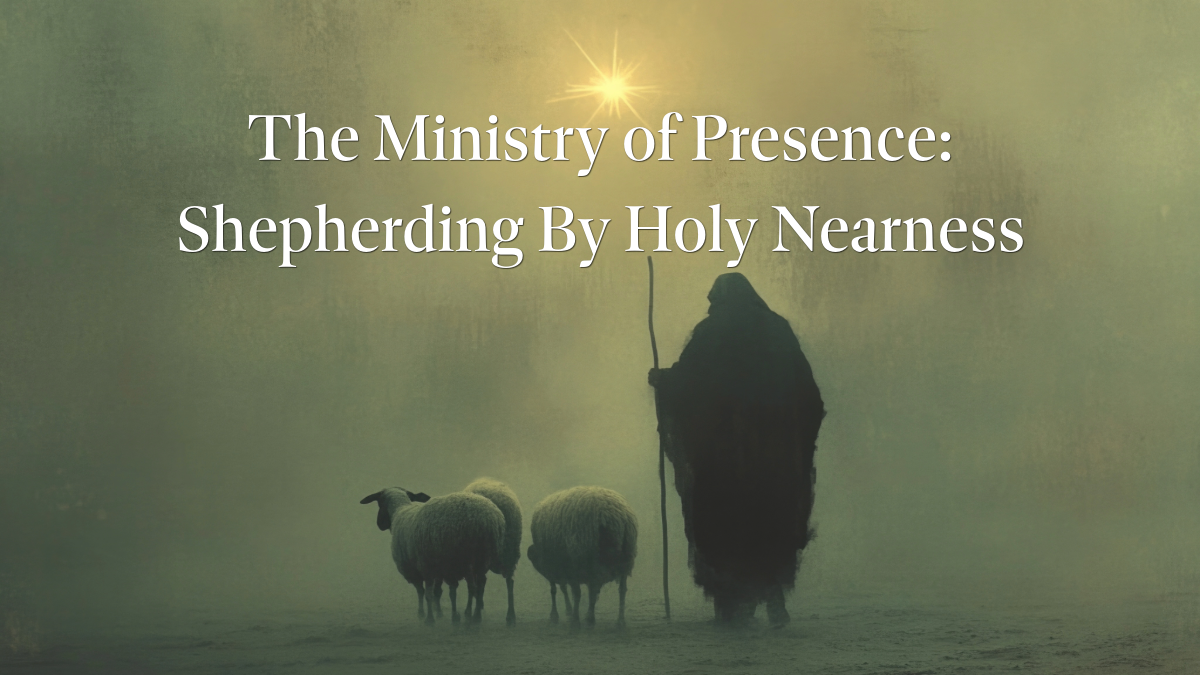
“And surely I am with you always, to the very end of the age” (Matt. 28:20).
In every generation, the Lord calls shepherds not just to preach, teach, or administrate, but to be present, and to embody His nearness among His people. The ministry of presence is not a modern pastoral innovation; it is woven into the very fabric of Holy Scripture. From the Lord walking in the garden, to the Messiah who “became flesh and dwelt among us” (Jn. 1:14), to the Holy Spirit who abides within, the Lord’s answer to human need has always been presence.
For pastors and ministers, our calling is no different. Before our people need our sermons, strategies, or solutions, they need us, our attention, our nearness, our willingness to sit in their stories without rushing to fix them. They need us to listen, often with no expectation or desire for an answer or response, just listening. The ministry of presence is not passive; it is profoundly pastoral, and biblical.
A ministry of presence reflects the heart of a shepherd. David writes, “The Lord is my shepherd” leading to, “You are with me” (Ps. 23:1, 4). He does not find comfort in God’s power alone, but in God’s presence. The tools of the shepherd, the rod and staff matter, but only because the Shepherd is near enough to wield them.
Likewise, our flock draws strength not simply from our knowledge or gifting, but from our nearness in their valleys and on their mountaintops. Presence communicates what words often cannot: You are not alone. God sees you. God is here.
Messiah Yeshua/Jesus models this perfectly. Before He heals, He notices. Before He teaches, He sits among the people. Before He raises Lazarus, He weeps (Jn. 11:35). His ministry is not rushed efficiency; it is His incarnational nearness.
A ministry of presence builds trust and safety. As Paul reminds the Thessalonians, “We were delighted to share with you not only the gospel of God but our own lives as well” (1 Thess. 2:8). Ministry, contrary to what is often imagined, is not transactional; it is entirely relational. Trust is not built from the pulpit alone, it is cultivated in living rooms, hospital rooms, fellowship halls, and quiet conversations after service. It is sharing a text of encouragement out of the blue, just to say “hi” or “I’m praying for you this morning.”
I’ve learned over the years, through much trial and error, that when leaders are consistently present, people feel safe bringing their real questions, wounds, and hopes to us as their pastors. A ministry of presence dismantles fear, and creates a profound sense of belonging. Presence opens the door for discipleship that is not only instructional but transformational, for the shepherd and the sheep.
Actually, a ministry of presence is a form of prayerful intercession. Job’s friends often receive criticism for their later words, but their initial response is instructive: “They sat with him on the ground seven days and seven nights … and no one spoke a word to him, for they saw that his suffering was very great” (Job 2:13). Before they spoke, they sat. Before they counseled, they entered his grief. They were present.
To be present with someone in their pain is to intercede with your life, your very present person. It is to stand as a witness before God and before them. It is to say, “Your burden matters enough for me to carry it with you.” You are laying aside other concerns, even personal obligations to be present in someone’s trial or their joy.
The ministry of presence is a type of prayer that immerses us in the moment or season we are praying for, along with those we pray for. It requires us to slow down. One of the greatest threats to pastoral presence is pastoral busyness. It is a busyness that our people are very aware of, or at least that is what I have been told. Ministry can easily become a cycle of tasks, meetings, and crises that leave little room for unhurried presence. The stream of human need to our eyes is endless, but that stream belongs to the Lord. He has asked us to tend to those in our care.
Messiah Jesus, who carried the weight of the world’s redemption, moved slowly enough to notice Zacchaeus in a tree (Lk. 19:1–5), the woman who touched His garment (Mk. 5:30–34), and the children the disciples tried to push away (Mk. 10:13–16). Presence requires margin. Margin requires intentionality. And intentionality requires the humility to admit that ministry is not sustained by our productivity or our achievement, but by God’s presence and grace working through our availability.
The incarnation of Messiah is the ultimate validation of presence as ministry. At the incarnation, the Word became flesh, and He was present among His people. He did not redeem humanity from a distance; He entered our world, with our limitations, and with our suffering. When we show up, fully, attentively, compassionately, we bear witness of the God who graciously shows up.
Paul writes, “Rejoice with those who rejoice; weep with those who weep” (Ro. 12:15). This is a ministry of presence. It is not glamorous. It is not efficient. But it is holy. And you are there to rejoice or to weep.
Programs, as I have written about previously, can support discipleship, but presence forms discipleship. Jesus did not hand His disciples a curriculum; He gave them Himself: “He appointed twelve that they might be with Him” (Mk. 3:14). Before they were sent out, they were invited in, and there He was.
I’ve heard several variations of this adage: discipleship is caught as much as taught. I would add, it should be imitated more than originated. We imitate our elders, who imitated the apostles, who imitated the Messiah; an abbreviated version of a much longer and fuller chain. Dear pastor, people learn prayer by praying with you. They learn faithfulness by watching you endure. They learn compassion by experiencing your compassion toward them. A ministry of presence is the soil where spiritual formation, the Potter’s hands in a believers life, takes root.
You may not always have the perfect words. You may not have an immediate solution for every problem. You may not have the emotional energy you wish you had or believe others have. But you can be present. And sometimes, presence itself is the miracle someone needs.
When Moses protested his inadequacy, God did not give him a strategy, He gave him a promise: “My presence will go with you, and I will give you rest” (Ex. 33:14). And His presence goes with you as you go with the flock entrusted to you.
Maranatha. Shalom.
Bp. Justin D. Elwell
