
Counting Up to Shavuot (Pentecost)
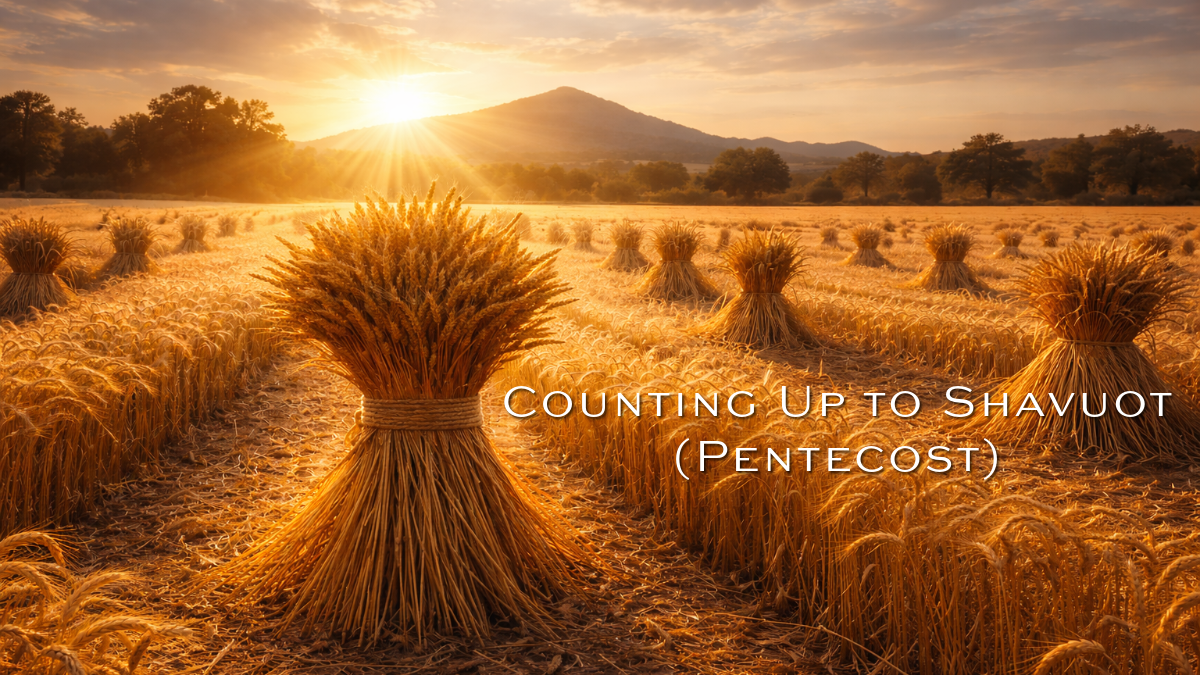
Counting Up to Shavuot (Pentecost)
In Leviticus 23:15–16, the Lord commands Israel to count seven full weeks from the day of Firstfruits, forty-nine days, culminating in the fiftieth day, Shavuot/Pentecost. This counting, known as Sefirat HaOmer (ספירת העומר), is often overlooked in biblical study, yet it forms a vital bridge between redemption and revelation, between deliverance and holy empowerment.
An omer is a measure, a sheaf of grain, about two liters, but its meaning reaches far deeper. It comes from the Hebrew root עָמַר (amar), meaning “to heap up,” “to bind together,” even “to press closely.” This is not exclusively agricultural language; it is the language of spiritual formation. The counting of the Omer is not just marking time - it is marking transformation.
We do not count down to Shavuot. We count up.
Each day is an ascent. Each day is another step away from Egypt and closer to Sinai. Each day lifts us from bondage toward covenant, from redemption toward purpose. The Lord is not simply bringing us out — He is bringing us up.
And for those of us in Messiah, this journey is illuminated even more fully.
Yeshua rose from the grave on Bikkurim, the Feast of Firstfruits, the very first day of the Omer count. As the apostle Paul writes, He is “the firstfruits of those who have fallen asleep” (1 Cor. 15:20). From that day forward, every appearance of the risen Messiah occurred within the counting of the Omer. He appeared to Miriam, to the women, to Peter, to the disciples in the upper room, to the two on the road to Emmaus, and even to the five hundred witnesses Paul records.
The Omer, then, is filled with resurrection life. Yet on the 40th day, something remarkable happens.
Yeshua ascends.
This moment is deeply significant. The fortieth day of the Omer carries profound biblical and even linguistic meaning, especially when viewed through the lens of the Hebrew letter Mem (מ / ם).
The letter Mem appears in two forms: an open Mem (מ) and a closed Mem (ם). Together, they even spell the name of the letter: mem (מֵם). The sages have long taught that these two forms represent two dimensions of Torah: the revealed and the hidden.
The open Mem (מ) represents what is revealed: what is accessible, taught, and seen. This is often associated with Moses, the one through whom the Torah was openly given.
The closed Mem (ם) represents what is hidden: what is sealed, mysterious, awaiting revelation. This points toward Messiah, in whom the fullness of God’s purposes are made known.
This insight casts a beautiful light on the relationship between Moses and Yeshua. As Yeshua Himself said in John 5:46–47, “For if you believed Moses, you would believe me; for he wrote of me. But if you do not believe his writings, how will you believe my words?” Moses spoke openly, but within his words were hidden treasures, the shadows and patterns pointing forward to the Messiah.
Then, on the 40th day, the day marked by Mem, Messiah ascends openly before His disciples.
What was once hidden is now revealed. What was once sealed is now opened.
Yet even in this revelation, there is a command: wait.
Yeshua instructs His disciples not to leave Jerusalem, but to wait for the promise of the Father - the Holy Spirit. The journey is not yet complete. The counting continues.
From day 40 to day 50, there is anticipation. Expectation. A final movement of preparation.
And what has been happening all along? They have been becoming an omer. They have been bound together.
For forty days, Yeshua appeared to them, teaching, strengthening, and drawing them into unity. He was not just giving them information; He was forming them into a people. He was pressing them together, shaping them into a single sheaf, a unified offering.
This is the heart of עָמַר - to bind closely, even under pressure. And then we arrive at Acts 2:1: “When the day of Shavuot had come, they were all together in one place.”
There it is.
The first heap.
The first sheaf.
A community “made alive together” in Messiah, as Paul later writes in Ephesians 2:5. The language is striking, as it echoes the very definition of עָמַר. They are not just gathered; they are bound. Not just assembled; they are formed.
And at Shavuot, two loaves baked with leaven are lifted before the Lord: representing the firstfruits of the wheat harvest. Many have seen in these two loaves a picture of two peoples - Jew and Gentile - brought together as one new man, accepted before God because Messiah, the true Firstfruit, has been accepted.
This is where the counting leads. Not just to a day, but to a people. Not just to a moment, but to a transformation. So how do we live this out?
We continue to count.
Not by numbering days on a calendar, but by recognizing the work the Lord is doing within us. He is lifting us up. He is binding us together. He is pressing us, not to break us, but to form us.
Why the pressure?
Because sheaves must be gathered tightly to stand. Because a harvest must be bound before it is offered. Because unity is not accidental, it is cultivated.
When we share in the sufferings of Messiah, when we walk together in faith, when we gather around His Word and partake of the Living Manna, we are being shaped into that offering: a people prepared, a community made ready.
We are the omer. A heap of lives, bound together in Him. And as we are pressed, we do not fall apart, we stand together.
Counting up. Drawn upward. Until the day we are fully presented before the Lord, renewed in the One who has overcome death and the grave.
Maranatha. Shalom.
In the service of Messiah and His Church,
Bishop Justin D. Elwell
Restoration Fellowship International
